A record of documented arms, meaning and origin, researched for the Lister family lines. Documented in 2 countries.
Reg. 8869 · French, J–L
Coat of Arms & Family Crest Details
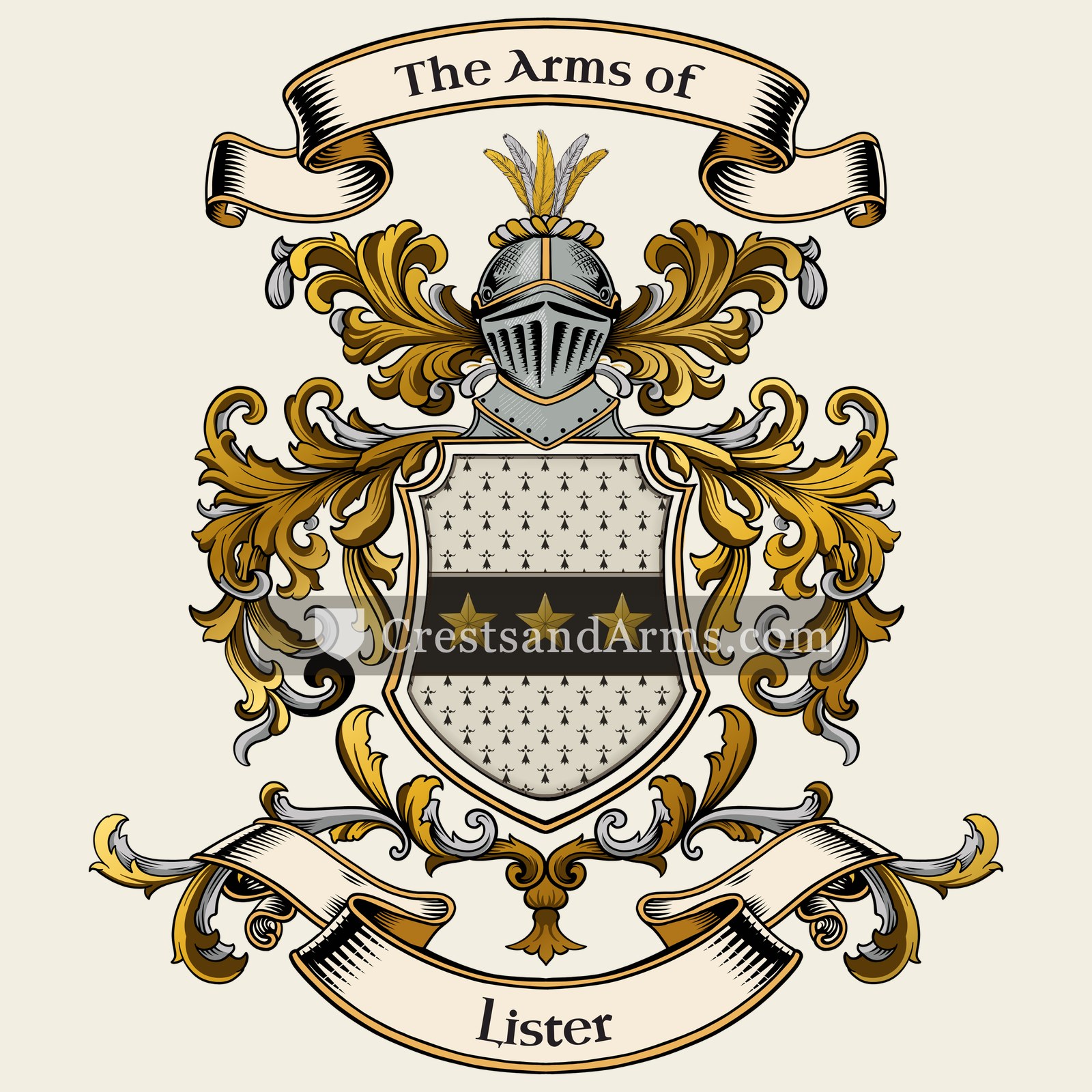
Symbols on this shield
fessThe military belt, and readiness to serve
mulletThe third son, and a divine quality from above
Colours
ErmineMeans: Dignity
Black (Sable)Means: Constancy
Gold (Or)Means: Generosity
Historical info
Source
J. B. Rietstap, Armorial Général, Gouda: G. B. van Goor Zonen, 1884–87
Blazon (the actual original written record)
“D'herm. à la fasce de sa., ch. de trois étoiles d'or. C.: une tête et col de cerf coupée, de couleur naturelle sur gu., ramée d'or. S.: à dextre un cerf reg. de sa., ramé et onglé d'or, ch. sur le corps d'une aigle d'or, et coll. d'un collier de S S et de herses sarasines d'or; à sen. un cheval bai, bridé et sellé au nat., tenant une bannière de sin., frangée d'or et ch. des lettres Y. L. D. (York light dragoons) du même. D.: RETINENS VESTIGIA FAMÆ.”
Francec. 1797
Digital archive packCoat of arms PNG, gold border print PDF, vector SVG and the certificate of authenticity. Sent to your email in minutes.
Map of France showing where the Lister arms are recorded
The Lister arms were recorded in France, c. 1797.
Arms such as these were typically recorded in Bretagne.
More families held coats of arms in Bretagne than anywhere else in France. The land was divided into many small estates rather than a few large ones, so far more households counted as gentry, and each needed a shield of its own to be told apart.
This is where the arms were entered in the register. Families often moved to other parts of the country, so the same name can turn up in more than one region.
The body that granted and recorded arms in France in this period.
How Arms Worked in France
In France, a coat of arms was a mark of honor that passed down through the male line to all legitimate descendants. Families often used the same shield without changes to show their shared heritage. If a branch wanted to stand out, they could add a small mark to their shield to show their specific place in the family tree.
Granting authority
The Juge d'armes de France acted as the official authority that regulated and verified coats of arms across the country.
How they got arms
Families typically inherited their arms from ancestors, though they could also receive them through royal grants or by proving their noble status.
Where arms were recorded
Coats of arms were officially recorded in the Armorial Général de France, which began its main collection in the year 1696.
The family's standing
Recorded among the armigerous families of France.
Origin & History of the Lister Family in France
The family name Lister has deep roots in the historical landscape of France, particularly within the region of Brittany. By the year 1797, members of the family were well-established in this coastal area during a time of significant political and social transition. The name itself is often associated with the occupational history of the Middle Ages, as it likely originated as a term for a person who worked as a dyer of cloth. In the context of Brittany, families with this name were often integrated into the local community through trade and agriculture. Because Brittany maintained a distinct cultural identity throughout French history, the Lister family likely navigated the unique linguistic and social traditions of the region while contributing to the local economy. Their presence in official records from the late 18th century suggests that they were settled citizens who played a part in the daily life of their parishes before the turn of the century.
Coat of Arms & Family Crest Details
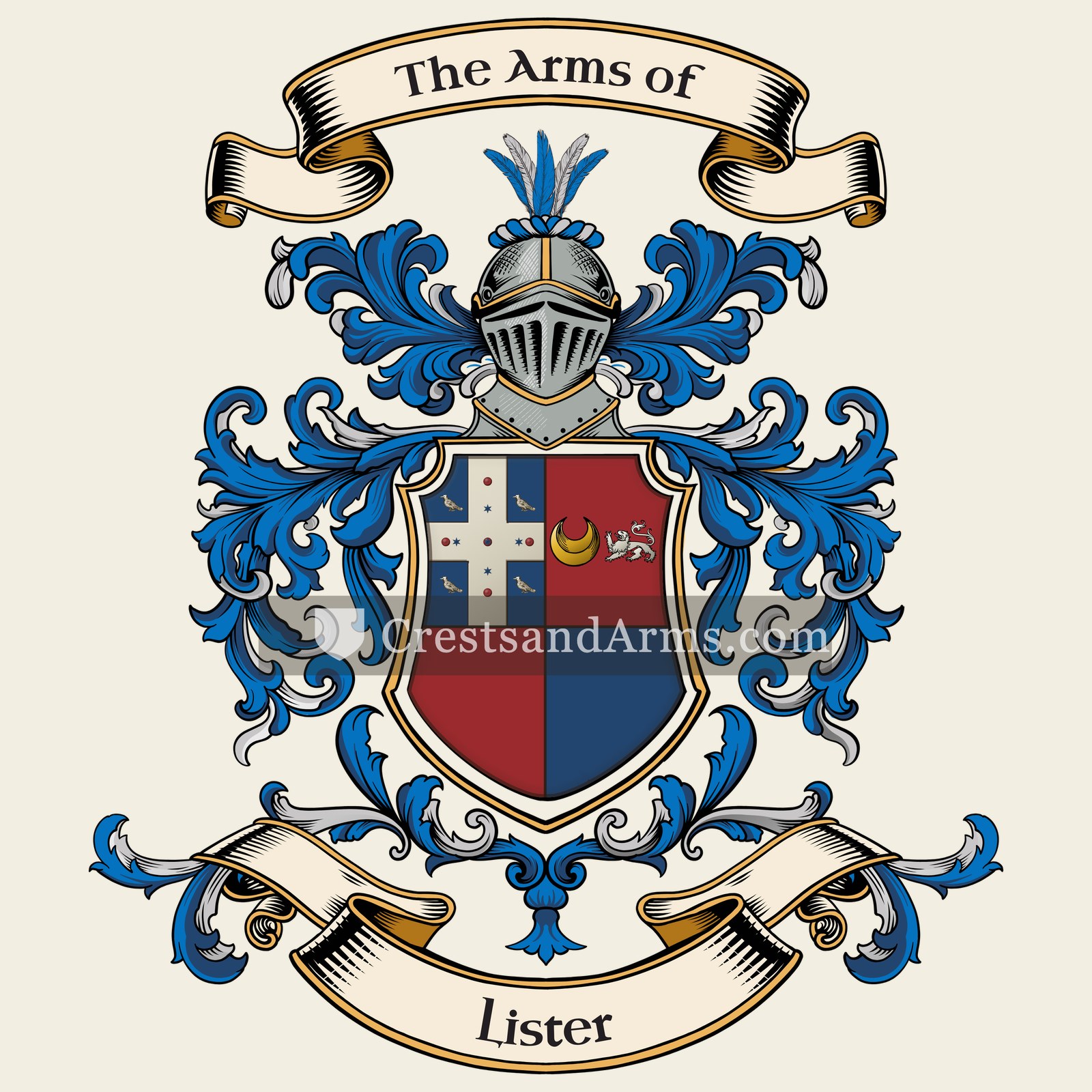
Symbols on this shield
cross symbolChristian faith and service
dovePeace, love and the Holy Spirit
roundelA coin, and one who has been to the crusades
starThe celestial goddess, and nobility
crescentHonour by the sovereign, and the second son
lionCourage, strength and royalty
Colours
Blue (Azure)Means: Loyalty and truth
Red (Gules)Means: Military strength
Silver (Argent)Means: Peace and sincerity
Gold (Or)Means: Generosity
Historical info
Source
Sir Bernard Burke, The General Armory of England, Scotland, Ireland and Wales, London: Harrison & Sons, 1884
Blazon (the actual original written record)
“Az. on a cross betw. four doves ar. five torteaux, each charged with an estoile of the second, quartering gu. semée of crescents or, a lion ramp. ar., another coat of LISTER”
Englandc. 1566
Digital archive packCoat of arms PNG, gold border print PDF, vector SVG and the certificate of authenticity. Sent to your email in minutes.
Map of England showing where the Lister arms are recorded
The Lister arms were recorded in England, c. 1566.
Arms such as these were typically recorded in York.
Yorkshire is the largest of the English counties, and it held more gentry families than any other. Land there was split among a great many households rather than a few, so a great many of them carried arms.
This is where the arms were entered in the register. Families often moved to other parts of the country, so the same name can turn up in more than one region.
The body that granted and recorded arms in England in this period.
Elizabeth I of England
Sovereign of the period
Elizabeth I of England
1558–1603
Reigning in France when the Lister arms are first recorded.
How Arms Worked in England
English heraldry allowed arms to be shared by all legitimate descendants of the original owner. These symbols were treated as personal property that moved through the generations to all children. While the eldest son kept the original design, other family members could use the same shield without needing to change it or register their own unique versions.
Granting authority
The College of Arms in London has regulated the use of coats of arms throughout England and Wales since 1484.
How they got arms
Families typically obtained their coats of arms through a formal grant from the Crown or by proving their ancient right to them.
Where arms were recorded
All official coats of arms are recorded in the registers kept at the College of Arms, which date back to the fifteenth century.
The family's standing
Recorded among the armigerous families of England.
Origin & History of the Lister Family in England
The surname Lister originated as an occupational name during the Middle Ages, derived from the Middle English word "litster," which referred to a dyer of cloth. As the textile industry became a cornerstone of the English economy, those who worked with dyes and pigments often adopted the trade as their family identifier. By the time the family appears in official records in York in 1566, the name was already well-established among the urban merchant and artisan classes. These early Listers were likely part of the thriving trade guilds that defined life in northern English cities during the sixteenth century. Their presence in York suggests that the family played a functional role in the city's commercial success, moving away from rural agricultural life to participate in the specialized manufacturing processes that helped shape England's early industrial identity.
Lister Meaning & Related Branches
Root word
litster
Middle English term for a person who dyes cloth.
This name
ListerAn occupational surname for a dyer of fabrics or textiles.
also spelled
Lystre
Lyster
Related arms
Lystervariant spelling
Litstervariant spelling
Baterecorded with Lister, same area
Brahamrecorded with Lister, same area
Documented Sources
J. B. Rietstap, Armorial Général, Gouda: G. B. van Goor Zonen, 1884–87
Archives départementales du Morbihan, État civil de la commune de Vannes, 1797
Archives départementales d'Ille-et-Vilaine, Registres paroissiaux et d'état civil, 1797
Dauzat, Albert, Dictionnaire étymologique des noms de famille et prénoms de France, 1951
Digital archive packCoat of arms PNG, gold border print PDF, vector SVG and the certificate of authenticity. Sent to your email in minutes.


 fessThe military belt, and readiness to serve
 mulletThe third son, and a divine quality from above
 fessThe military belt, and readiness to serve
 mulletThe third son, and a divine quality from above

 cross symbolChristian faith and service
 dovePeace, love and the Holy Spirit
 roundelA coin, and one who has been to the crusades
 starThe celestial goddess, and nobility
 crescentHonour by the sovereign, and the second son
 lionCourage, strength and royalty