A record of documented arms, meaning and origin, researched for the Lither family lines. Documented in 3 countries.
Reg. 4202 · Britain, J–L
Coat of Arms & Family Crest Details
Symbols on this shield
roseThe seventh son, and beauty with grace
Colours
Blue (Azure)Means: Loyalty and truth
Silver (Argent)Means: Peace and sincerity
Historical info
Source
J. B. Rietstap, Armorial Général, Gouda: G. B. van Goor Zonen, 1884–87
Blazon (the actual original written record)
“D'azur à une rose d'arg., ch. d'un coeur de gu., surch. d'une croix du second émail; le tout renfermé dans un cyclamor d'or [Armes attribuées au docteur Martin Luther.]”
Britainc. 1700
Digital archive packCoat of arms PNG, gold border print PDF, vector SVG and the certificate of authenticity. Sent to your email in minutes.
Map of Britain showing where the Lither arms are recorded
The Lither arms were recorded in Britain, c. 1700.
Arms such as these were typically recorded in Kent.
Kent sits between London and the short crossing to Europe, and the trade passing through made it wealthy. Merchant families bought land with that money, and it was landowners who took coats of arms.
This is where the arms were entered in the register. Families often moved to other parts of the country, so the same name can turn up in more than one region.
The body that granted and recorded arms in Britain in this period.
William III of England
Sovereign of the period
William III of England
1694–1702
Reigning in Britain when the Lither arms are first recorded.
How Arms Worked in Britain
English heraldry allowed arms to be shared by all legitimate descendants of the original owner. These symbols were treated as personal property that moved through the generations to all children. While the eldest son kept the original design, other family members could use the same shield without needing to change it or register their own unique versions.
Granting authority
The College of Arms in London has regulated the use of coats of arms throughout England and Wales since 1484.
How they got arms
Families typically obtained their coats of arms through a formal grant from the Crown or by proving their ancient right to them.
Where arms were recorded
All official coats of arms are recorded in the registers kept at the College of Arms, which date back to the fifteenth century.
The family's standing
Recorded among the armigerous families of Britain.
Origin & History of the Lither Family in Britain
The surname Lither is a rare name that appears to have deep roots in the historical records of Kent, England. By the year 1700, families carrying this name were already established within the region, living during a time when England was transitioning into a modern industrial society. The name likely originated as a locational identifier, which was a common way for people to distinguish themselves in small rural communities before the widespread use of formal census records. Because the name is geographically concentrated, it suggests that the early Lither families were likely farmers or skilled tradespeople who remained in the same English parishes for several generations. These families lived through significant shifts in British history, including the agricultural changes that reshaped the Kentish landscape during the eighteenth century. By studying local parish registers from this era, we can see how the Lither name persisted in the region while other families moved toward the growing cities.
Coat of Arms & Family Crest Details
Symbols on this shield
applePeace, plenty and long-standing settlement
roseThe seventh son, and beauty with grace
Colours
Blue (Azure)Means: Loyalty and truth
Silver (Argent)Means: Peace and sincerity
Gold (Or)Means: Generosity
Red (Gules)Means: Military strength
Historical info
Source
J. B. Rietstap, Armorial Général, Gouda: G. B. van Goor Zonen, 1884–87
Blazon (the actual original written record)
“d'azur sur arg.; l'azur ch. de deux pommes d'or, les queues en bas, et l'arg. d'une rose de gu., bout. d'or. C.: un homme barbu iss., coiffé d'une couronne de roses de gu., hab. d'un parti d'azur et d'arg., au rabat de l'un à l'autre, tenant de sa main dextre une rose de gu., bout. d'or, tigée et feuillée de sin., et de sa sen. une pomme d'or, tigée et feuillée de sin. L. d'arg. et d'azur [Descendants d'un frère du grand-père du réformateur.]”
SaxonySaxony, c. 1570
Digital archive packCoat of arms PNG, gold border print PDF, vector SVG and the certificate of authenticity. Sent to your email in minutes.
Map of Germany showing where the Lither arms are recorded
The Lither arms were recorded in Saxony, c. 1570.
Saxony had mines, trade and old landed families all at once. Silver made some fortunes and land held others, and both sorts of family kept arms, which is why Saxon names appear so often in the registers.
This is where the arms were entered in the register. Families often moved to other parts of the country, so the same name can turn up in more than one region.
The body that granted and recorded arms in Germany in this period.
Maximilian II, Holy Roman Emperor
Sovereign of the period
Maximilian II, Holy Roman Emperor
1564–1576
Reigning in Britain when the Lither arms are first recorded.
How Arms Worked in Germany
In the Holy Roman Empire, coats of arms were often granted to individuals by the Emperor or his representatives. These arms were then passed down through the generations to all legitimate descendants of the original holder. Younger branches of a family usually kept the same shield design without needing to change it, as the arms belonged to the entire lineage.
Granting authority
The Holy Roman Emperor held the sole power to grant new coats of arms throughout his vast imperial territories.
How they got arms
Families typically obtained their coats of arms through a formal imperial grant or by proving their noble status to the authorities.
Where arms were recorded
These grants were officially recorded in the Imperial Chancery registers, which began keeping formal records of such honors during the Middle Ages.
The family's standing
Recorded among the armigerous families of Saxony.
Origin & History of the Lither Family in Germany
The Lither family name traces its roots to the historical region of Saxony, where members of the family were firmly established by the year 1570. During this period, Saxony was a central hub of the Protestant Reformation and a place of significant social change. Families living in this area were often tied to the land or local trade guilds, which helped shape their identity and movement across the German states. The name itself likely evolved from regional dialects spoken in the Elbe River valley, reflecting the linguistic shifts common in Central Germany during the late sixteenth century. As the family grew, they participated in the typical life of the Saxon peasantry and craftsmen, navigating the complex political landscape of the Holy Roman Empire. Their presence in the records from 1570 suggests they were part of a stable community that valued local property and church membership, which were the primary ways families documented their existence before the modern era.
Coat of Arms & Family Crest Details
Symbols on this shield
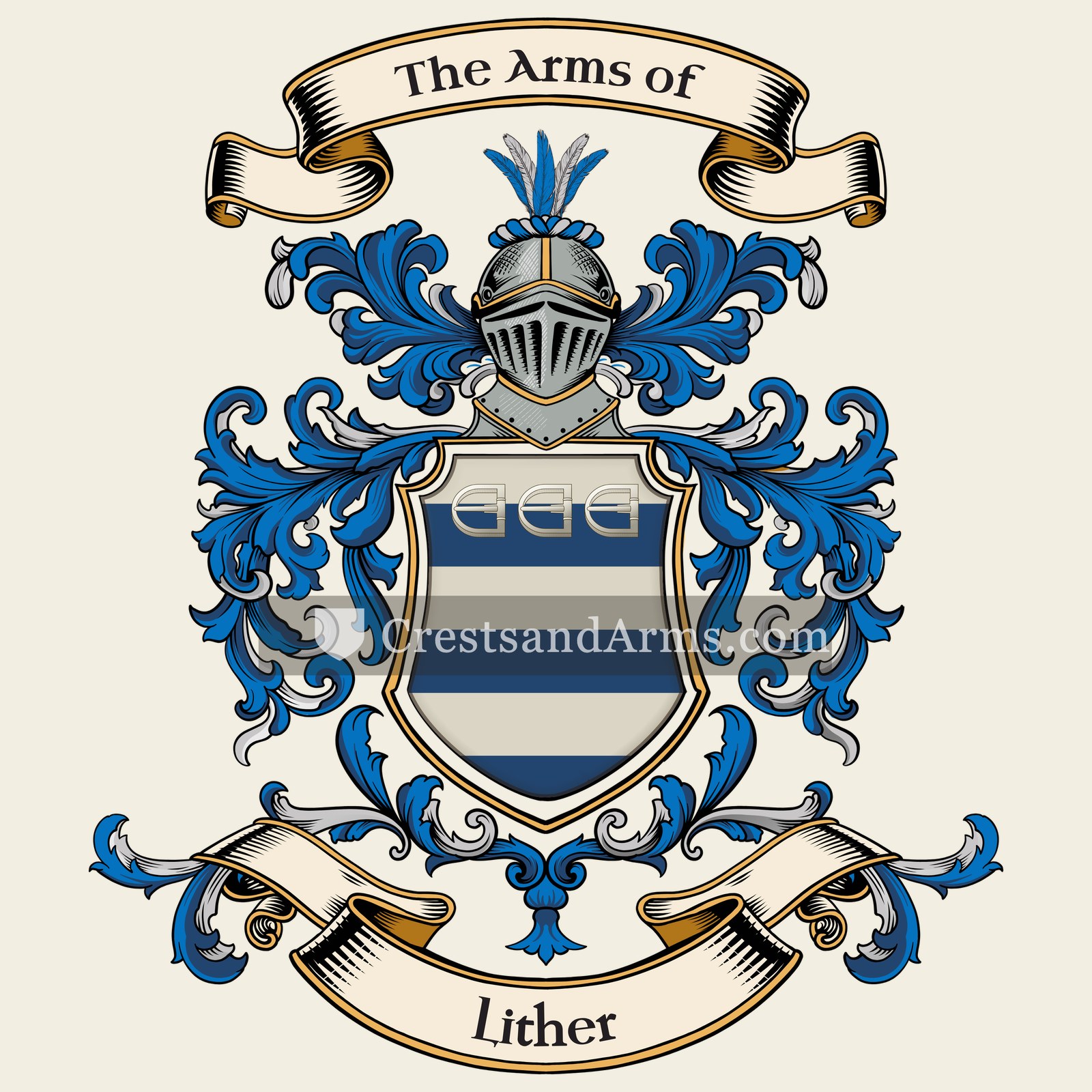
buckleFidelity, and a bond firmly held
Colours
Blue (Azure)Means: Loyalty and truth
Silver (Argent)Means: Peace and sincerity
Historical info
Source
Sir Bernard Burke, The General Armory of England, Scotland, Ireland and Wales, London: Harrison & Sons, 1884
Blazon (the actual original written record)
“Barry of six az. and ar. in chief three round buckles of the last”
Irelandc. 1678
Digital archive packCoat of arms PNG, gold border print PDF, vector SVG and the certificate of authenticity. Sent to your email in minutes.
Map of Ireland showing where the Lither arms are recorded
The Lither arms were recorded in Ireland, c. 1678.
Arms such as these were typically recorded in Dublin.
Dublin was the seat of government in Ireland and the place where grants were sought and recorded. Families with business at the castle or the courts settled nearby, and settling there put their arms on record.
This is where the arms were entered in the register. Families often moved to other parts of the country, so the same name can turn up in more than one region.
The body that granted and recorded arms in Ireland in this period.
Charles II of England
Sovereign of the period
Charles II of England
1660–1685
Reigning in Britain when the Lither arms are first recorded.
How Arms Worked in Ireland
The Ulster King of Arms granted coats of arms to individuals who proved their social standing and good character. These symbols were typically inherited by all legitimate descendants of the original holder. If a family branch wanted a unique look, they could apply for a specific change to their design through the office to ensure their identity remained distinct.
Granting authority
The Ulster King of Arms acted as the official body that regulated and issued all coats of arms throughout Ireland.
How they got arms
Families obtained their arms through formal grants issued by the office after proving their eligibility and paying the required fees.
Where arms were recorded
All official grants were recorded in the registers held by the Ulster King of Arms starting from the year 1552.
The family's standing
Recorded among the armigerous families of Ireland.
Origin & History of the Lither Family in Ireland
The history of the Lither name in Ireland centers on the city of Dublin during the late seventeenth century. Records confirm that members of the family were established in the capital by 1678, a time when Dublin was a rapidly growing hub of trade and administration. The name likely arrived in Ireland through migration from England, as many families moved across the Irish Sea during the seventeenth century to seek new opportunities in the city's expanding merchant class. While the name remains rare, its presence in Dublin city records suggests that early family members were integrated into the urban life of the period. These individuals lived through a time of significant political and social change in Ireland, and their presence in the capital indicates they were part of the professional or artisan communities that helped shape the city during the Restoration era.
Related Branches & Arms
Root word
Lith
Old English term referring to a gentle slope or a hill.
This name
LitherA topographical name for someone who lived near a gentle slope or hillside.
also spelled
Luter
Luthere
Luthar
Documented Sources
J. B. Rietstap, Armorial Général, Gouda: G. B. van Goor Zonen, 1884–87
Everitt, Alan, Continuity and Colonization: The Evolution of Kentish Settlement, 1986
Kent History and Library Centre, Parish Registers of Kent, 1538–1900
National Archives, The Hearth Tax Returns for Kent, 1664
Digital archive packCoat of arms PNG, gold border print PDF, vector SVG and the certificate of authenticity. Sent to your email in minutes.


 roseThe seventh son, and beauty with grace
 roseThe seventh son, and beauty with grace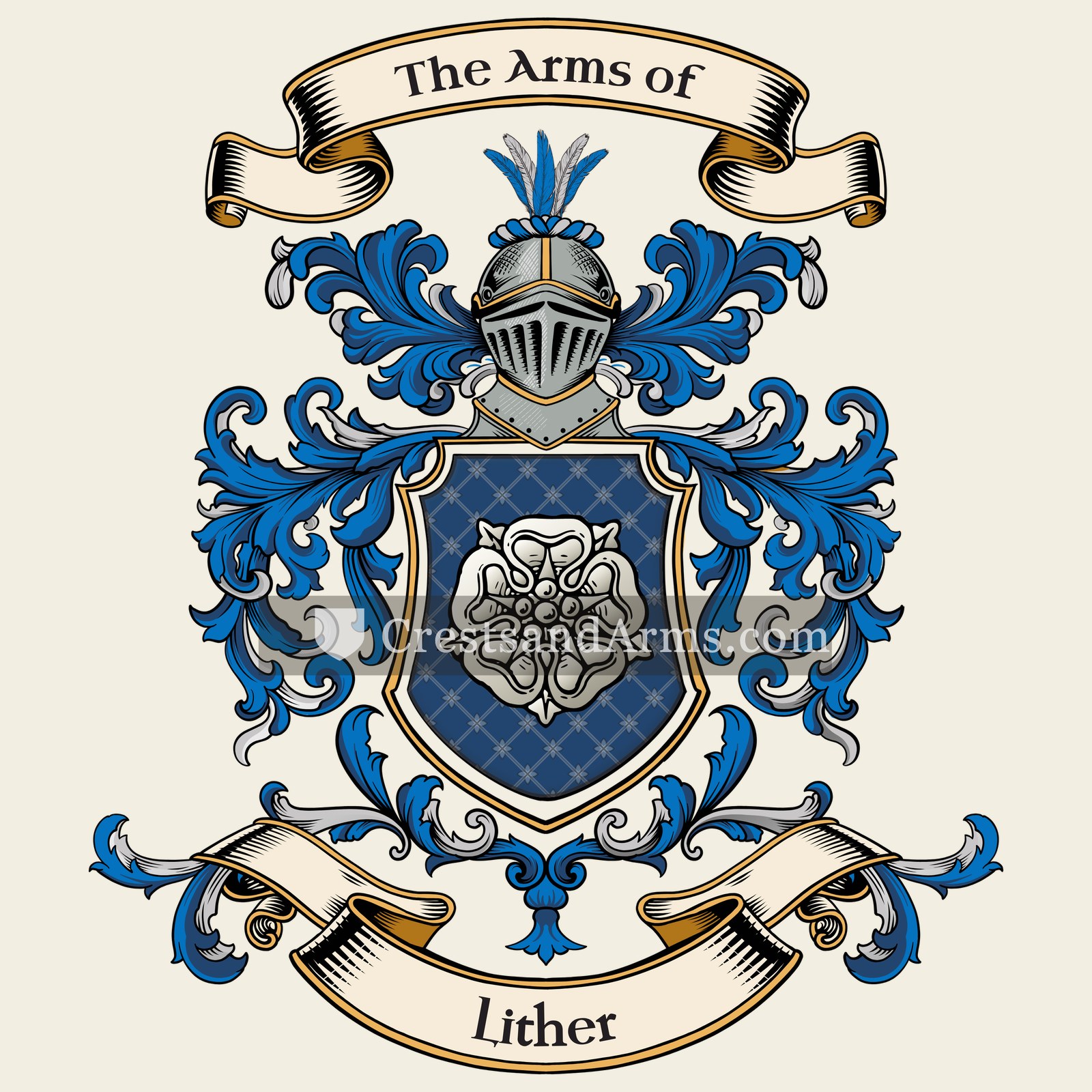


 applePeace, plenty and long-standing settlement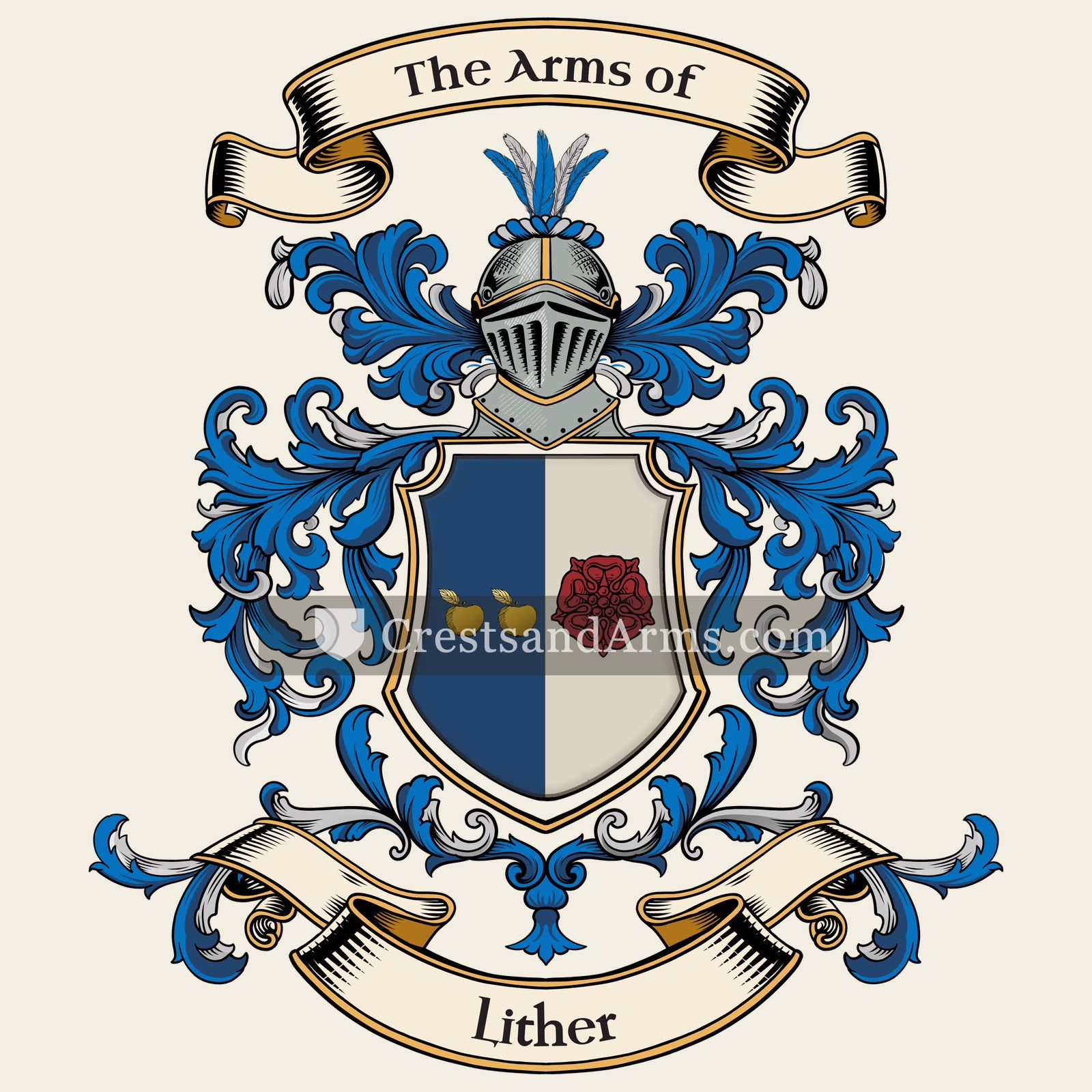


 buckleFidelity, and a bond firmly held