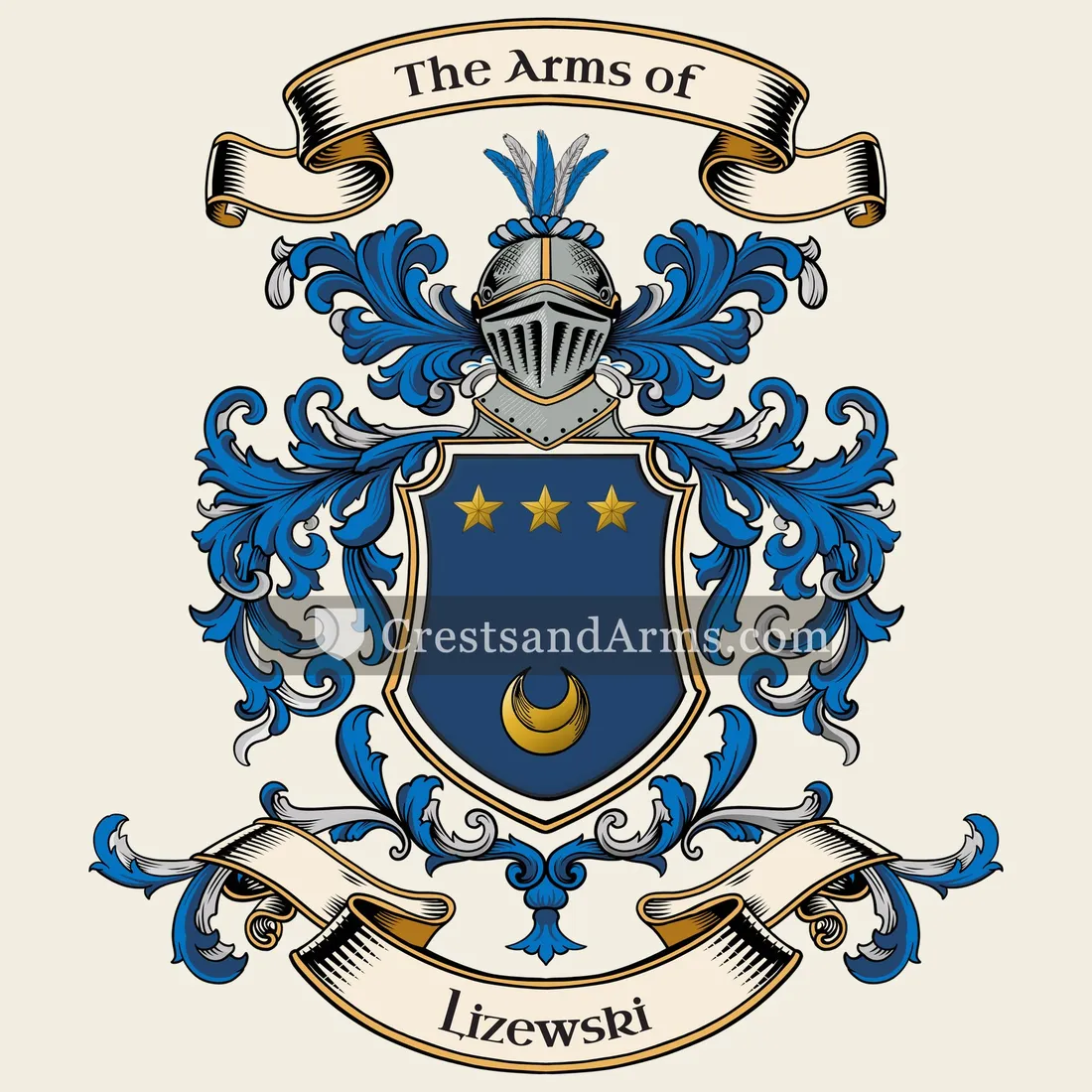
A record of documented arms, meaning and origin, researched for the Lizewski family of Poland.
Reg. 4377 · Polish, J–L
Meaning of the Lizewski family crest colors & symbols
Symbols on this shield
mulletThe third son, and a divine quality from above
crescentHonour by the sovereign, and the second son
Colours
Blue (Azure)Means: Loyalty and truth
Gold (Or)Means: Generosity
Historical info
Source
J. B. Rietstap, Armorial Général, Gouda: G. B. van Goor Zonen, 1884–87
Blazon (the actual original written record)
“D'azur à trois étoiles malordonnées d'or en chef et un croiss. du même en p. Cq. cour. C.: un senestrochère arm., posé sur le coude, brandissant un sabre, le tout au nat.”
PolandPosnanie, c. 1772
Digital archive packCoat of arms PNG, gold border print PDF, vector SVG and the certificate of authenticity. Sent to your email in minutes.
Map of Poland showing where the Lizewski arms are recorded
The Lizewski arms were recorded in Posnanie, c. 1772.
This is where the arms were entered in the register. Families often moved to other parts of the country, so the same name can turn up in more than one region.
Region
Posnanie
Town
Posnanie
First recorded
1772
Granting Authority for the Lizewski Arms
Ennoblement by the Sejm
Author: Olek Remesz · CC BY-SA 3.0
The body that granted and recorded arms in Poland in this period.
Stanisław August Poniatowski
Sovereign of the period
Stanisław August Poniatowski
1764–1795
Reigning in Poland when the Lizewski arms are first recorded.
How Arms Worked in Poland
Polish noble families shared a single coat of arms across many different surnames, creating large clans rather than individual designs. These symbols were held collectively by all members of the clan regardless of their specific family name. When a new family joined the nobility, they were adopted into an existing clan and began using that group's established shield.
Granting authority
The Sejm, which was the Polish parliament, held the power to grant noble status and the right to bear arms.
How they got arms
Families typically received their coat of arms through a formal act of ennoblement granted by the Sejm for distinguished service.
Where arms were recorded
These grants were officially recorded in the Crown Metrica, which served as the central archive for state documents starting in the sixteenth century.
The family's standing
Recorded among the armigerous families of Poland.
Origin & History of the Lizewski Family in Poland
The surname Lizewski is a topographic name that originated in the historical region of Poland. It is derived from the Polish word "liza," which refers to a specific type of clearing or a meadow located within a wooded area. Families carrying this name were likely among the early settlers who cleared land for farming in the fertile territories of the Greater Poland region, known as Posnanie. By the year 1772, records confirm that the Lizewski family had established a firm presence in this area. During this period, the family members were typically part of the rural population who lived and worked on the land. Their history is closely tied to the development of agricultural communities in the Prussian partition of Poland, where they maintained their identity through generations of farming and local trade.
Lizewski Meaning & Related Branches
Root word
Liza
A diminutive form of the name Elizabeth meaning God is my oath.
This name
LizewskiA habitational surname indicating someone who originated from a place called Lizewo or similar.
also spelled
Loyewski
Lojewsky
Loyevski
Documented Sources
J. B. Rietstap, Armorial Général, Gouda: G. B. van Goor Zonen, 1884–87
Brückner, Aleksander, Słownik etymologiczny języka polskiego, 1927
Rymut, Kazimierz, Nazwiska Polaków: słownik historyczno-etymologiczny, 1999
State Archive in Poznań (Archiwum Państwowe w Poznaniu), Akta stanu cywilnego parafii rzymskokatolickiej w Poznaniu, 1772
Digital archive packCoat of arms PNG, gold border print PDF, vector SVG and the certificate of authenticity. Sent to your email in minutes.


 mulletThe third son, and a divine quality from above
 crescentHonour by the sovereign, and the second son
 mulletThe third son, and a divine quality from above
 crescentHonour by the sovereign, and the second son