Map of Wales showing where the Llewellyn arms are recorded
The Llewellyn arms were recorded in Powys, c. 1647.
This is where the arms were entered in the register. Families often moved to other parts of the country, so the same name can turn up in more than one region.
The body that granted and recorded arms in Wales in this period.
Charles I of England
Sovereign of the period
Charles I of England
1625–1649
Reigning in Wales when the Llewellyn arms are first recorded.
How Arms Worked in Wales
English heraldry allowed arms to be shared by all legitimate descendants of the original owner. These symbols were treated as personal property that moved through the generations to all children. While the eldest son kept the original design, other family members could use the same shield without needing to change it or register their own unique versions.
Granting authority
The College of Arms in London has regulated the use of coats of arms throughout England and Wales since 1484.
How they got arms
Families typically obtained their coats of arms through a formal grant from the Crown or by proving their ancient right to them.
Where arms were recorded
All official coats of arms are recorded in the registers kept at the College of Arms, which date back to the fifteenth century.
The family's standing
Recorded among the armigerous families of Wales.
Origin & History of the Llewellyn Family in Wales
The name Llewellyn originates from the ancient Welsh personal name Llywelyn, which carries a rich linguistic history rooted in the Brythonic language. Historically, the name was associated with powerful figures in medieval Wales, including two prominent princes who fought to maintain Welsh independence against English expansion. By the time members of the family were recorded in the region of Powys in 1647, the name had transitioned from a royal title to a hereditary surname. This shift followed the broader trend in Wales where patronymic naming systems, which used "ap" to mean "son of," gradually gave way to fixed surnames to satisfy administrative requirements. Families living in Powys during the seventeenth century were part of a society deeply connected to the land and local parish life, where the name served as a link to their ancestral heritage and the long history of the Welsh people.
Coat of Arms & Family Crest Details
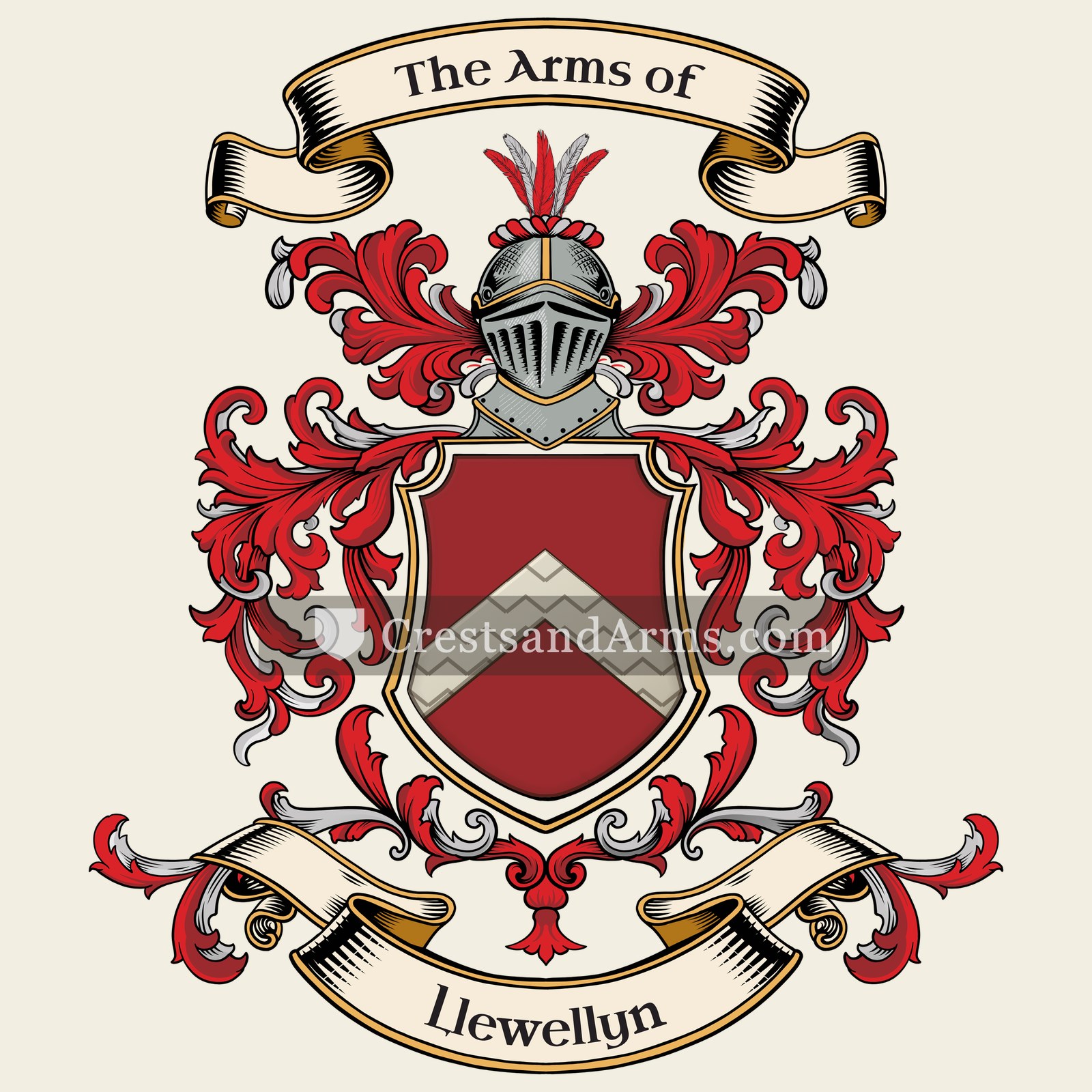
Symbols on this shield
chevronProtection, and faithful service completed
Colours
Red (Gules)Means: Military strength
Silver (Argent)Means: Peace and sincerity
Historical info
Source
Sir Bernard Burke, The General Armory of England, Scotland, Ireland and Wales, London: Harrison & Sons, 1884
Blazon (the actual original written record)
“Gu. three chev. ar”
GlamorganPeterstone-super-Ely-Coedriglan · Glamorgan, c. 1620
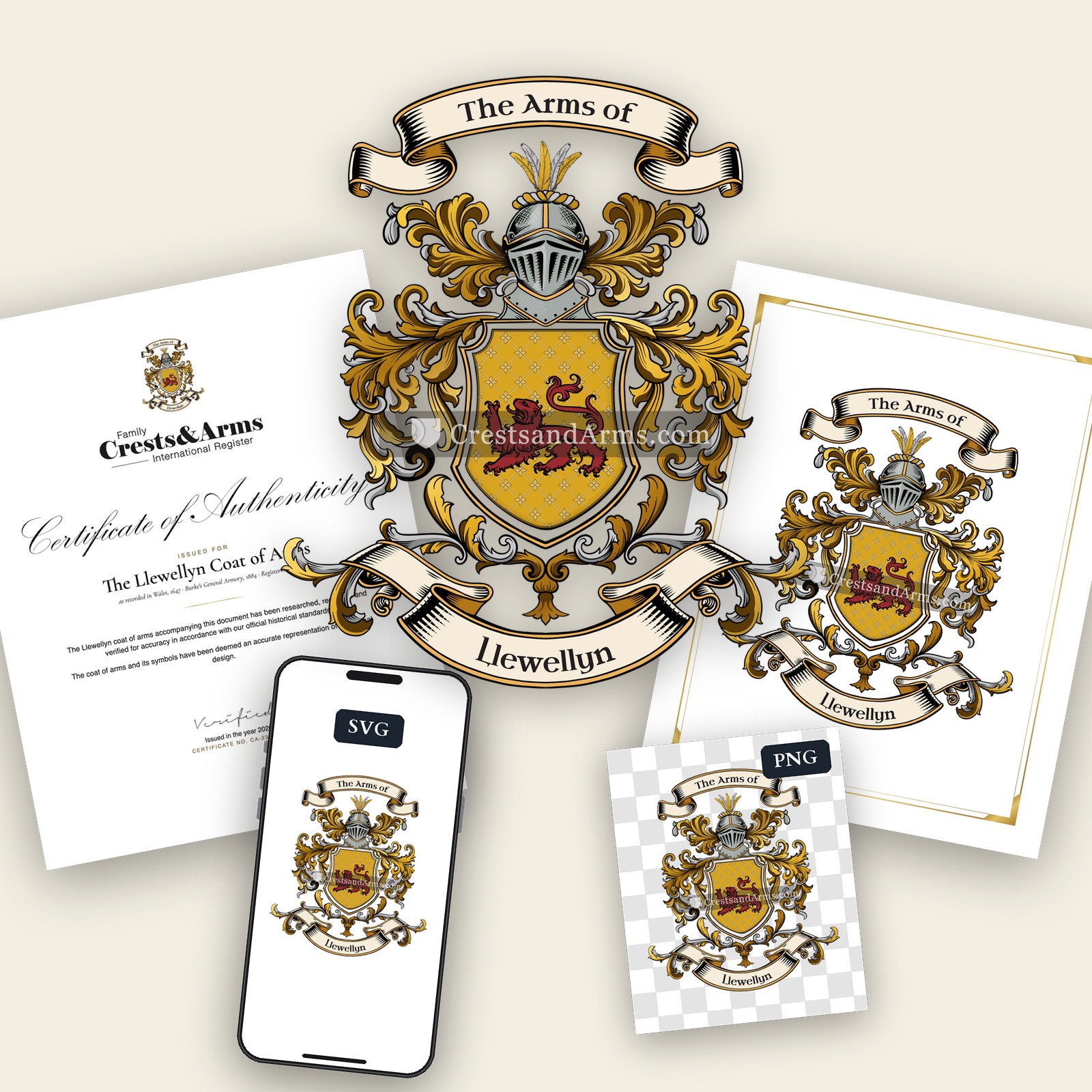
Digital archive packCoat of arms PNG, gold border print PDF, vector SVG and the certificate of authenticity. Sent to your email in minutes.
Map of England showing where the Llewellyn arms are recorded
The Llewellyn arms were recorded in Glamorgan, c. 1620.
Glamorgan was the richest part of Wales, with good coastal farmland and Norman castles along it. The families who held those castles kept their land for centuries, and long holding brought recorded arms.
This is where the arms were entered in the register. Families often moved to other parts of the country, so the same name can turn up in more than one region.
The body that granted and recorded arms in England in this period.
James VI and I
Sovereign of the period
James VI and I
1603–1625
Reigning in Wales when the Llewellyn arms are first recorded.
How Arms Worked in England
English heraldry allowed arms to be shared by all legitimate descendants of the original owner. These symbols were treated as personal property that moved through the generations to all children. While the eldest son kept the original design, other family members could use the same shield without needing to change it or register their own unique versions.
Granting authority
The College of Arms in London has regulated the use of coats of arms throughout England and Wales since 1484.
How they got arms
Families typically obtained their coats of arms through a formal grant from the Crown or by proving their ancient right to them.
Where arms were recorded
All official coats of arms are recorded in the registers kept at the College of Arms, which date back to the fifteenth century.
The family's standing
Recorded among the armigerous families of Glamorgan.
Origin & History of the Llewellyn Family in England
The surname Llewellyn originates from the ancient Welsh personal name Llywelyn, which translates to leader or lion-like. While the name is deeply rooted in the history of Wales, it began to appear more frequently in English records as families migrated across the border for trade and employment. By the year 1620, records confirm that members of the Llewellyn family were well-established in the region of Glamorgan. During this period, the name was often recorded in parish registers and legal documents as the family integrated into the local administration of the area. As the influence of the English language grew, the spelling evolved from its traditional Welsh form into the version commonly used today. This transition reflects a broader historical trend where families maintained their unique cultural identity while adapting to the changing social landscape of the British Isles.
Llewellyn Meaning & Related Branches
Root word
Llew
A Welsh word meaning lion.
This name
LlewellynDerived from the elements for lion and leader or like, signifying lion-like.
also spelled
Lluellin
Lluellyn
Lewellin
Related arms
Dillwynsimilar arms
Lewellinvariant spelling
Lluellinvariant spelling
Lluellynvariant spelling
Documented Sources
Sir Bernard Burke, The General Armory of England, Scotland, Ireland and Wales, London: Harrison & Sons, 1884
Morgan, P. and Morgan, T. J., Welsh Surnames, 1985
Davies, John, Hanes Cymru, 1990
The National Library of Wales, Records of the Court of Great Sessions
Powys County Archives, Parish Registers of Montgomeryshire
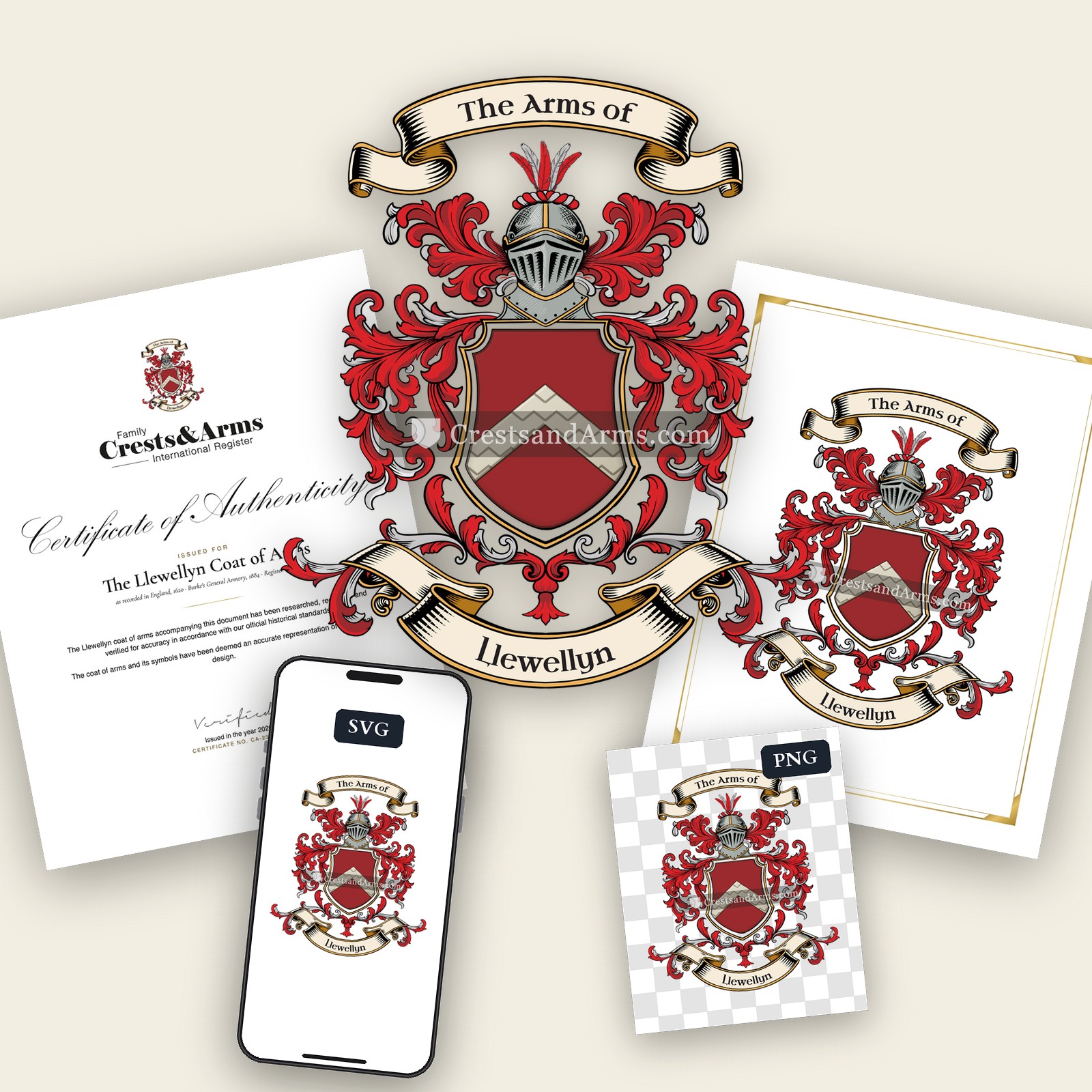
Digital archive packCoat of arms PNG, gold border print PDF, vector SVG and the certificate of authenticity. Sent to your email in minutes.


 lionCourage, strength and royalty
 lionCourage, strength and royalty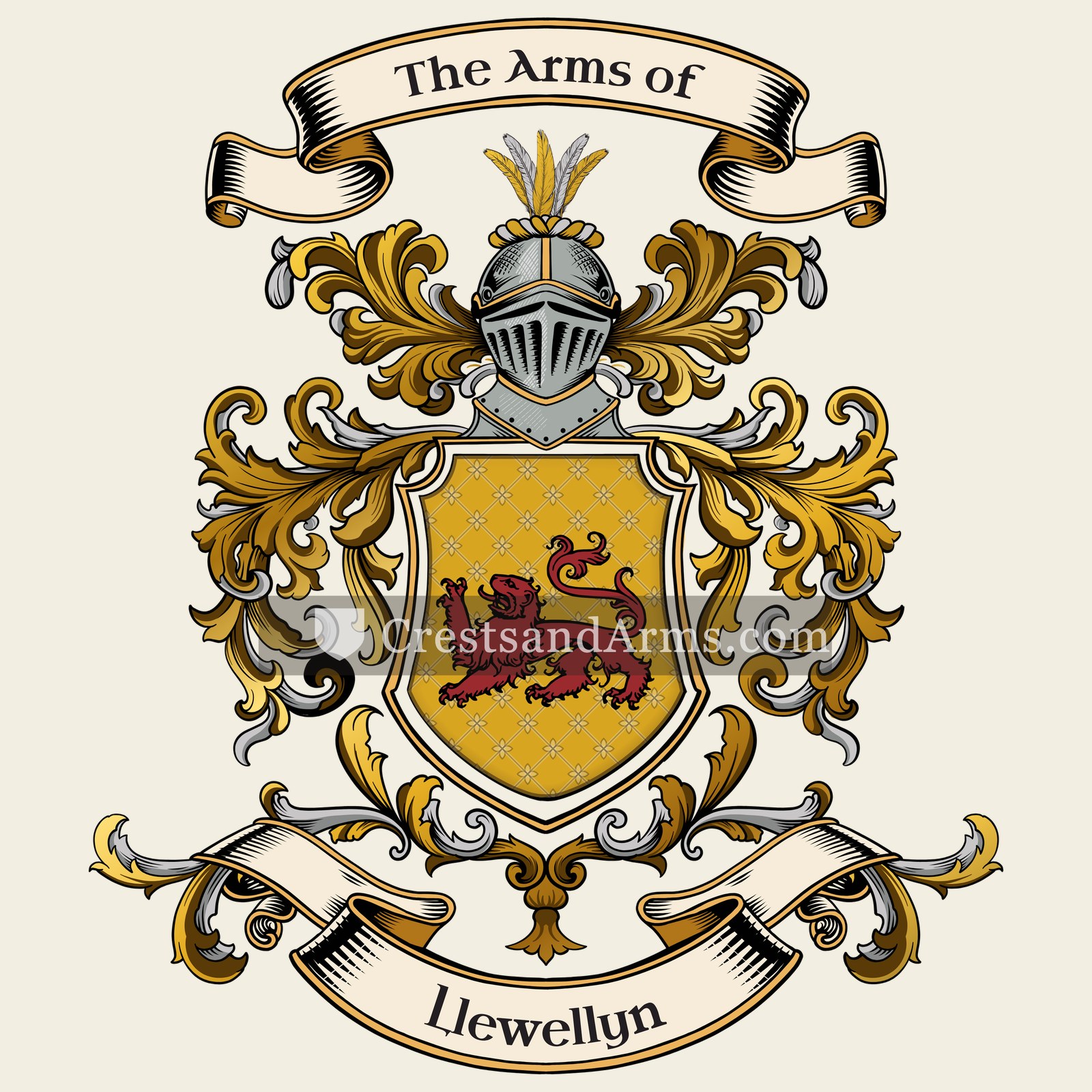


 chevronProtection, and faithful service completed