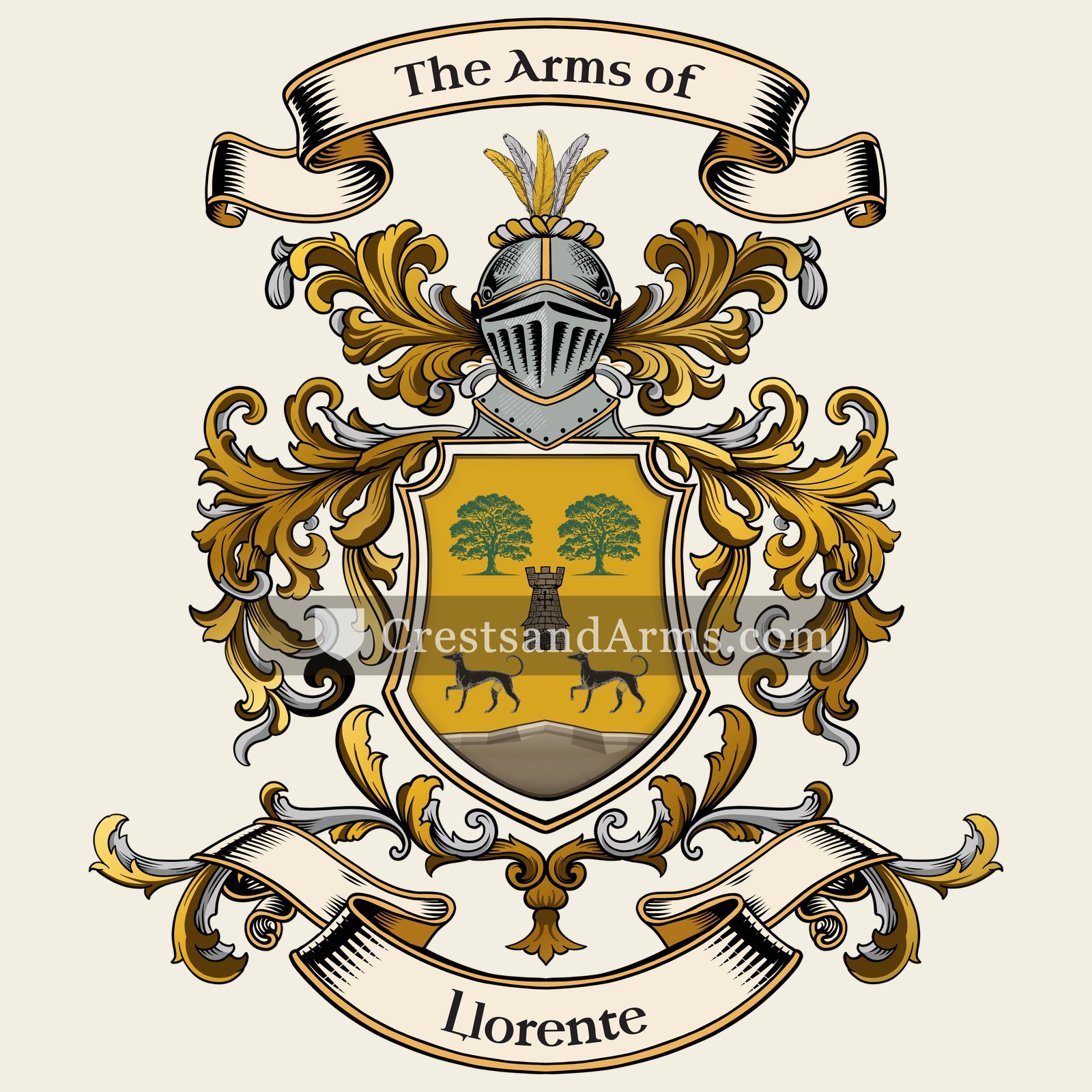
A record of documented arms, meaning and origin, researched for the Llorente family of Spain.
Reg. 1036 · Spanish, J–L
Coat of Arms & Family Crest Details
Symbols on this shield
mountThe ground held, and steadfastness upon it
towerGrandeur and solidity, and a stronghold defended
treeLife, endurance and deep roots
greyhoundCourage, vigilance and loyalty
Colours
Gold (Or)Means: Generosity
Green (Vert)Means: Hope
Black (Sable)Means: Constancy
Historical info
Source
J. B. Rietstap, Armorial Général, Gouda: G. B. van Goor Zonen, 1884–87
Blazon (the actual original written record)
“D'or à une tour donjonnée au nat., accostée de deux arbres de sin. et sommée d'une banderole flottante à sen., coupée d'azur sur gu; la porte accostée de deux lévriers pass. et adossés de sa., enchainés à ladite porte; le tout soutenu d'une terrasse au nat.”
SpainBiscaye, c. 1722
Digital archive packCoat of arms PNG, gold border print PDF, vector SVG and the certificate of authenticity. Sent to your email in minutes.
Map of Spain showing where the Llorente arms are recorded
The Llorente arms were recorded in Biscaye, c. 1722.
This is where the arms were entered in the register. Families often moved to other parts of the country, so the same name can turn up in more than one region.
The body that granted and recorded arms in Spain in this period.
Philip V of Spain
Sovereign of the period
Philip V of Spain
1714–1724
Reigning in Spain when the Llorente arms are first recorded.
How Arms Worked in Spain
In Spain, a coat of arms was considered a form of property that belonged to the entire family line. These arms were passed down from a father to all his children equally. Younger branches of the family usually kept the original design without needing to add any special marks to distinguish their specific line.
Granting authority
The Cronista Rey de Armas was the official body that regulated and granted coats of arms throughout Spain.
How they got arms
Families often obtained their arms through royal grants or by proving their noble status to the official heraldic authority.
Where arms were recorded
Coats of arms were officially recorded in the registers of the Cronista Rey de Armas starting in 1496.
The family's standing
Recorded among the armigerous families of Spain.
Origin & History of the Llorente Family in Spain
The surname Llorente originates from the Latin name Laurentius, which means one who is crowned with laurel leaves. Over many centuries, this name evolved through various regional dialects in Spain before settling into its current form. By the early 18th century, the family had established a notable presence in the province of Biscay. During this period, the region was known for its strong local traditions and a unique social structure that emphasized land ownership and family lineage. Members of the Llorente family living in Biscay in 1722 were likely part of a society that valued deep roots in the Basque countryside. As the name spread from these northern territories, it became associated with families who played active roles in their local communities and regional administration.
Related Branches & Arms
Root word
Laurentius
Derived from the Latin word for the laurel tree or laurel crown.
This name
LlorenteA patronymic surname signifying a descendant of someone named Lawrence, meaning one crowned with laurel.
also spelled
Llorentte
Llorent
Llorentee
Yorente
Documented Sources
J. B. Rietstap, Armorial Général, Gouda: G. B. van Goor Zonen, 1884–87
Moll, Francesc de Borja. Els llinatges catalans. 1959
Archivo de la Real Chancillería de Valladolid. Registro de Ejecutorias. 1722
García Carraffa, Alberto and Arturo. Diccionario heráldico y genealógico de apellidos españoles y americanos. 1920
Digital archive packCoat of arms PNG, gold border print PDF, vector SVG and the certificate of authenticity. Sent to your email in minutes.


 mountThe ground held, and steadfastness upon it
 towerGrandeur and solidity, and a stronghold defended
 treeLife, endurance and deep roots
 greyhoundCourage, vigilance and loyalty
 mountThe ground held, and steadfastness upon it
 towerGrandeur and solidity, and a stronghold defended
 treeLife, endurance and deep roots
 greyhoundCourage, vigilance and loyalty