Map of England showing where the Lofland arms are recorded
The Lofland arms were recorded in Norfolk, c. 1620.
Norfolk grew rich on wool and grain, and its wealth was spread among many middling families rather than a few great ones. Households of that kind bought land and took arms, and the county holds a large share of English names.
This is where the arms were entered in the register. Families often moved to other parts of the country, so the same name can turn up in more than one region.
The body that granted and recorded arms in England in this period.
James VI and I
Sovereign of the period
James VI and I
1603–1625
Reigning in England when the Lofland arms are first recorded.
How Arms Worked in England
English heraldry allowed arms to be shared by all legitimate descendants of the original owner. These symbols were treated as personal property that moved through the generations to all children. While the eldest son kept the original design, other family members could use the same shield without needing to change it or register their own unique versions.
Granting authority
The College of Arms in London has regulated the use of coats of arms throughout England and Wales since 1484.
How they got arms
Families typically obtained their coats of arms through a formal grant from the Crown or by proving their ancient right to them.
Where arms were recorded
All official coats of arms are recorded in the registers kept at the College of Arms, which date back to the fifteenth century.
The family's standing
Recorded among the armigerous families of Norfolk.
Origin & History of the Lofland Family in England
The Lofland family name is rooted in the coastal regions of England, with records confirming their presence in Norfolk as early as 1620. The name likely originated as a topographic descriptor, referring to individuals who lived on or near a "low land" or a marshy area common to the East Anglian landscape. During the early seventeenth century, the family was part of a period of significant social and economic change in Norfolk, a region known for its strong ties to maritime trade and agricultural innovation. As the family established itself in this area, they were likely involved in the local farming communities or the burgeoning wool trade that defined the Norfolk economy at the time. By the mid-1600s, members of the family began to migrate, eventually carrying the name across the Atlantic to the American colonies, where they settled in areas such as Delaware and Maryland. This migration reflects the broader movement of English families seeking new opportunities during the colonial era, marking the transition of the Lofland name from a local Norfolk identifier to a lasting presence in North America.
Related Branches & Arms
Root word
Lof-land
Old English elements meaning praise or glory and land or territory.
This name
LoflandA topographical name referring to someone who lived on land associated with praise or fame.
also spelled
Luvland
Lovelandt
Documented Sources
Sir Bernard Burke, The General Armory of England, Scotland, Ireland and Wales, London: Harrison & Sons, 1884
Blomefield, Francis, An Essay Towards a Topographical History of the County of Norfolk, 1739
Norfolk Record Office, Parish Register Transcripts for the Diocese of Norwich, 1600–1650
Coldham, Peter Wilson, The Complete Book of Emigrants, 1607–1660, 1987
Digital archive packCoat of arms PNG, gold border print PDF, vector SVG and the certificate of authenticity. Sent to your email in minutes.


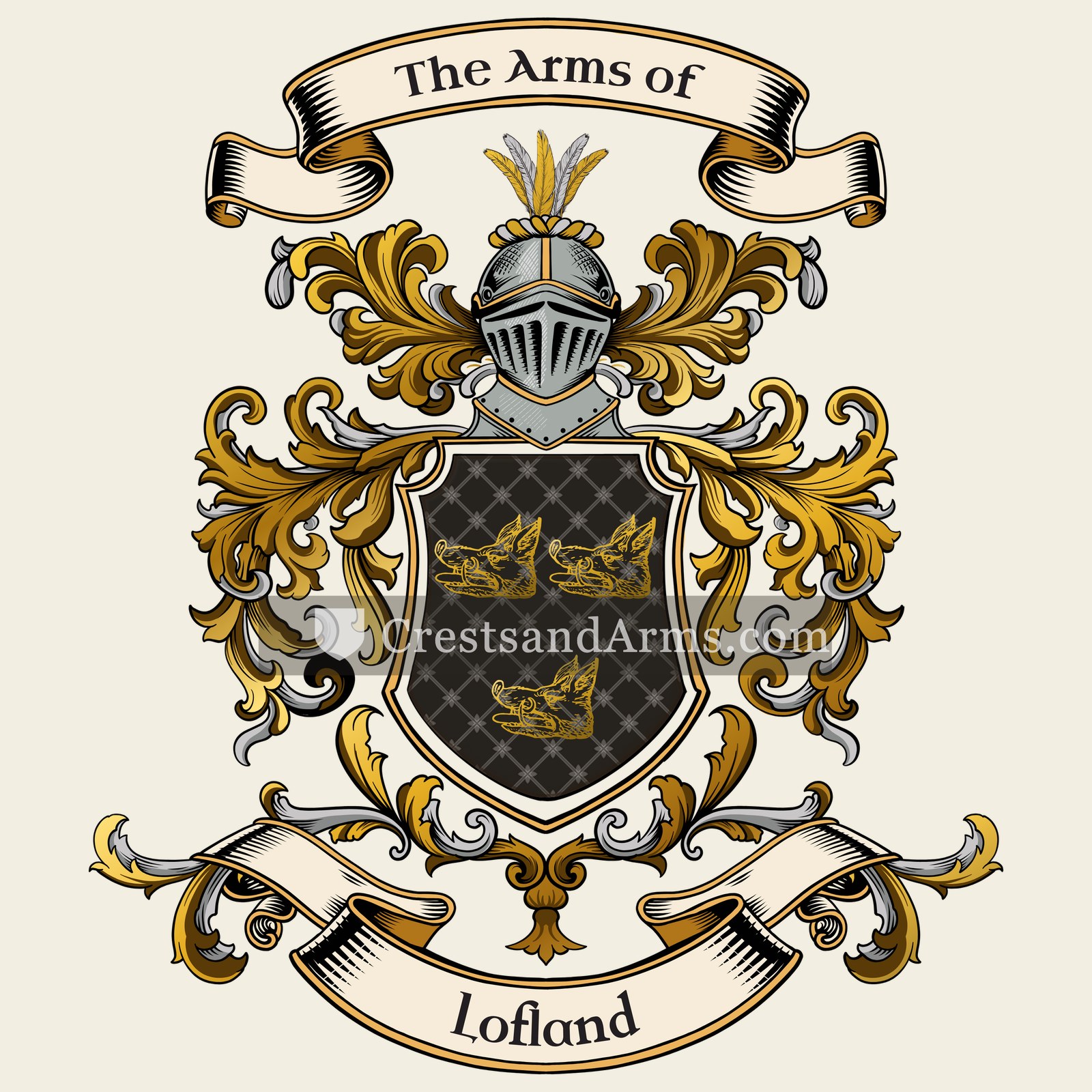
 boars headA fierce fighter who battles to the end
 boars headA fierce fighter who battles to the end