Map of France showing where the Loges arms are recorded
The Loges arms were recorded in Bourgogne, c. 1663.
Bourgogne was one of the richest parts of France, built on wine, wool and the roads that carried both. Wealth of that kind bought land, and land brought arms, so the region filled with armed families earlier than most of the country.
This is where the arms were entered in the register. Families often moved to other parts of the country, so the same name can turn up in more than one region.
The body that granted and recorded arms in France in this period.
Louis XIV of France
Sovereign of the period
Louis XIV of France
1643–1715
Reigning in France when the Loges arms are first recorded.
How Arms Worked in France
In France, a coat of arms was a mark of honor that passed down through the male line to all legitimate descendants. Families often used the same shield without changes to show their shared heritage. If a branch wanted to stand out, they could add a small mark to their shield to show their specific place in the family tree.
Granting authority
The Juge d'armes de France acted as the official authority that regulated and verified coats of arms across the country.
How they got arms
Families typically inherited their arms from ancestors, though they could also receive them through royal grants or by proving their noble status.
Where arms were recorded
Coats of arms were officially recorded in the Armorial Général de France, which began its main collection in the year 1696.
The family's standing
Recorded among the armigerous families of Bourgogne.
Origin & History of the Loges Family in France
The family name Loges finds its historical roots in the lush landscapes of the Bourgogne region of France. By the year 1663, records confirm that members of the family were well-established residents within this area. The name itself is topographical in origin, likely derived from the Old French word *loge*, which referred to a small hut, a shelter, or a dwelling place. This suggests that the earliest ancestors to carry the name were likely identified by the specific location of their home or their occupation as caretakers of woodland lodges. During the seventeenth century, Bourgogne was a center of agricultural and viticultural importance, and families like the Loges were deeply integrated into the local community structures. They lived through a period of significant social change in France, where the transition from feudal ties to more localized land management defined the daily lives of families in the countryside. As they settled into the regional landscape, the Loges family became part of the enduring history of the French provinces, contributing to the cultural and social fabric of the Bourgogne region for generations.
Meaning of the Loges family crest colors & symbols
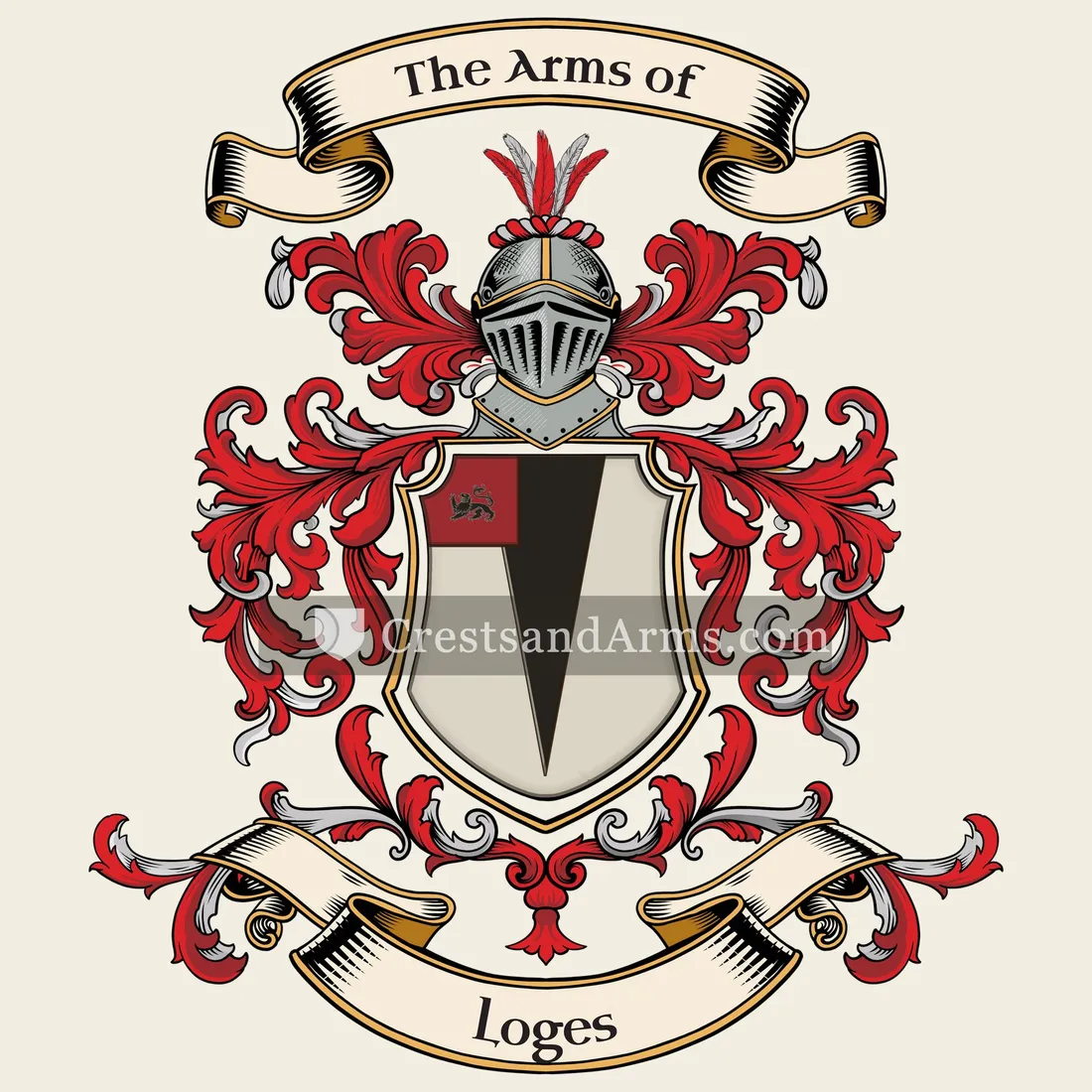
Symbols on this shield
pileWell-doing, and a mark of distinction
cantonA mark of honour granted by the sovereign
lionCourage, strength and royalty
Colours
Silver (Argent)Means: Peace and sincerity
Red (Gules)Means: Military strength
Historical info
Source
Sir Bernard Burke, The General Armory of England, Scotland, Ireland and Wales, London: Harrison & Sons, 1884
Blazon (the actual original written record)
“Ar. three piles in point az. on a canton gu. a lion ramp. of the first”
Englandc. 1620
Digital archive packCoat of arms PNG, gold border print PDF, vector SVG and the certificate of authenticity. Sent to your email in minutes.
Map of England showing where the Loges arms are recorded
The Loges arms were recorded in England, c. 1620.
Arms such as these were typically recorded in York.
Yorkshire is the largest of the English counties, and it held more gentry families than any other. Land there was split among a great many households rather than a few, so a great many of them carried arms.
This is where the arms were entered in the register. Families often moved to other parts of the country, so the same name can turn up in more than one region.
The body that granted and recorded arms in England in this period.
James VI and I
Sovereign of the period
James VI and I
1603–1625
Reigning in France when the Loges arms are first recorded.
How Arms Worked in England
English heraldry allowed arms to be shared by all legitimate descendants of the original owner. These symbols were treated as personal property that moved through the generations to all children. While the eldest son kept the original design, other family members could use the same shield without needing to change it or register their own unique versions.
Granting authority
The College of Arms in London has regulated the use of coats of arms throughout England and Wales since 1484.
How they got arms
Families typically obtained their coats of arms through a formal grant from the Crown or by proving their ancient right to them.
Where arms were recorded
All official coats of arms are recorded in the registers kept at the College of Arms, which date back to the fifteenth century.
The family's standing
Recorded among the armigerous families of England.
Origin & History of the Loges Family in England
The family name Loges has roots that stretch back to the medieval period, though its presence in England became more firmly established by the early seventeenth century. By 1620, records confirm that members of the family were living in the historic city of York. During this era, York was a bustling northern hub where families often settled to participate in the growing trade and craft industries of the region. The name likely originated from a descriptive term or a place name, reflecting the way surnames were commonly formed in England to identify a person by their residence or occupation. As these individuals navigated life in a city defined by its ancient walls and cathedral, they contributed to the local community during a time of significant social and political change in England. Their presence in York suggests that the family was part of the urban middle class, moving through the daily life of a city that served as the administrative and religious heart of the north.
Loges Meaning & Related Branches
Root word
Loge
A small hut, cabin, or lodge made of wood.
This name
LogesRefers to a person who lived in or worked at a small dwelling or lodge.
also spelled
Logesse
Logess
Logez
Lozh
Logis
Related arms
Loggevariant spelling
Documented Sources
J. B. Rietstap, Armorial Général, Gouda: G. B. van Goor Zonen, 1884–87
Archives départementales de la Côte-d'Or, Registres paroissiaux et d'état civil
Dauzat, Albert, Dictionnaire étymologique des noms de famille et prénoms de France, 1951
Morlet, Marie-Thérèse, Dictionnaire étymologique des noms de famille, 1991
Digital archive packCoat of arms PNG, gold border print PDF, vector SVG and the certificate of authenticity. Sent to your email in minutes.


 saltireResolution, and St Andrew's cross
 saltireResolution, and St Andrew's cross


 pileWell-doing, and a mark of distinction
 cantonA mark of honour granted by the sovereign
 lionCourage, strength and royalty