Map of Russia showing where the Lohmann arms are recorded
The Lohmann arms were recorded in Esthonie, c. 1784.
Arms such as these were typically recorded in Moscow.
Moscow held the Russian court, and rank there came from service rather than land. Families who served the Tsar were entered in the registers of nobility, and that entry is where their arms are recorded.
This is where the arms were entered in the register. Families often moved to other parts of the country, so the same name can turn up in more than one region.
The body that granted and recorded arms in Russia in this period.
Catherine II of Russia
Sovereign of the period
Catherine II of Russia
1762–1796
Reigning in Russia when the Lohmann arms are first recorded.
How Arms Worked in Russia
Russian heraldry was strictly tied to the nobility and the state service system. Families proved their ancient status or earned new rank to receive an official grant from the Tsar. These symbols were then inherited by all legitimate children of the noble line. If a family lacked proof of their status, they were often excluded from the official records entirely.
Granting authority
The Herald Master's Office acted as the central state body that strictly regulated and verified all noble heraldic symbols.
How they got arms
Families typically received their arms through a formal state grant or by proving their noble status to the government authorities.
Where arms were recorded
All approved coats of arms were officially recorded in the General Armorial of the Noble Families of the Russian Empire starting in 1797.
The family's standing
Recorded among the armigerous families of Russia.
Origin & History of the Lohmann Family in Russia
The surname Lohmann is of German origin and typically describes someone who lived near a specific type of woodland or clearing. The name is derived from the Middle Low German word "loh," which refers to a forest or a brushy area, combined with "mann," meaning a person or dweller. While the name is deeply rooted in German-speaking lands, the family history took a significant turn by the late 18th century. By 1784, members of the Lohmann family had established a presence in Moscow, likely as part of the broader migration of skilled professionals, merchants, and craftsmen who moved to the Russian Empire during the reign of Catherine the Great. These early settlers often served as vital links between the German states and the Russian economy, bringing specialized knowledge in trade and industry to a rapidly growing capital city. This transition from rural German roots to the urban environment of Moscow highlights the family's adaptability and their role in the international networks of the Enlightenment era.
Related Branches & Arms
Root word
Loh
A low-lying area or a clearing in a forest.
This name
LohmannA person who lived near a forest clearing or a low-lying meadow.
also spelled
Vonlohman
Lohmann
von Loman
Lohman
Documented Sources
J. B. Rietstap, Armorial Général, Gouda: G. B. van Goor Zonen, 1884–87
Bahlow, Hans, Deutsches Namenlexikon: Familien- und Vornamen nach Ursprung und Sinn erklärt, 1967
Kappeler, Andreas, Rußland als Vielvölkerreich: Entstehung, Geschichte, Zerfall, 1992
Russian State Archive of Ancient Acts (RGADA), Fond 16, Department of Foreign Relations (18th Century Records)
Digital archive packCoat of arms PNG, gold border print PDF, vector SVG and the certificate of authenticity. Sent to your email in minutes.


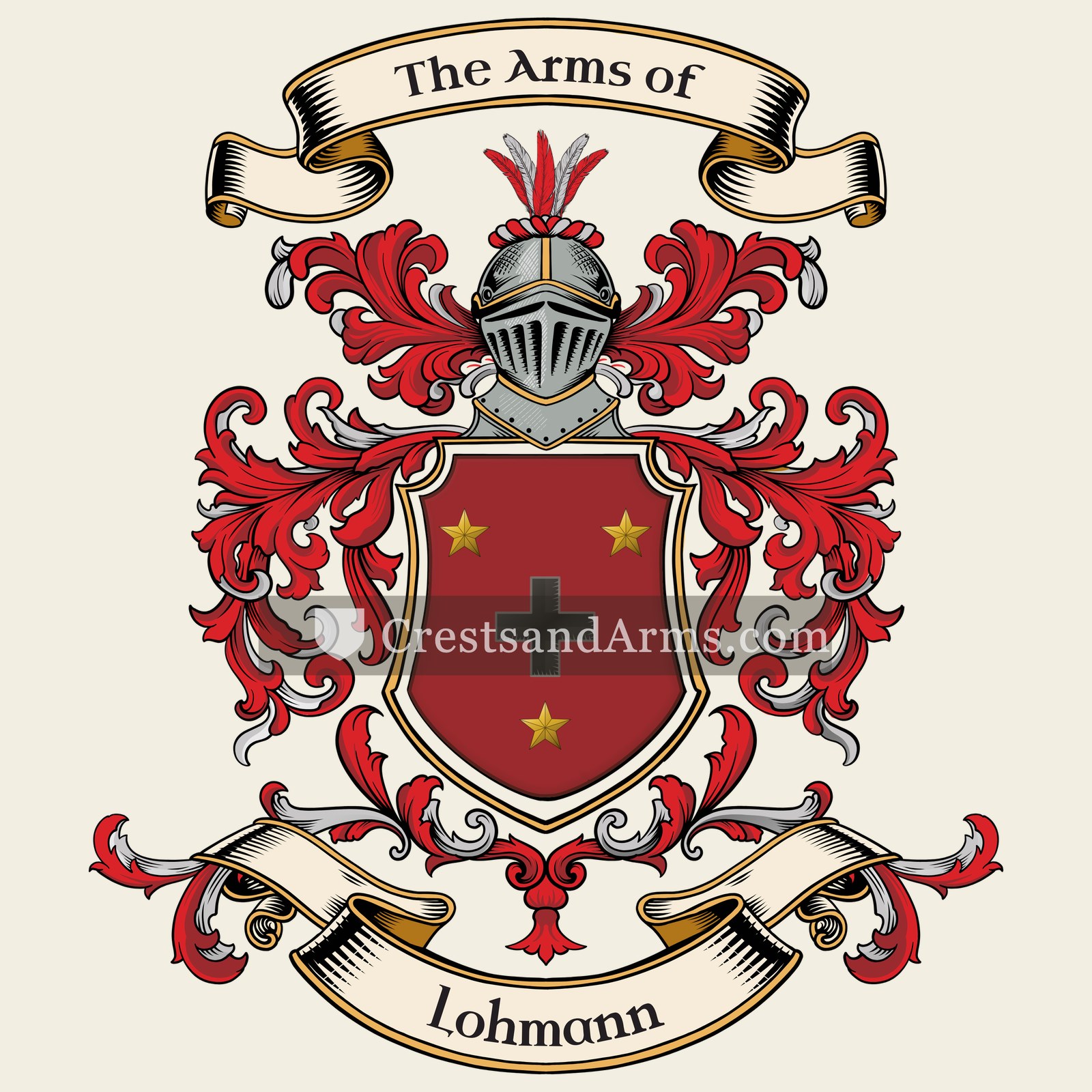
 cross symbolChristian faith and service
 mulletThe third son, and a divine quality from above
 cross symbolChristian faith and service
 mulletThe third son, and a divine quality from above