Map of France showing where the Lohrmann arms are recorded
The Lohrmann arms were recorded in Normandie, c. 1663.
Normandie held a dense crowd of knightly families on some of the best farmland in France. Its men had fought and settled abroad for generations, and a family that sent sons to war needed a shield they could be recognised by.
This is where the arms were entered in the register. Families often moved to other parts of the country, so the same name can turn up in more than one region.
The body that granted and recorded arms in France in this period.
Louis XIV of France
Sovereign of the period
Louis XIV of France
1643–1715
Reigning in France when the Lohrmann arms are first recorded.
How Arms Worked in France
In France, a coat of arms was a mark of honor that passed down through the male line to all legitimate descendants. Families often used the same shield without changes to show their shared heritage. If a branch wanted to stand out, they could add a small mark to their shield to show their specific place in the family tree.
Granting authority
The Juge d'armes de France acted as the official authority that regulated and verified coats of arms across the country.
How they got arms
Families typically inherited their arms from ancestors, though they could also receive them through royal grants or by proving their noble status.
Where arms were recorded
Coats of arms were officially recorded in the Armorial Général de France, which began its main collection in the year 1696.
The family's standing
Recorded among the armigerous families of Normandie.
Origin & History of the Lohrmann Family in France
The history of the Lohrmann family name is rooted in the movement of people across European borders during the seventeenth century. While the name possesses linguistic origins that suggest a connection to Germanic regions, historical records confirm that members of the family were established in the Normandy region of France by 1663. During this era, families often migrated for trade, military service, or religious reasons, leading to the integration of foreign surnames into local French communities. The presence of the Lohrmann name in Normandy indicates that these early ancestors successfully adapted to a new cultural environment while maintaining their distinct family identity. Over time, the name became a permanent part of the regional landscape, reflecting the broader patterns of migration that shaped the demographics of early modern Europe.
Related Branches & Arms
Root word
Lohrmann
Derived from the Middle High German word for a forest clearing.
This name
LohrmannAn occupational or habitational name for someone living near a forest clearing.
also spelled
Lormant
Documented Sources
J. B. Rietstap, Armorial Général, Gouda: G. B. van Goor Zonen, 1884–87
Archives départementales de la Seine-Maritime, Registres paroissiaux et d'état civil
Bouchard, Gérard, Quelques arpents d'Amérique: Population et économie du peuplement, 1996
Mousnier, Roland, La famille, l'enfant et l'éducation en France et en Grande-Bretagne du XVIe au XVIIIe siècle, 1975
Digital archive packCoat of arms PNG, gold border print PDF, vector SVG and the certificate of authenticity. Sent to your email in minutes.


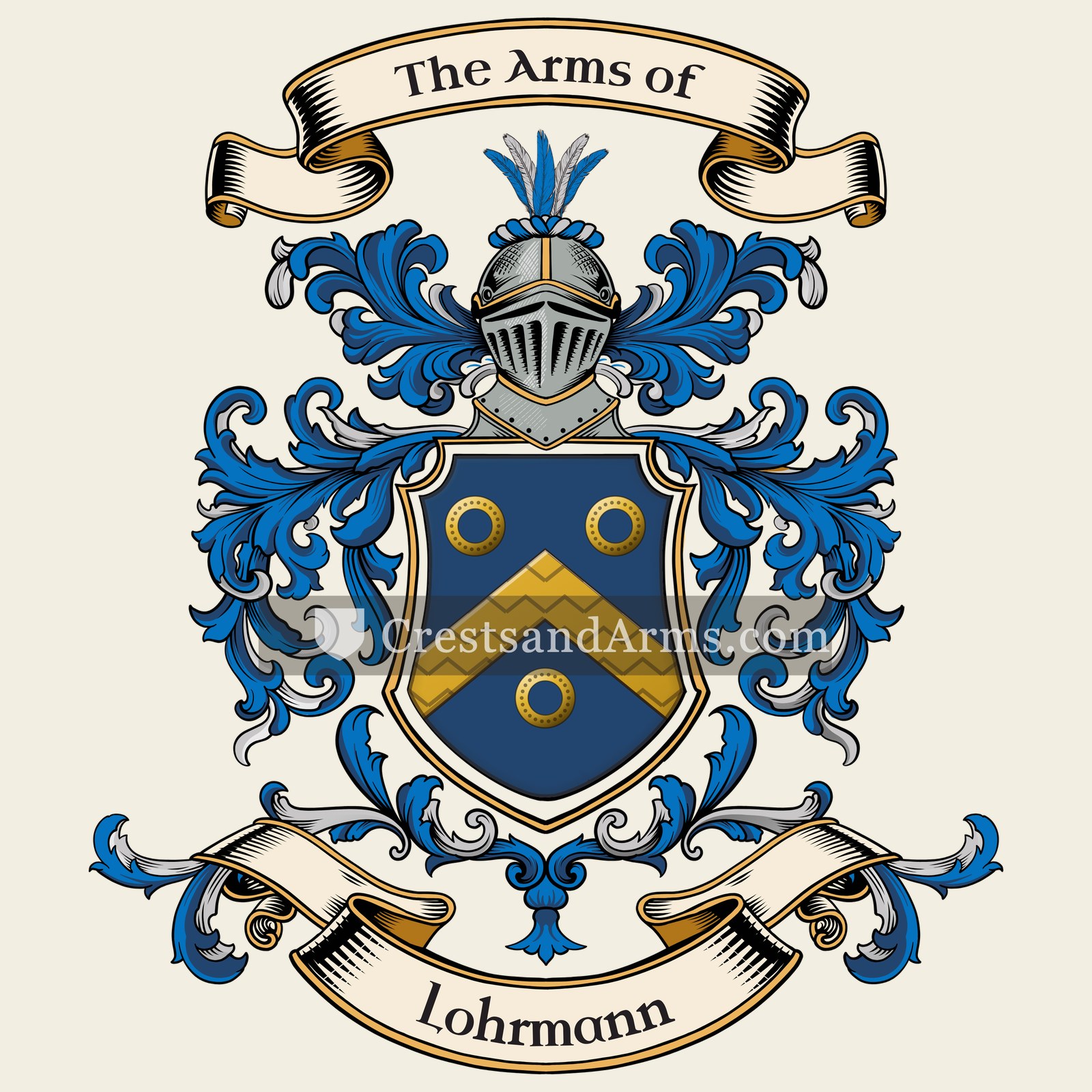
 chevronProtection, and faithful service completed
 ringFidelity, and a promise kept
 chevronProtection, and faithful service completed
 ringFidelity, and a promise kept