Map of Portugal showing where the Lopes arms are recorded
The Lopes arms were recorded in Portugal, c. 1706.
Arms such as these were typically recorded in Lisboa.
Lisbon was the seat of the Portuguese crown and the port its wealth came through. Families made rich by trade and by service to the king took arms, and the crown's heralds recorded them there.
This is where the arms were entered in the register. Families often moved to other parts of the country, so the same name can turn up in more than one region.
The body that granted and recorded arms in Portugal in this period.
Peter II of Portugal
Sovereign of the period
Peter II of Portugal
1683–1706
Reigning in Portugal when the Lopes arms are first recorded.
How Arms Worked in Portugal
In Portugal, a coat of arms was a family possession that passed from a father to his children. Every legitimate descendant had the right to use the family shield without needing to change it. Younger branches of the family kept the original design, though they sometimes added small symbols to distinguish their specific line from the main branch.
Granting authority
The Cartório da Nobreza acted as the official body that managed and regulated noble titles and coats of arms in Portugal.
How they got arms
Families typically inherited their arms through bloodline, though they could also receive new grants from the crown for distinguished service.
Where arms were recorded
Coats of arms were officially recorded in the books of the Cartório da Nobreza starting in the year 1512.
The family's standing
Recorded among the armigerous families of Portugal.
Origin & History of the Lopes Family in Portugal
The surname Lopes is a patronymic name, which means it was originally created to identify a person as the son of someone named Lopo. The name Lopo itself is derived from the Latin word lupus, meaning wolf, a common root for names throughout the Iberian Peninsula during the Middle Ages. By the time the family was established in Lisboa in 1706, the name had already been in use for centuries across Portugal. Families carrying this name were often integrated into the urban fabric of the capital, working in various trades and professional roles that supported the city's growth. Because the name was linked to a common given name, it was adopted by many different families independently rather than belonging to a single bloodline. This widespread use allowed the name to spread from the rural northern regions of Portugal down to the bustling ports and administrative centers of the south. By the early eighteenth century, the Lopes name was a well-established part of the Portuguese identity, representing a long history of families who had settled into the social and economic life of Lisboa.
Coat of Arms & Family Crest Details
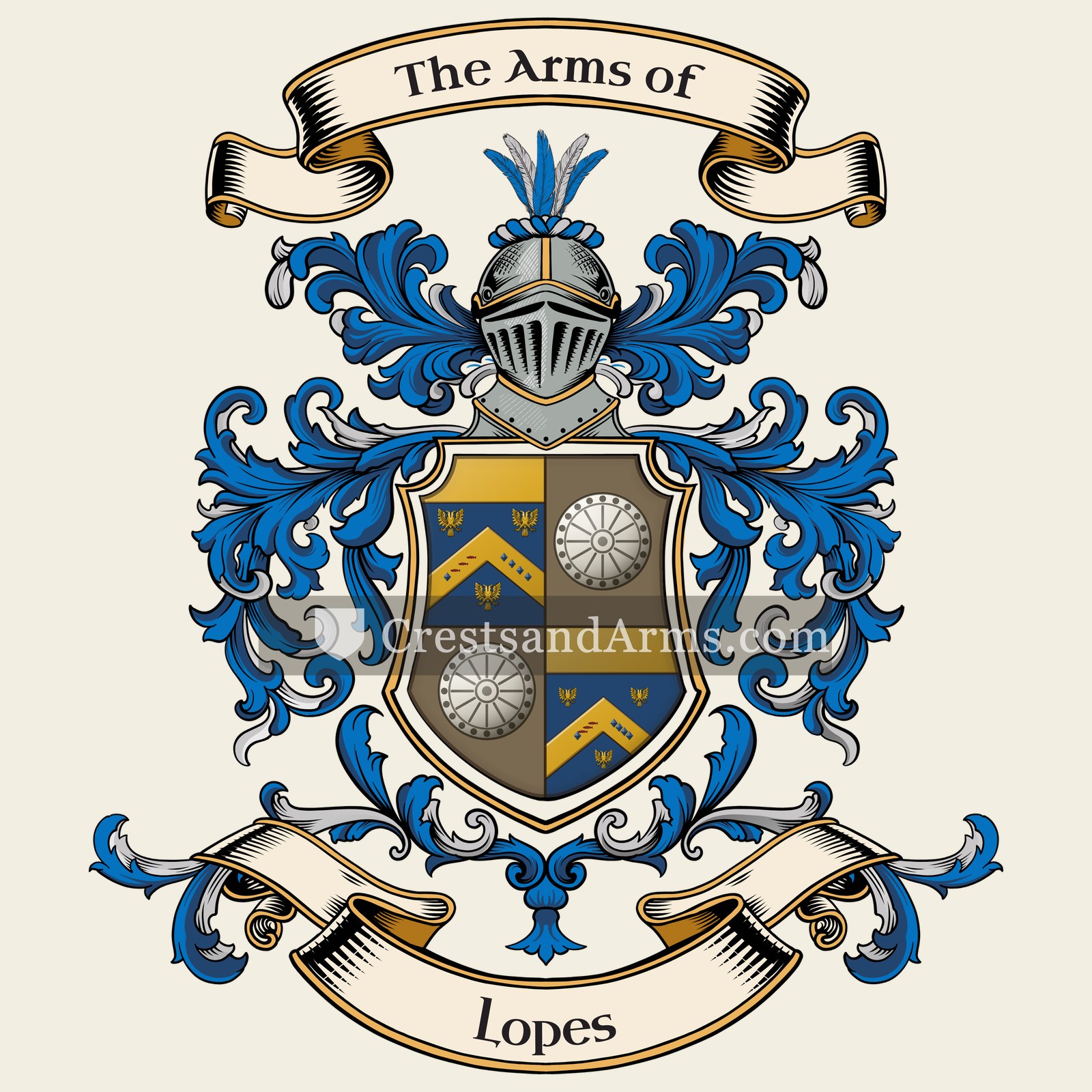
Symbols on this shield
chevronProtection, and faithful service completed
chiefAuthority, wisdom and dominion
eagleNobility, strength and a keen mind
fishA true and generous mind, and Christian faith
lozengeHonour and nobility, and the arms of a woman
roundelA coin, and one who has been to the crusades
Colours
Blue (Azure)Means: Loyalty and truth
Gold (Or)Means: Generosity
Red (Gules)Means: Military strength
Historical info
Source
Sir Bernard Burke, The General Armory of England, Scotland, Ireland and Wales, London: Harrison & Sons, 1884
Blazon (the actual original written record)
“Quarterly, 1st and 4th, az. on a chev. betw. three eagles rising or, as many bars gemelle gu. on a chief of the second five lozenges of the first, for LOPES; 2nd and 3rd, in a landscape field a fountain, thereout issuing a palm tree all ppr., for FRANCO”
DevonMaristow · Devon, c. 1620
Digital archive packCoat of arms PNG, gold border print PDF, vector SVG and the certificate of authenticity. Sent to your email in minutes.
Map of England showing where the Lopes arms are recorded
The Lopes arms were recorded in Devon, c. 1620.
Devon was a county of small manors and seafaring families. Its gentry were spread thickly across the countryside, and money made at sea often bought an estate, which in turn brought a coat of arms.
This is where the arms were entered in the register. Families often moved to other parts of the country, so the same name can turn up in more than one region.
The body that granted and recorded arms in England in this period.
James VI and I
Sovereign of the period
James VI and I
1603–1625
Reigning in Portugal when the Lopes arms are first recorded.
How Arms Worked in England
English heraldry allowed arms to be shared by all legitimate descendants of the original owner. These symbols were treated as personal property that moved through the generations to all children. While the eldest son kept the original design, other family members could use the same shield without needing to change it or register their own unique versions.
Granting authority
The College of Arms in London has regulated the use of coats of arms throughout England and Wales since 1484.
How they got arms
Families typically obtained their coats of arms through a formal grant from the Crown or by proving their ancient right to them.
Where arms were recorded
All official coats of arms are recorded in the registers kept at the College of Arms, which date back to the fifteenth century.
The family's standing
Recorded among the armigerous families of Devon.
Origin & History of the Lopes Family in England
The surname Lopes arrived in England as part of a broader movement of Sephardic Jewish families fleeing religious persecution in the Iberian Peninsula during the sixteenth and seventeenth centuries. By the year 1620, records confirm that members of the family had established a presence in Devon, a coastal region that served as a vital gateway for trade and migration. These early settlers often integrated into the local merchant class, utilizing their international connections to navigate the complex maritime economy of the era. While many families of this origin initially faced significant social and legal hurdles, the Lopes name became increasingly associated with the burgeoning mercantile activities of the English West Country. Their transition from refugees to established residents reflects the quiet but persistent influence of immigrant communities on the regional development of southern England.
Related Branches & Arms
Root word
Lupus
Latin term for a wolf.
This name
LopesA patronymic surname signifying son of the wolf, representing strength and courage.
also spelled
Lopez
Loppez
Related arms
Lopezvariant spelling
Heywoodrecorded with Lopes, same area
Documented Sources
J. B. Rietstap, Armorial Général, Gouda: G. B. van Goor Zonen, 1884–87
Machado, José Pedro, Dicionário Onomástico Etimológico da Língua Portuguesa, 1981
Sanches de Baena, Visconde de, Archivo Heráldico Genealógico, 1872
Arquivo Nacional da Torre do Tombo, Registos Paroquiais de Lisboa, 1706
Digital archive packCoat of arms PNG, gold border print PDF, vector SVG and the certificate of authenticity. Sent to your email in minutes.


 towerGrandeur and solidity, and a stronghold defended
 towerGrandeur and solidity, and a stronghold defended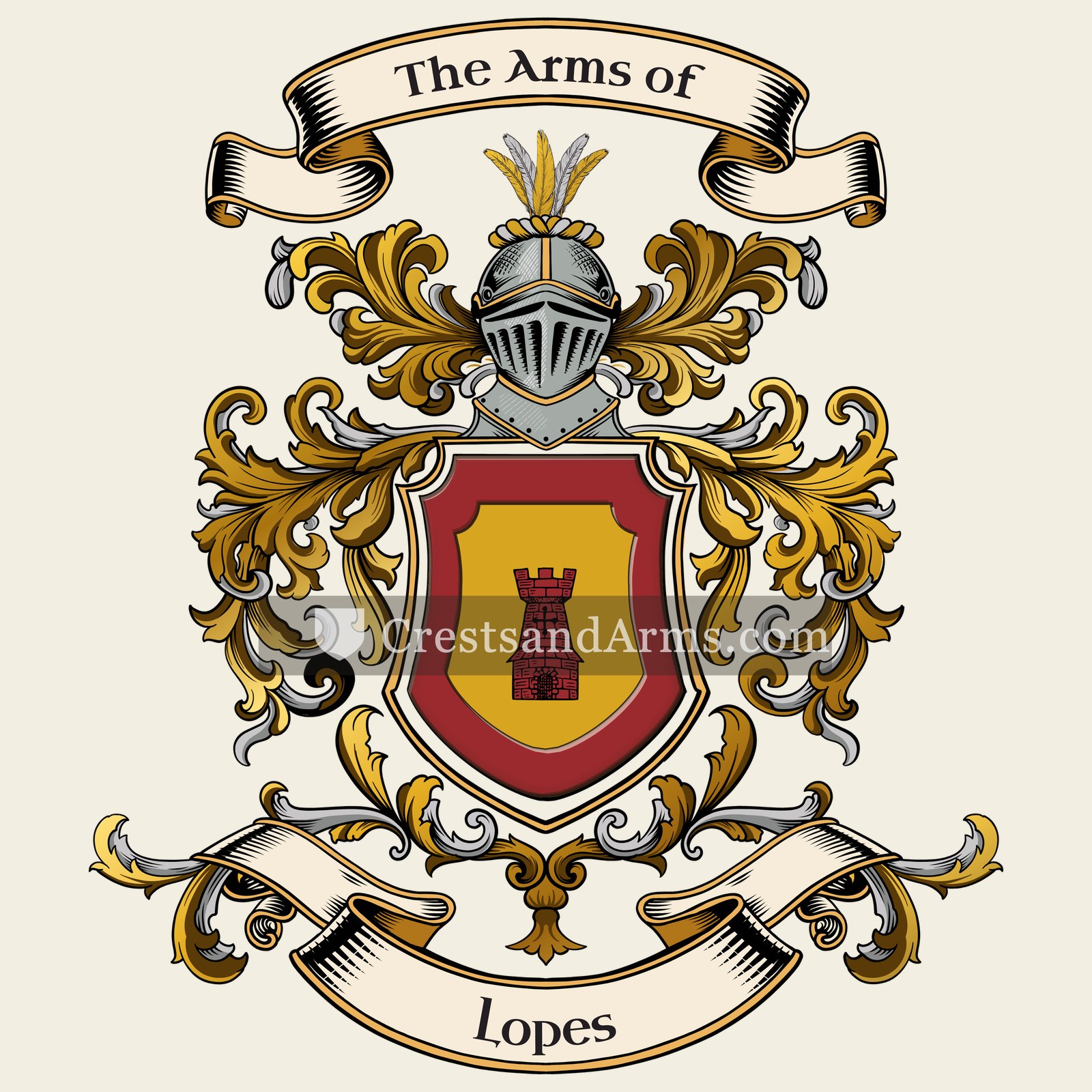


 chevronProtection, and faithful service completed
 chiefAuthority, wisdom and dominion
 eagleNobility, strength and a keen mind
 fishA true and generous mind, and Christian faith
 lozengeHonour and nobility, and the arms of a woman
 roundelA coin, and one who has been to the crusades