Map of France showing where the Lorensen arms are recorded
The Lorensen arms were recorded in Alsace, c. 1663.
Alsace lay between France and the German lands and belonged to both at different times. Its families held small estates and served whichever side ruled, and men who served in arms carried arms of their own.
This is where the arms were entered in the register. Families often moved to other parts of the country, so the same name can turn up in more than one region.
The body that granted and recorded arms in France in this period.
Louis XIV of France
Sovereign of the period
Louis XIV of France
1643–1715
Reigning in France when the Lorensen arms are first recorded.
How Arms Worked in France
In France, a coat of arms was a mark of honor that passed down through the male line to all legitimate descendants. Families often used the same shield without changes to show their shared heritage. If a branch wanted to stand out, they could add a small mark to their shield to show their specific place in the family tree.
Granting authority
The Juge d'armes de France acted as the official authority that regulated and verified coats of arms across the country.
How they got arms
Families typically inherited their arms from ancestors, though they could also receive them through royal grants or by proving their noble status.
Where arms were recorded
Coats of arms were officially recorded in the Armorial Général de France, which began its main collection in the year 1696.
The family's standing
Recorded among the armigerous families of Alsace.
Origin & History of the Lorensen Family in France
The surname Lorensen is a patronymic name, which means it was originally formed by adding a suffix to the given name of a father. In this case, the name indicates that the family descends from an ancestor named Lorenz, a popular variation of the Latin name Laurentius. By 1663, records confirm that members of the family were living in the Alsace region, a territory located between modern-day France and Germany. During this period, Alsace was a cultural crossroads where families often navigated complex shifts in political borders and local customs. Because the region was heavily influenced by both Germanic and French traditions, the spelling of the name likely evolved to reflect the linguistic habits of the local population. Families in this area were often involved in agriculture or skilled trades, and they maintained strong ties to their local parishes, which served as the primary keepers of birth and marriage records during the seventeenth century.
Lorensen Meaning & Related Branches
Root word
Laurentius
Derived from the Latin word for the laurel tree or crown.
This name
LorensenA patronymic surname meaning son of Laurence, signifying one from Laurentum.
also spelled
Lorenz
Lorentz
Lawrence
Documented Sources
J. B. Rietstap, Armorial Général, Gouda: G. B. van Goor Zonen, 1884–87
Heintze, Albert. Die deutschen Familiennamen: geschichtlich, geographisch, sprachlich. 1882
Bach, Adolf. Deutsche Namenkunde. 1952
Archives départementales du Bas-Rhin, Registres paroissiaux et d'état civil
Digital archive packCoat of arms PNG, gold border print PDF, vector SVG and the certificate of authenticity. Sent to your email in minutes.


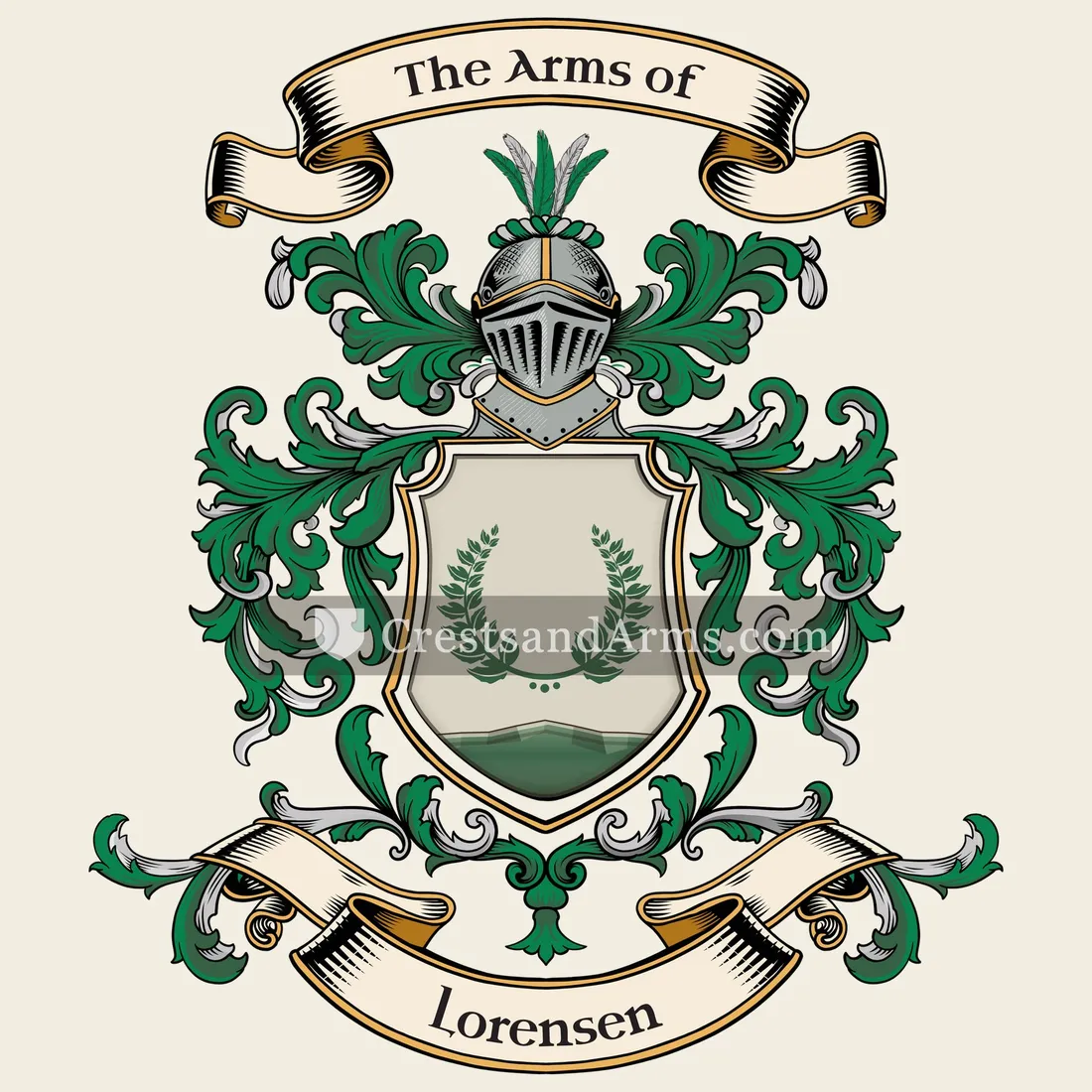
 mountThe ground held, and steadfastness upon it
 wreathHonour, and a victory crowned
 mountThe ground held, and steadfastness upon it
 wreathHonour, and a victory crowned