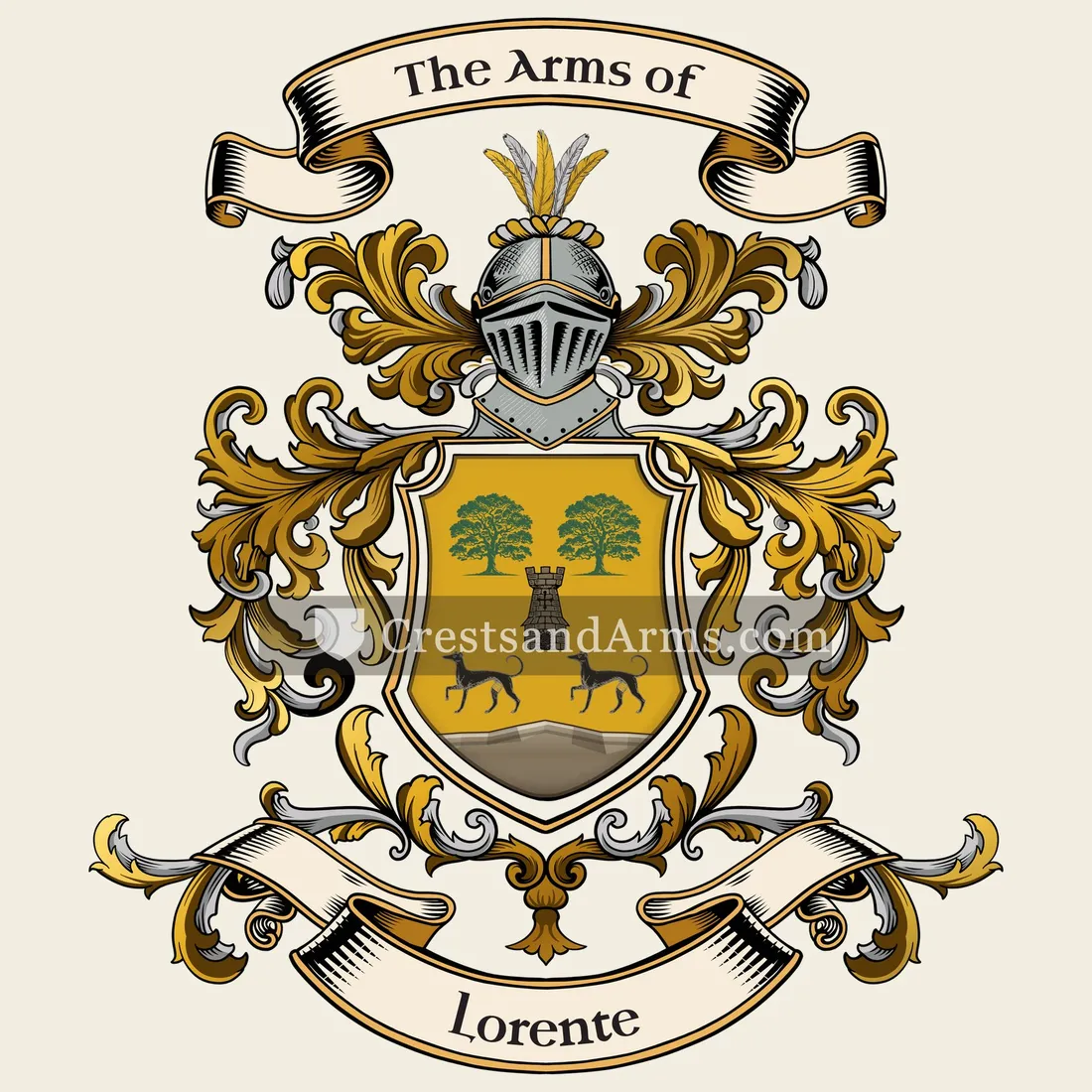
A record of documented arms, meaning and origin, researched for the Lorente family of Spain.
Reg. 4456 · Spanish, J–L
Meaning of the Lorente family crest colors & symbols
Symbols on this shield
mountThe ground held, and steadfastness upon it
towerGrandeur and solidity, and a stronghold defended
treeLife, endurance and deep roots
greyhoundCourage, vigilance and loyalty
Colours
Gold (Or)Means: Generosity
Green (Vert)Means: Hope
Black (Sable)Means: Constancy
Historical info
Source
J. B. Rietstap, Armorial Général, Gouda: G. B. van Goor Zonen, 1884–87
Blazon (the actual original written record)
“D'or à une tour donjonnée au nat., accostée de deux arbres de sin. et sommée d'une banderole flottante à sen., coupée d'azur sur gu; la porte accostée de deux lévriers pass. et adossés de sa., enchainés à ladite porte; le tout soutenu d'une terrasse au nat.”
SpainBiscaye, c. 1722
Digital archive packCoat of arms PNG, gold border print PDF, vector SVG and the certificate of authenticity. Sent to your email in minutes.
Map of Spain showing where the Lorente arms are recorded
The Lorente arms were recorded in Biscaye, c. 1722.
This is where the arms were entered in the register. Families often moved to other parts of the country, so the same name can turn up in more than one region.
The body that granted and recorded arms in Spain in this period.
Philip V of Spain
Sovereign of the period
Philip V of Spain
1714–1724
Reigning in Spain when the Lorente arms are first recorded.
How Arms Worked in Spain
In Spain, a coat of arms was considered a form of property that belonged to the entire family line. These arms were passed down from a father to all his children equally. Younger branches of the family usually kept the original design without needing to add any special marks to distinguish their specific line.
Granting authority
The Cronista Rey de Armas was the official body that regulated and granted coats of arms throughout Spain.
How they got arms
Families often obtained their arms through royal grants or by proving their noble status to the official heraldic authority.
Where arms were recorded
Coats of arms were officially recorded in the registers of the Cronista Rey de Armas starting in 1496.
The family's standing
Recorded among the armigerous families of Spain.
Origin & History of the Lorente Family in Spain
The surname Lorente finds its historical roots in the northern regions of Spain, particularly within the Basque Country. By the early 18th century, records confirm that members of the family were firmly established in the province of Biscay by 1722. The name itself is a patronymic derivative of the Latin name Laurentius, which means one who is crowned with laurel leaves. During this period, families in the Basque region often lived in ancestral homesteads known as caseríos, which served as the center of both agricultural life and family identity. As the family grew, members moved throughout the Iberian Peninsula, carrying the name into various professional and social spheres while maintaining the strong regional ties that defined their early history in the rugged landscape of northern Spain.
Lorente Meaning & Related Branches
Root word
Laurentius
Derived from the Latin word for the laurel tree or crown.
This name
LorenteA patronymic surname indicating descent from someone named Lawrence or one crowned with laurel.
also spelled
Llorentte
Llorent
Llorentee
Yorente
Documented Sources
J. B. Rietstap, Armorial Général, Gouda: G. B. van Goor Zonen, 1884–87
Mikeldi de Altube, Diccionario etimológico de apellidos vascos, 1968
Archivo Foral de Bizkaia, Sección de Gobierno, Padrones de hidalguía, 1722
Endika de Mogrobejo, Diccionario hispano-americano de heráldica, onomástica y genealogía, 1995
Digital archive packCoat of arms PNG, gold border print PDF, vector SVG and the certificate of authenticity. Sent to your email in minutes.


 mountThe ground held, and steadfastness upon it
 towerGrandeur and solidity, and a stronghold defended
 treeLife, endurance and deep roots
 greyhoundCourage, vigilance and loyalty
 mountThe ground held, and steadfastness upon it
 towerGrandeur and solidity, and a stronghold defended
 treeLife, endurance and deep roots
 greyhoundCourage, vigilance and loyalty