Map of Britain showing where the Lovallo arms are recorded
The Lovallo arms were recorded in Britain, c. 1700.
Arms such as these were typically recorded in Kent.
Kent sits between London and the short crossing to Europe, and the trade passing through made it wealthy. Merchant families bought land with that money, and it was landowners who took coats of arms.
This is where the arms were entered in the register. Families often moved to other parts of the country, so the same name can turn up in more than one region.
The body that granted and recorded arms in Britain in this period.
William III of England
Sovereign of the period
William III of England
1694–1702
Reigning in Britain when the Lovallo arms are first recorded.
How Arms Worked in Britain
English heraldry allowed arms to be shared by all legitimate descendants of the original owner. These symbols were treated as personal property that moved through the generations to all children. While the eldest son kept the original design, other family members could use the same shield without needing to change it or register their own unique versions.
Granting authority
The College of Arms in London has regulated the use of coats of arms throughout England and Wales since 1484.
How they got arms
Families typically obtained their coats of arms through a formal grant from the Crown or by proving their ancient right to them.
Where arms were recorded
All official coats of arms are recorded in the registers kept at the College of Arms, which date back to the fifteenth century.
The family's standing
Recorded among the armigerous families of Britain.
Origin & History of the Lovallo Family in Britain
The Lovallo family name represents a fascinating thread in the social tapestry of eighteenth-century Kent. While the name itself carries linguistic roots that suggest a Mediterranean origin, its documented presence in the English countryside by the year 1700 highlights the mobility of individuals across Europe during the early modern period. At that time, Kent served as a vital gateway for trade and migration due to its proximity to the coast and its busy ports. Families arriving in this region often integrated into local agricultural or mercantile communities, adapting their surnames to the phonetic patterns of the English language. By settling in Kent, the early members of the Lovallo family became part of a diverse population that helped shape the local economy and culture of the region during a time of significant national growth.
Meaning of the Lovallo family crest colors & symbols
Symbols on this shield
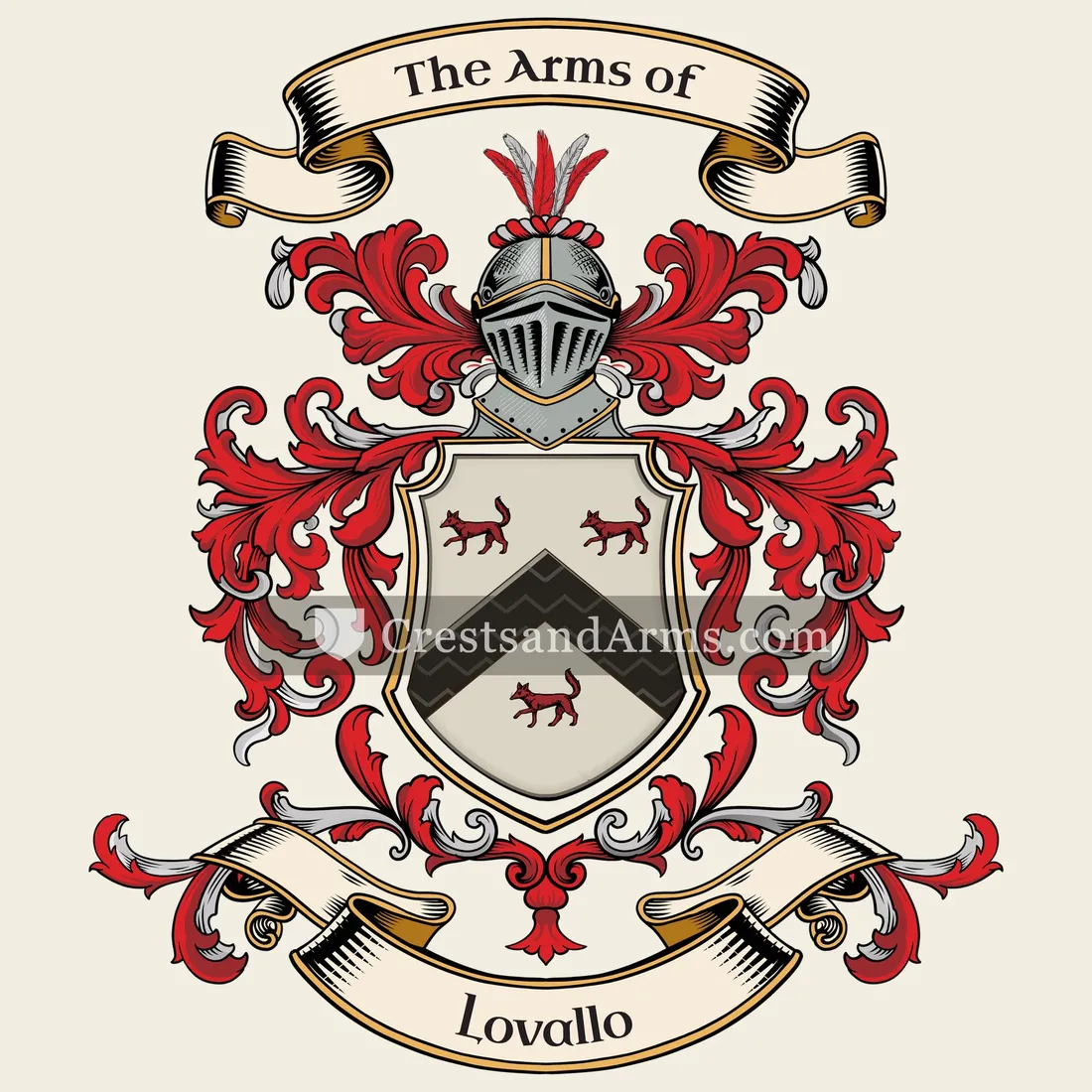
chevronProtection, and faithful service completed
foxWit and wisdom in defence
Colours
Silver (Argent)Means: Peace and sincerity
Black (Sable)Means: Constancy
Red (Gules)Means: Military strength
Historical info
Source
Sir Bernard Burke, The General Armory of England, Scotland, Ireland and Wales, London: Harrison & Sons, 1884
Blazon (the actual original written record)
“Ar. a chev. sa. betw. three foxes' heads erased gu”
EnglandLondon, c. 1563
Digital archive packCoat of arms PNG, gold border print PDF, vector SVG and the certificate of authenticity. Sent to your email in minutes.
Map of England showing where the Lovallo arms are recorded
The Lovallo arms were recorded in London, c. 1563.
This is where the arms were entered in the register. Families often moved to other parts of the country, so the same name can turn up in more than one region.
The body that granted and recorded arms in England in this period.
Elizabeth I of England
Sovereign of the period
Elizabeth I of England
1558–1603
Reigning in Britain when the Lovallo arms are first recorded.
How Arms Worked in England
English heraldry allowed arms to be shared by all legitimate descendants of the original owner. These symbols were treated as personal property that moved through the generations to all children. While the eldest son kept the original design, other family members could use the same shield without needing to change it or register their own unique versions.
Granting authority
The College of Arms in London has regulated the use of coats of arms throughout England and Wales since 1484.
How they got arms
Families typically obtained their coats of arms through a formal grant from the Crown or by proving their ancient right to them.
Where arms were recorded
All official coats of arms are recorded in the registers kept at the College of Arms, which date back to the fifteenth century.
The family's standing
Recorded among the armigerous families of England.
Origin & History of the Lovallo Family in England
The Lovallo family name appears in the historical record of London as early as 1563, marking a significant presence during the reign of Queen Elizabeth I. While the name likely has roots in Southern Europe, its arrival in England suggests a history tied to the movement of merchants, artisans, or religious refugees seeking opportunity in a rapidly growing capital city. During the sixteenth century, London was a bustling center of international trade, and families with names like Lovallo often integrated into the local economy by working in specialized crafts or maritime commerce. Because the name was relatively uncommon in England at the time, those who carried it were likely part of a small, distinct community of foreign-born residents who helped shape the diverse cultural landscape of the city. By establishing themselves in London during this era, the early Lovallo family members became part of the long tradition of immigrant families who contributed to the social and economic development of the English capital.
Meaning of the Lovallo family crest colors & symbols
Symbols on this shield
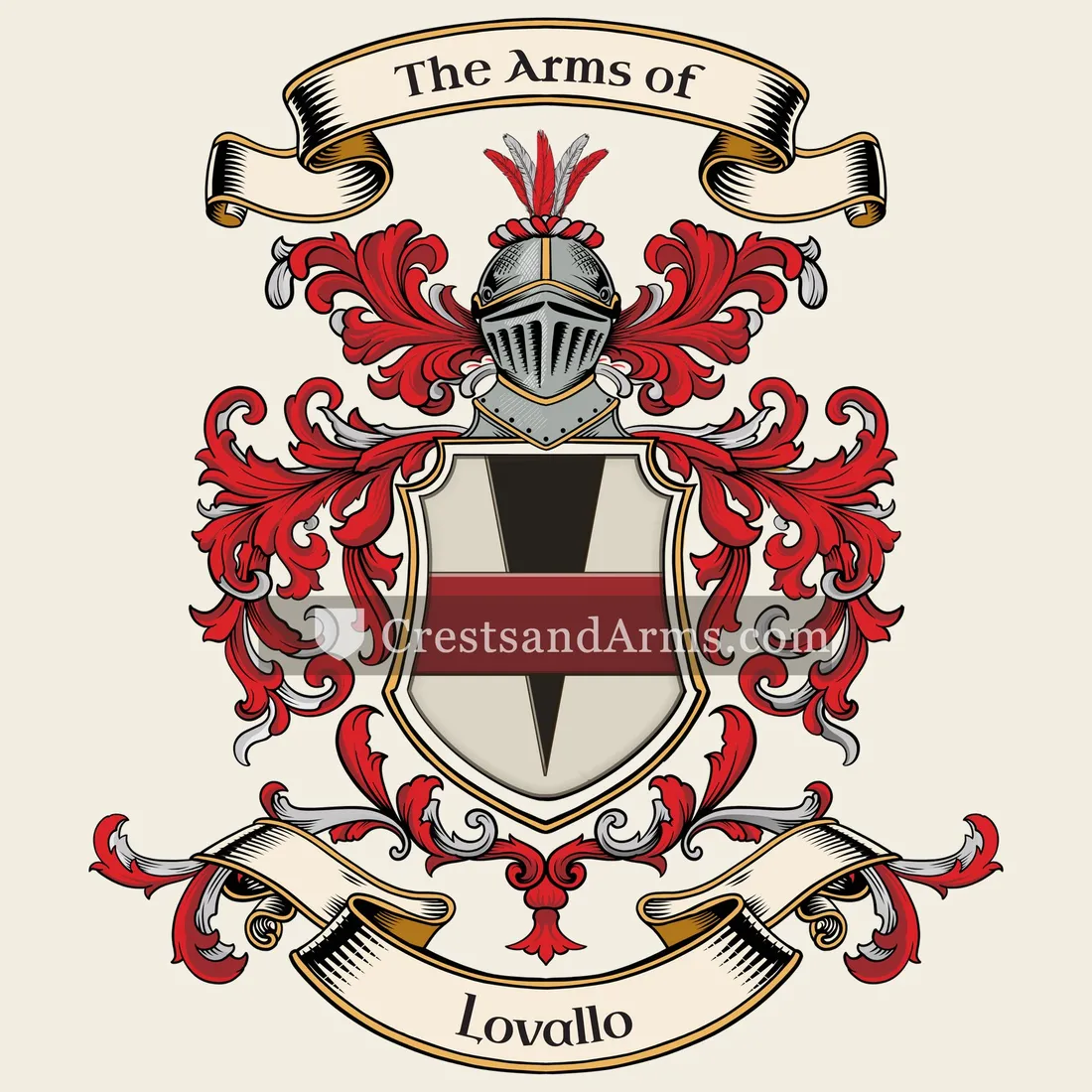
pileWell-doing, and a mark of distinction
fessThe military belt, and readiness to serve
Colours
Silver (Argent)Means: Peace and sincerity
Black (Sable)Means: Constancy
Red (Gules)Means: Military strength
Historical info
Source
Sir Bernard Burke, The General Armory of England, Scotland, Ireland and Wales, London: Harrison & Sons, 1884
Blazon (the actual original written record)
“Ar. three piles sa. surmounted of a fesse wavy gu”
ForfarBallumbie · Forfar, c. 1748
Digital archive packCoat of arms PNG, gold border print PDF, vector SVG and the certificate of authenticity. Sent to your email in minutes.
Map of Scotland showing where the Lovallo arms are recorded
The Lovallo arms were recorded in Forfar, c. 1748.
Forfar, now called Angus, was farming country on Scotland's east coast between the hills and the sea. Its landed families were long-settled, and long settlement is exactly what fills a register of arms.
This is where the arms were entered in the register. Families often moved to other parts of the country, so the same name can turn up in more than one region.
The body that granted and recorded arms in Scotland in this period.
George II of Great Britain
Sovereign of the period
George II of Great Britain
1727–1760
Reigning in Britain when the Lovallo arms are first recorded.
How Arms Worked in Scotland
Scottish heraldry is unique because it treats a coat of arms as a piece of personal property protected by law. Only one person can own a specific design at any given time. When a family grows, the head keeps the original shield while other relatives must apply for their own distinct version with slight changes to prove their specific identity.
Granting authority
The Court of the Lord Lyon acts as the official body that regulates and controls all heraldic matters throughout Scotland.
How they got arms
Individuals obtain a legal right to their arms through a formal petition process that confirms their identity and family connection.
Where arms were recorded
All valid coats of arms are officially entered into the Public Register of All Arms and Bearings starting from 1672.
The family's standing
Recorded among the armigerous families of Forfar.
Origin & History of the Lovallo Family in Scotland
The Lovallo family name maintains a distinct presence in the historical records of Forfar, Scotland, dating back to at least 1748. During this period, Forfar served as a bustling royal burgh where families often settled to participate in the local linen and weaving trades. While the name itself suggests roots that may have traveled from continental Europe, the Lovallo line integrated into the social fabric of Angus by participating in the local parish life and community governance of the eighteenth century. These early ancestors lived through a time of significant agricultural and industrial transition in the Scottish Lowlands. By establishing themselves in Forfar, the family became part of a regional history defined by the growth of small market towns and the daily labor of the Scottish working class. Their presence in the local records provides a clear look at how families of diverse origins contributed to the long-term development of Scottish town life.
Lovallo Meaning & Related Branches
Root word
Lupus
Latin term for a wolf.
This name
LovalloA diminutive or descriptive surname likely referring to a person with wolf-like characteristics.
also spelled
Lovel
Luvell
Loveles
Loveless
Documented Sources
J. B. Rietstap, Armorial Général, Gouda: G. B. van Goor Zonen, 1884–87
Hasted, Edward, The History and Topographical Survey of the County of Kent, 1797
The National Archives, Parish registers and settlement examinations for the County of Kent, Series PC/1
Digital archive packCoat of arms PNG, gold border print PDF, vector SVG and the certificate of authenticity. Sent to your email in minutes.


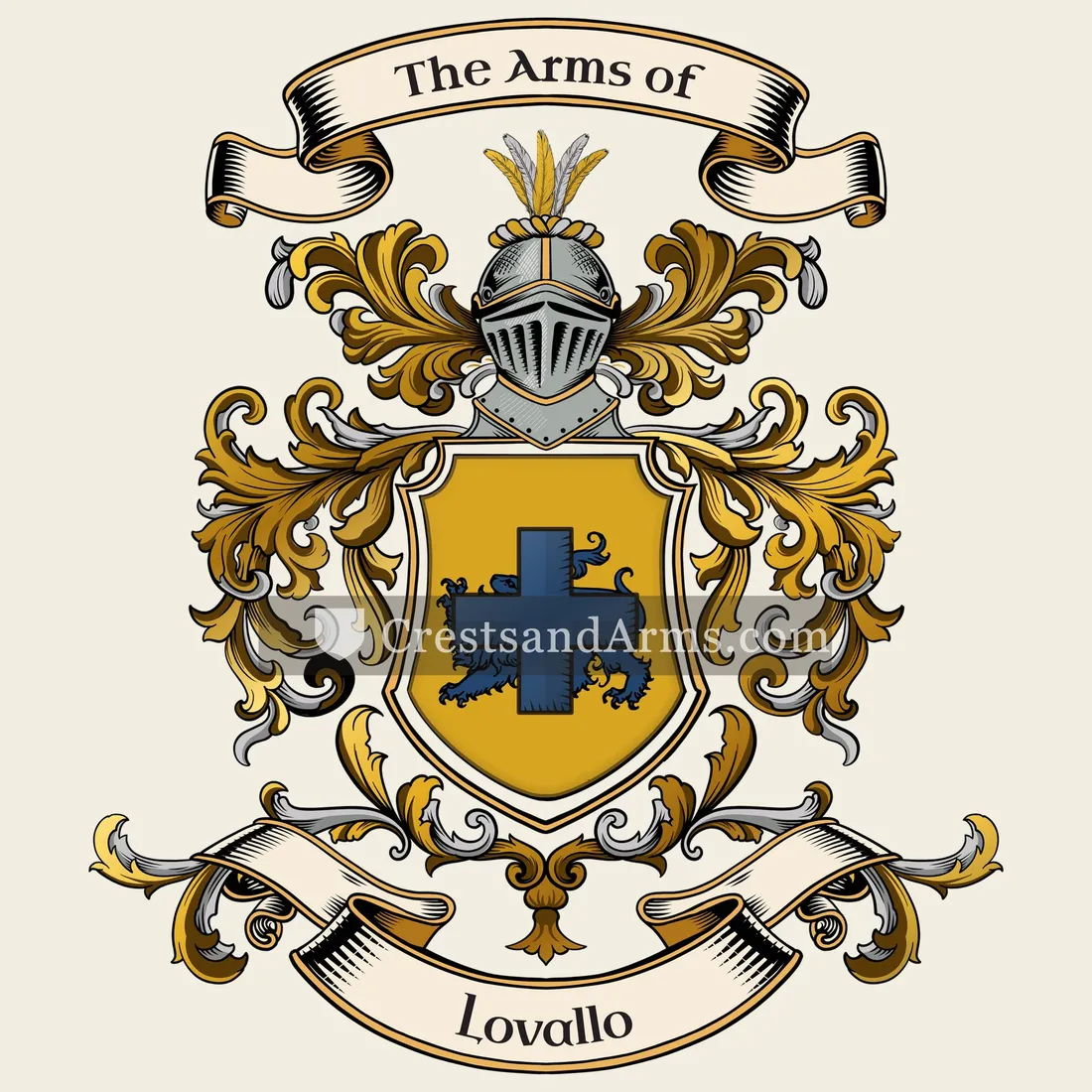
 cross symbolChristian faith and service
 lionCourage, strength and royalty
 cross symbolChristian faith and service
 lionCourage, strength and royalty


 chevronProtection, and faithful service completed
 foxWit and wisdom in defence

 pileWell-doing, and a mark of distinction
 fessThe military belt, and readiness to serve