Map of Ireland showing where the Lovett arms are recorded
The Lovett arms were recorded in Dublin, c. 1679.
Dublin was the seat of government in Ireland and the place where grants were sought and recorded. Families with business at the castle or the courts settled nearby, and settling there put their arms on record.
This is where the arms were entered in the register. Families often moved to other parts of the country, so the same name can turn up in more than one region.
The body that granted and recorded arms in Ireland in this period.
Charles II of England
Sovereign of the period
Charles II of England
1660–1685
Reigning in Ireland when the Lovett arms are first recorded.
How Arms Worked in Ireland
The Ulster King of Arms granted coats of arms to individuals who proved their social standing and good character. These symbols were typically inherited by all legitimate descendants of the original holder. If a family branch wanted a unique look, they could apply for a specific change to their design through the office to ensure their identity remained distinct.
Granting authority
The Ulster King of Arms acted as the official body that regulated and issued all coats of arms throughout Ireland.
How they got arms
Families obtained their arms through formal grants issued by the office after proving their eligibility and paying the required fees.
Where arms were recorded
All official grants were recorded in the registers held by the Ulster King of Arms starting from the year 1552.
The family's standing
Recorded among the armigerous families of Dublin.
Origin & History of the Lovett Family in Ireland
The Lovett family name has a long history in Ireland, with clear evidence of the family residing in Dublin as early as 1679. The name itself is thought to have originated from the Old French word "louvet," which translates to "little wolf." During the seventeenth century, families with this name were often integrated into the urban life of Dublin, which was a major center for trade and administration at the time. As the family established itself in the city, they became part of the growing merchant and professional classes that shaped the capital. Over the following decades, members of the Lovett family moved beyond the city walls and settled in various parts of the country, adapting to the changing social and economic landscape of Ireland. Their presence in early records suggests that they were active participants in the development of Dublin during a period of significant political transition.
Coat of Arms & Family Crest Details
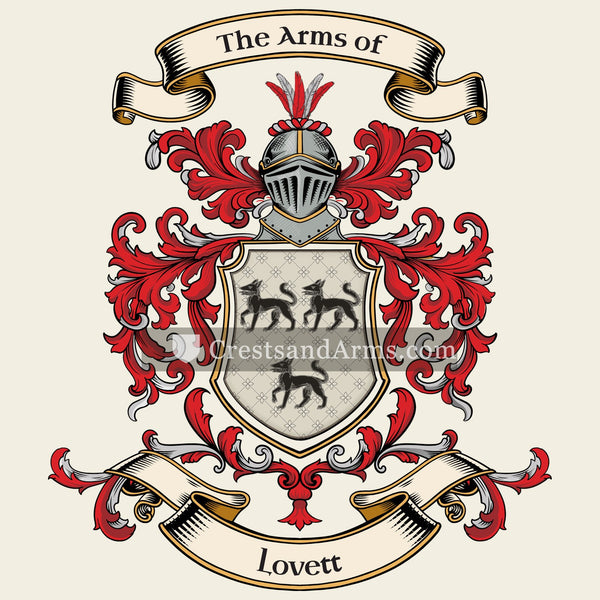
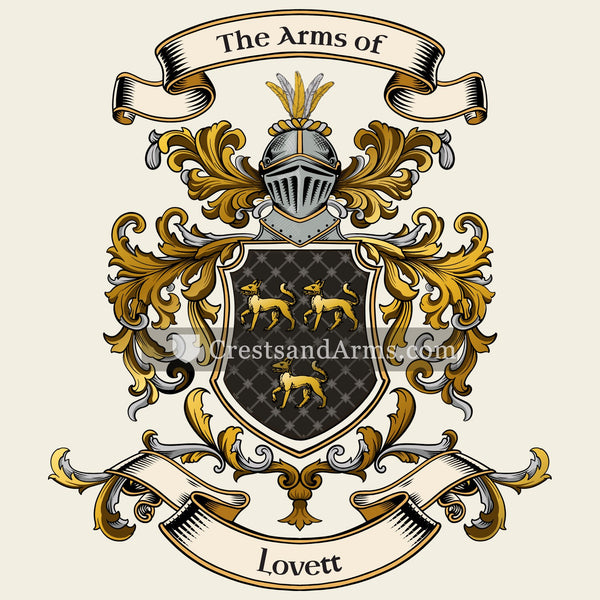
Symbols on this shield
wolfReward from long service and hard work
Colours
Black (Sable)Means: Constancy
Gold (Or)Means: Generosity
Historical info
Source
Sir Bernard Burke, The General Armory of England, Scotland, Ireland and Wales, London: Harrison & Sons, 1884
Blazon (the actual original written record)
“Sa. three wolves' heads erased or”
WorcesterElmley Lovett · Worcester, c. 1620
Digital archive packCoat of arms PNG, gold border print PDF, vector SVG and the certificate of authenticity. Sent to your email in minutes.
Map of England showing where the Lovett arms are recorded
The Lovett arms were recorded in Worcester, c. 1620.
Worcestershire was orchard and farming country with a scattering of old manors. Its gentry were middling rather than great, but a manor was a manor, and holding one was what brought arms.
This is where the arms were entered in the register. Families often moved to other parts of the country, so the same name can turn up in more than one region.
The body that granted and recorded arms in England in this period.
James VI and I
Sovereign of the period
James VI and I
1603–1625
Reigning in Ireland when the Lovett arms are first recorded.
How Arms Worked in England
English heraldry allowed arms to be shared by all legitimate descendants of the original owner. These symbols were treated as personal property that moved through the generations to all children. While the eldest son kept the original design, other family members could use the same shield without needing to change it or register their own unique versions.
Granting authority
The College of Arms in London has regulated the use of coats of arms throughout England and Wales since 1484.
How they got arms
Families typically obtained their coats of arms through a formal grant from the Crown or by proving their ancient right to them.
Where arms were recorded
All official coats of arms are recorded in the registers kept at the College of Arms, which date back to the fifteenth century.
The family's standing
Recorded among the armigerous families of Worcester.
Origin & History of the Lovett Family in England
The surname Lovett finds its roots in the medieval period of England, emerging as a descriptive nickname derived from the Old French word "louvet," which translates to "little wolf." This name likely served as a playful or character-based label for an ancestor known for their fierce or cunning nature. By the early 17th century, the family had established a notable presence in the city of Worcester. Records from this era indicate that members of the Lovett family were active participants in the local community, navigating the social and economic shifts of the Stuart period. As the family settled into the region, they became part of the fabric of English provincial life, contributing to the growth and historical narrative of the West Midlands long before the name spread further across the globe.
Lovett Meaning & Related Branches
Root word
Louve
Derived from the Old French word for wolf.
This name
LovettA nickname for a person with a wolf-like or fierce temperament.
also spelled
Luvett
Lovete
Lovitt
Related arms
Caverecorded with Lovett, same area
Leighrecorded with Lovett, same area
Prosserrecorded with Lovett, same area
Wegg-Prosserrecorded with Lovett, same area
Documented Sources
Sir Bernard Burke, The General Armory of England, Scotland, Ireland and Wales, London: Harrison & Sons, 1884
MacLysaght, Edward, The Surnames of Ireland, 1985
National Archives of Ireland, Dublin City Records, 1679
Woulfe, Patrick, Sloinnte Gaedheal is Gall: Irish Names and Surnames, 1923
Digital archive packCoat of arms PNG, gold border print PDF, vector SVG and the certificate of authenticity. Sent to your email in minutes.


 wolfReward from long service and hard work
 wolfReward from long service and hard work