Map of England showing where the Lowes arms are recorded
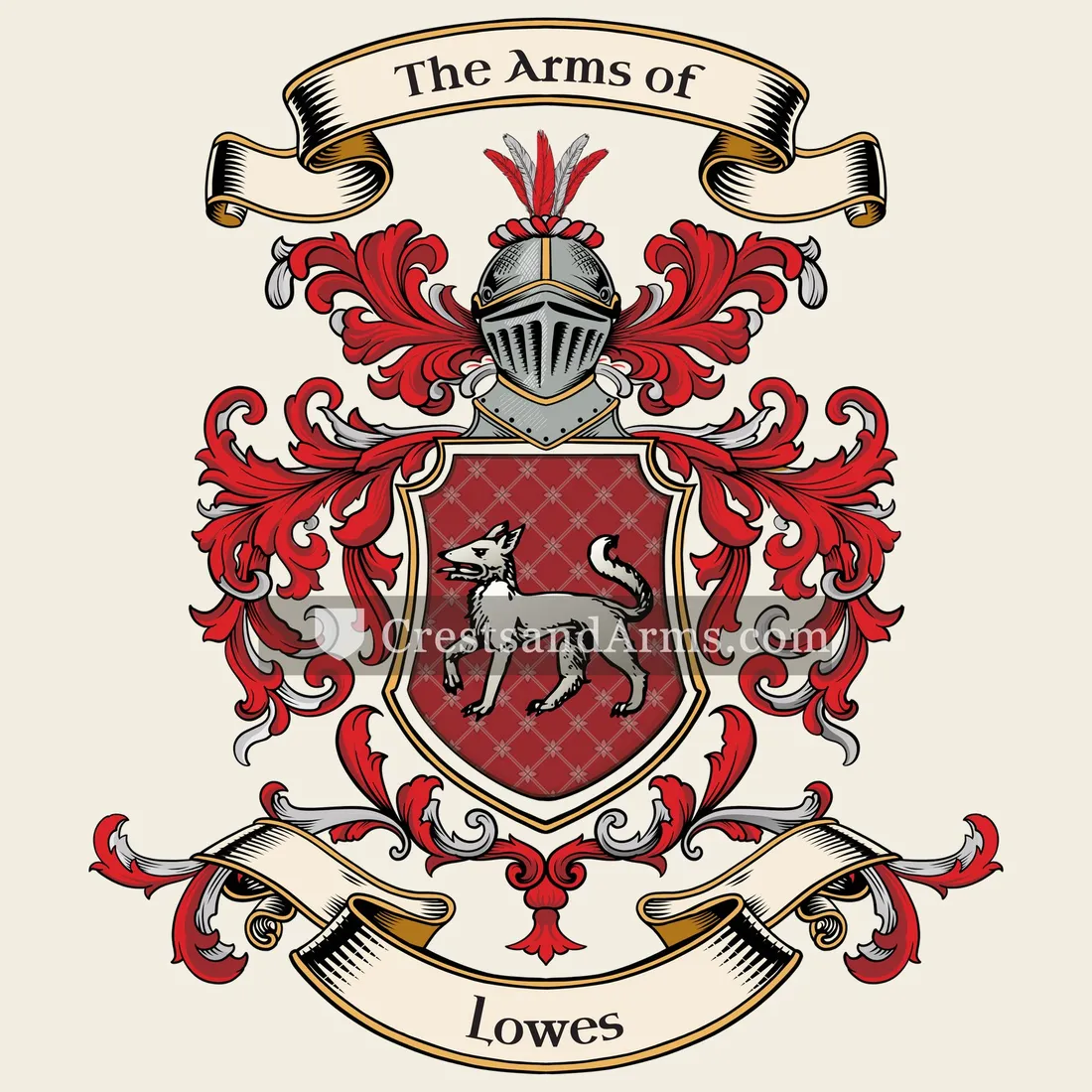
The Lowes arms were recorded in Northumberland, c. 1620.
Northumberland was border country facing Scotland, raided and fought over for three hundred years. Families held their land in return for defending it, and a defending household carried a shield.
This is where the arms were entered in the register. Families often moved to other parts of the country, so the same name can turn up in more than one region.
The body that granted and recorded arms in England in this period.
James VI and I
Sovereign of the period
James VI and I
1603–1625
Reigning in England when the Lowes arms are first recorded.
How Arms Worked in England
English heraldry allowed arms to be shared by all legitimate descendants of the original owner. These symbols were treated as personal property that moved through the generations to all children. While the eldest son kept the original design, other family members could use the same shield without needing to change it or register their own unique versions.
Granting authority
The College of Arms in London has regulated the use of coats of arms throughout England and Wales since 1484.
How they got arms
Families typically obtained their coats of arms through a formal grant from the Crown or by proving their ancient right to them.
Where arms were recorded
All official coats of arms are recorded in the registers kept at the College of Arms, which date back to the fifteenth century.
The family's standing
Recorded among the armigerous families of Northumberland.
Origin & History of the Lowes Family in England
The surname Lowes finds its deep historical roots in the rugged borderlands of Northern England, particularly within the county of Northumberland. By the early 17th century, the family was well-established in this region, where they lived amidst a landscape defined by rolling hills and a long history of cross-border conflict. The name itself is thought to be topographical, likely derived from the Old Norse word "hlaw," which refers to a hill, mound, or burial tumulus. Families living near these prominent landmarks were often identified by their proximity to them, eventually adopting the name as a permanent family identifier. By 1620, the Lowes family was deeply integrated into the local community, serving as landowners and farmers who navigated the challenging social and political climate of the Anglo-Scottish border. Their presence in the region during this era reflects a long-standing connection to the northern English countryside that predates the formal record-keeping of the Stuart period.
Lowes Meaning & Related Branches
Root word
Hlud
A Germanic element meaning loud, famous, or renowned.
This name
LowesA patronymic surname derived from the personal name Low, meaning son of the famous one.
also spelled
Lowis
Lowse
Lows
Related arms
Lowisvariant spelling
Documented Sources
Sir Bernard Burke, The General Armory of England, Scotland, Ireland and Wales, London: Harrison & Sons, 1884
Reaney, P.H. and Wilson, R.M., A Dictionary of English Surnames, 1991


 wolfReward from long service and hard work
 wolfReward from long service and hard work