Map of France showing where the Lucas arms are recorded
The Lucas arms were recorded in Flandre, c. 1663.
Flandre grew rich on cloth, and its towns were among the busiest in Europe. Merchant families bought land with their profits and took arms to go with it, so trade put as many names in the registers here as land did.
This is where the arms were entered in the register. Families often moved to other parts of the country, so the same name can turn up in more than one region.
The body that granted and recorded arms in France in this period.
Louis XIV of France
Sovereign of the period
Louis XIV of France
1643–1715
Reigning in France when the Lucas arms are first recorded.
How Arms Worked in France
In France, a coat of arms was a mark of honor that passed down through the male line to all legitimate descendants. Families often used the same shield without changes to show their shared heritage. If a branch wanted to stand out, they could add a small mark to their shield to show their specific place in the family tree.
Granting authority
The Juge d'armes de France acted as the official authority that regulated and verified coats of arms across the country.
How they got arms
Families typically inherited their arms from ancestors, though they could also receive them through royal grants or by proving their noble status.
Where arms were recorded
Coats of arms were officially recorded in the Armorial Général de France, which began its main collection in the year 1696.
The family's standing
Recorded among the armigerous families of Flandre.
Origin & History of the Lucas Family in France
The name Lucas is a classic example of a patronymic surname, which means it was derived from the given name of a male ancestor. In France, the name traces its roots back to the Latin name Lucas, which itself is a shortened form of Lucanus, meaning a person from Lucania in southern Italy. By the time the name became established in the northern region of Flandre during the mid-seventeenth century, it had already spread across many parts of Europe due to the popularity of Saint Luke the Evangelist. Families bearing this name in the French-speaking territories of Flandre were often part of the hardworking merchant or artisan classes. Records from 1663 confirm that these individuals were well-integrated into the local social fabric of the region. Their presence in this area reflects a period of significant movement and growth for families who were settling into permanent communities during the reign of King Louis XIV.
Coat of Arms & Family Crest Details
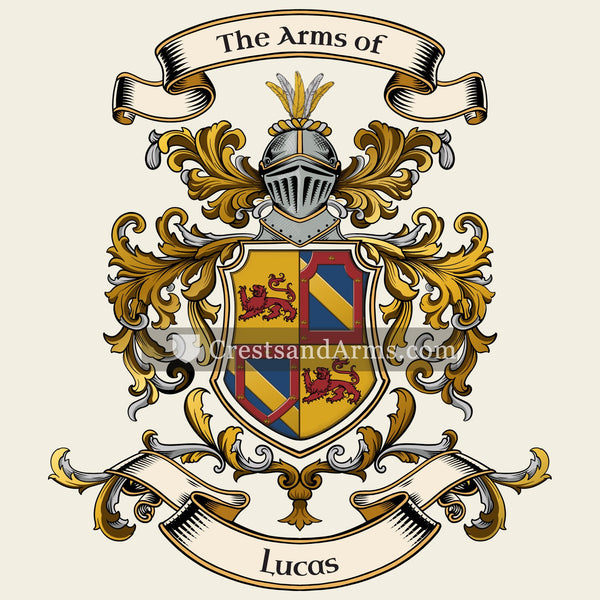
Symbols on this shield
bendDefence, and the scarf of a commander
lionCourage, strength and royalty
Colours
Gold (Or)Means: Generosity
Blue (Azure)Means: Loyalty and truth
Red (Gules)Means: Military strength
Historical info
Source
J. B. Rietstap, Armorial Général, Gouda: G. B. van Goor Zonen, 1884–87
Blazon (the actual original written record)
“Ec.: aux 1 et 4 d'or au lion de gu.; aux 2 et 3 d'azur à la bande d'or et à la bord. de gu., ch. de six lions d'or, 3 à chaque flanc, l'un sur l'autre.”
AndalusiaAndalusia, c. 1455
Digital archive packCoat of arms PNG, gold border print PDF, vector SVG and the certificate of authenticity. Sent to your email in minutes.
Map of Spain showing where the Lucas arms are recorded
The Lucas arms were recorded in Andalusia, c. 1455.
Andalusia was the last part of Spain taken back from the Moors, and the land was shared out among the men who took it. A grant of land came with a grant of arms, so the region produced a great many.
This is where the arms were entered in the register. Families often moved to other parts of the country, so the same name can turn up in more than one region.
The body that granted and recorded arms in Spain in this period.
Alfonso V of Aragon
Sovereign of the period
Alfonso V of Aragon
1416–1458
Reigning in France when the Lucas arms are first recorded.
How Arms Worked in Spain
In Spain, a coat of arms was considered a form of property that belonged to the entire family line. These arms were passed down from a father to all his children equally. Younger branches of the family usually kept the original design without needing to add any special marks to distinguish their specific line.
Granting authority
The Cronista Rey de Armas was the official body that regulated and granted coats of arms throughout Spain.
How they got arms
Families often obtained their arms through royal grants or by proving their noble status to the official heraldic authority.
Where arms were recorded
Coats of arms were officially recorded in the registers of the Cronista Rey de Armas starting in 1496.
The family's standing
Recorded among the armigerous families of Andalusia.
Origin & History of the Lucas Family in Spain
The surname Lucas finds its roots in the Latin name Lucas, which is derived from the Greek word for light. By the middle of the fifteenth century, the family had established a notable presence in the region of Andalusia. During this era, southern Spain was a dynamic frontier where families often held roles in local administration, trade, or the military as the region transitioned under the influence of the Reconquista. Members of the Lucas family living in Andalusia in 1455 were likely part of the growing urban middle class that helped rebuild the social and economic structures of cities like Seville and Córdoba. As the family spread across the Iberian Peninsula, they integrated into the local culture, eventually becoming a recognized part of the regional population. Their history reflects the broader movement of families who settled in newly stabilized territories to build new lives during a transformative period in Spanish history.
Coat of Arms & Family Crest Details
Symbols on this shield
fessThe military belt, and readiness to serve
ringFidelity, and a promise kept
Colours
Silver (Argent)Means: Peace and sincerity
Black (Sable)Means: Constancy
Historical info
Source
Sir Bernard Burke, The General Armory of England, Scotland, Ireland and Wales, London: Harrison & Sons, 1884
Blazon (the actual original written record)
“Ar. a fess betw. six annulets sa”
Englandc. 1563
Digital archive packCoat of arms PNG, gold border print PDF, vector SVG and the certificate of authenticity. Sent to your email in minutes.
Map of England showing where the Lucas arms are recorded
The Lucas arms were recorded in England, c. 1563.
Arms such as these were typically recorded in York.
Yorkshire is the largest of the English counties, and it held more gentry families than any other. Land there was split among a great many households rather than a few, so a great many of them carried arms.
This is where the arms were entered in the register. Families often moved to other parts of the country, so the same name can turn up in more than one region.
The body that granted and recorded arms in England in this period.
Elizabeth I of England
Sovereign of the period
Elizabeth I of England
1558–1603
Reigning in France when the Lucas arms are first recorded.
How Arms Worked in England
English heraldry allowed arms to be shared by all legitimate descendants of the original owner. These symbols were treated as personal property that moved through the generations to all children. While the eldest son kept the original design, other family members could use the same shield without needing to change it or register their own unique versions.
Granting authority
The College of Arms in London has regulated the use of coats of arms throughout England and Wales since 1484.
How they got arms
Families typically obtained their coats of arms through a formal grant from the Crown or by proving their ancient right to them.
Where arms were recorded
All official coats of arms are recorded in the registers kept at the College of Arms, which date back to the fifteenth century.
The family's standing
Recorded among the armigerous families of England.
Origin & History of the Lucas Family in England
The surname Lucas originates from the Latin name Lucas, which means "bringer of light." It became popular across medieval Europe because of Saint Luke the Evangelist. In England, the name spread as a common personal name before evolving into a hereditary surname during the late Middle Ages. By the time records appear in York in 1563, the family was already well-established within the social fabric of northern England. At this point in history, families like the Lucas line were often involved in local trade, agriculture, or the growing administrative life of cathedral cities. Their presence in York suggests they were part of the steady migration of families who moved into urban centers to participate in the expanding markets of the Elizabethan era. This transition from a simple given name to a permanent family identifier reflects the broader changes in English society as people sought to distinguish their lineages in an increasingly documented world.
Lucas Meaning & Related Branches
Root word
Lux
Latin word meaning light or illumination.
This name
LucasDerived from the Latin name Lucanus, signifying a person who comes from Lucania.
also spelled
Lucass
Lucaz
Lucat
Lukas
Lukis
Related arms
Ferguson-Davie de Creedysimilar arms
Lukisvariant spelling
Brunelrecorded with Lucas, same area
Atkinsonrecorded with Lucas, same area
Documented Sources
J. B. Rietstap, Armorial Général, Gouda: G. B. van Goor Zonen, 1884–87
Dauzat, Albert, Dictionnaire étymologique des noms et prénoms de France, 1951
Morlet, Marie-Thérèse, Dictionnaire étymologique des noms de famille, 1991
Archives départementales du Nord, Série B: Cours et juridictions, 1663
Digital archive packCoat of arms PNG, gold border print PDF, vector SVG and the certificate of authenticity. Sent to your email in minutes.


 fessThe military belt, and readiness to serve
 mulletThe third son, and a divine quality from above
 fessThe military belt, and readiness to serve
 mulletThe third son, and a divine quality from above


 bendDefence, and the scarf of a commander
 lionCourage, strength and royalty


 ringFidelity, and a promise kept


