Map of France showing where the Lucash arms are recorded
The Lucash arms were recorded in Flandre, c. 1663.
Flandre grew rich on cloth, and its towns were among the busiest in Europe. Merchant families bought land with their profits and took arms to go with it, so trade put as many names in the registers here as land did.
This is where the arms were entered in the register. Families often moved to other parts of the country, so the same name can turn up in more than one region.
The body that granted and recorded arms in France in this period.
Louis XIV of France
Sovereign of the period
Louis XIV of France
1643–1715
Reigning in France when the Lucash arms are first recorded.
How Arms Worked in France
In France, a coat of arms was a mark of honor that passed down through the male line to all legitimate descendants. Families often used the same shield without changes to show their shared heritage. If a branch wanted to stand out, they could add a small mark to their shield to show their specific place in the family tree.
Granting authority
The Juge d'armes de France acted as the official authority that regulated and verified coats of arms across the country.
How they got arms
Families typically inherited their arms from ancestors, though they could also receive them through royal grants or by proving their noble status.
Where arms were recorded
Coats of arms were officially recorded in the Armorial Général de France, which began its main collection in the year 1696.
The family's standing
Recorded among the armigerous families of Flandre.
Origin & History of the Lucash Family in France
The family name Lucash, often appearing in historical records as Lucas or Lucasse, traces its roots in the northern regions of France to the complex cultural landscape of the seventeenth century. By 1663, the family was well-established in the province of Flandre, a territory that frequently shifted between French and Spanish control during this era. Because this region served as a crossroads for trade and migration, the family likely lived in a society defined by a mixture of French and Flemish influences. Families in this area often worked in agriculture or local crafts, contributing to the vibrant economy of the borderlands. As the French monarchy expanded its influence over Flandre during the reign of Louis XIV, the Lucash family became part of a population navigating new administrative laws and shifting borders. Their presence in the region during the mid-1600s highlights the resilience of families who maintained their identity while living in a territory undergoing significant political and social change.
Meaning of the Lucash family crest colors & symbols
Symbols on this shield
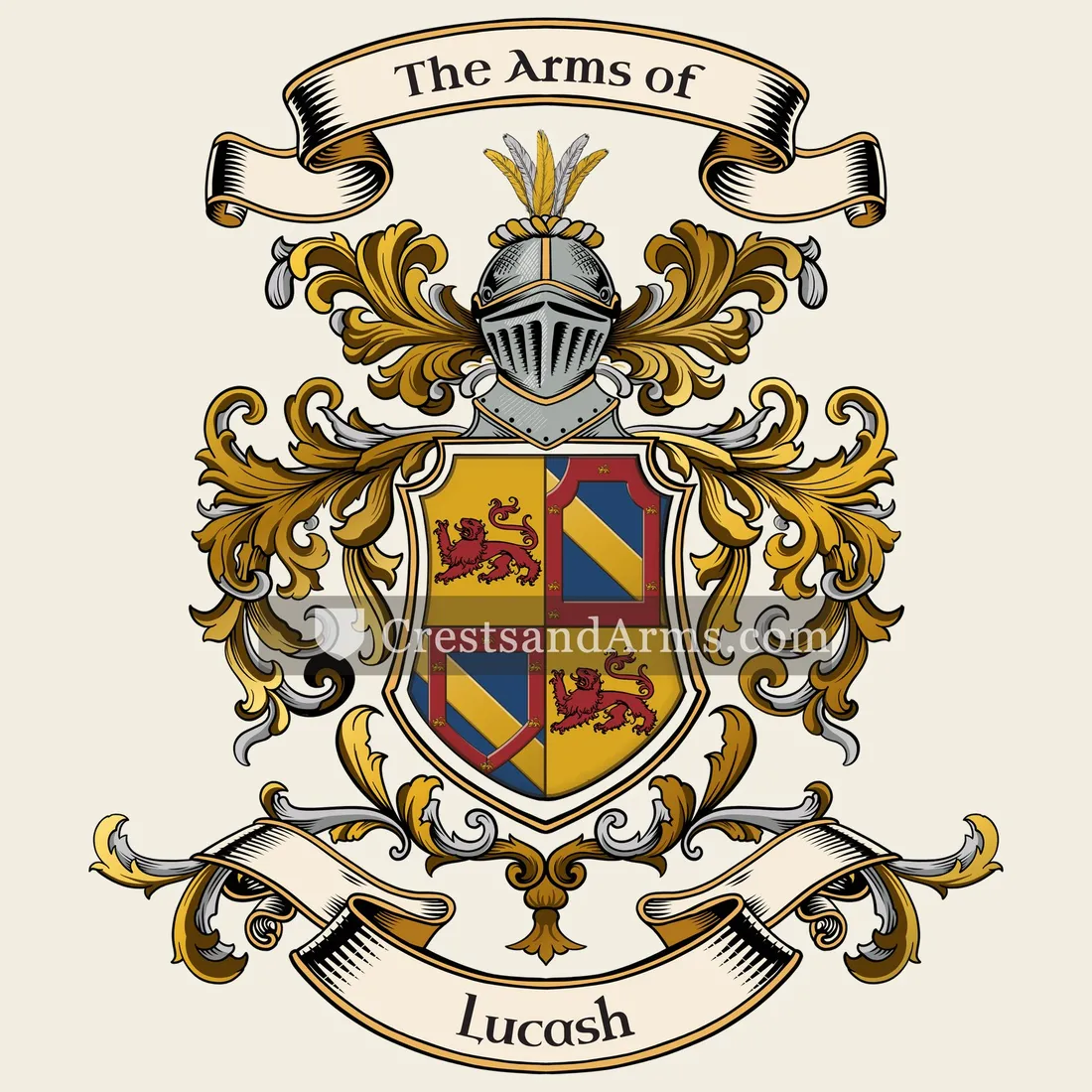
bendDefence, and the scarf of a commander
lionCourage, strength and royalty
Colours
Gold (Or)Means: Generosity
Blue (Azure)Means: Loyalty and truth
Red (Gules)Means: Military strength
Historical info
Source
J. B. Rietstap, Armorial Général, Gouda: G. B. van Goor Zonen, 1884–87
Blazon (the actual original written record)
“Ec.: aux 1 et 4 d'or au lion de gu.; aux 2 et 3 d'azur à la bande d'or et à la bord. de gu., ch. de six lions d'or, 3 à chaque flanc, l'un sur l'autre.”
AndalusiaAndalusia, c. 1455
Digital archive packCoat of arms PNG, gold border print PDF, vector SVG and the certificate of authenticity. Sent to your email in minutes.
Map of Spain showing where the Lucash arms are recorded
The Lucash arms were recorded in Andalusia, c. 1455.
Andalusia was the last part of Spain taken back from the Moors, and the land was shared out among the men who took it. A grant of land came with a grant of arms, so the region produced a great many.
This is where the arms were entered in the register. Families often moved to other parts of the country, so the same name can turn up in more than one region.
The body that granted and recorded arms in Spain in this period.
Alfonso V of Aragon
Sovereign of the period
Alfonso V of Aragon
1416–1458
Reigning in France when the Lucash arms are first recorded.
How Arms Worked in Spain
In Spain, a coat of arms was considered a form of property that belonged to the entire family line. These arms were passed down from a father to all his children equally. Younger branches of the family usually kept the original design without needing to add any special marks to distinguish their specific line.
Granting authority
The Cronista Rey de Armas was the official body that regulated and granted coats of arms throughout Spain.
How they got arms
Families often obtained their arms through royal grants or by proving their noble status to the official heraldic authority.
Where arms were recorded
Coats of arms were officially recorded in the registers of the Cronista Rey de Armas starting in 1496.
The family's standing
Recorded among the armigerous families of Andalusia.
Origin & History of the Lucash Family in Spain
The history of the Lucash family in Spain begins in the southern region of Andalusia during the mid-fifteenth century. By 1455, records indicate that members of the family were already established within this vibrant area, which served as a major cultural crossroads between Christian, Muslim, and Jewish communities. During this period, Andalusia was a place of significant social change and economic activity, particularly in cities like Seville and Granada. Families living in this region often adapted their names to reflect local linguistic shifts or their specific roles within the community. The Lucash name likely evolved from these regional interactions, as families navigated the complex legal and social structures of the late Reconquista era. Living in Andalusia at this time meant that the family was part of a society undergoing rapid transformation, which influenced how they identified themselves and recorded their presence in official documents.
Meaning of the Lucash family crest colors & symbols
Symbols on this shield
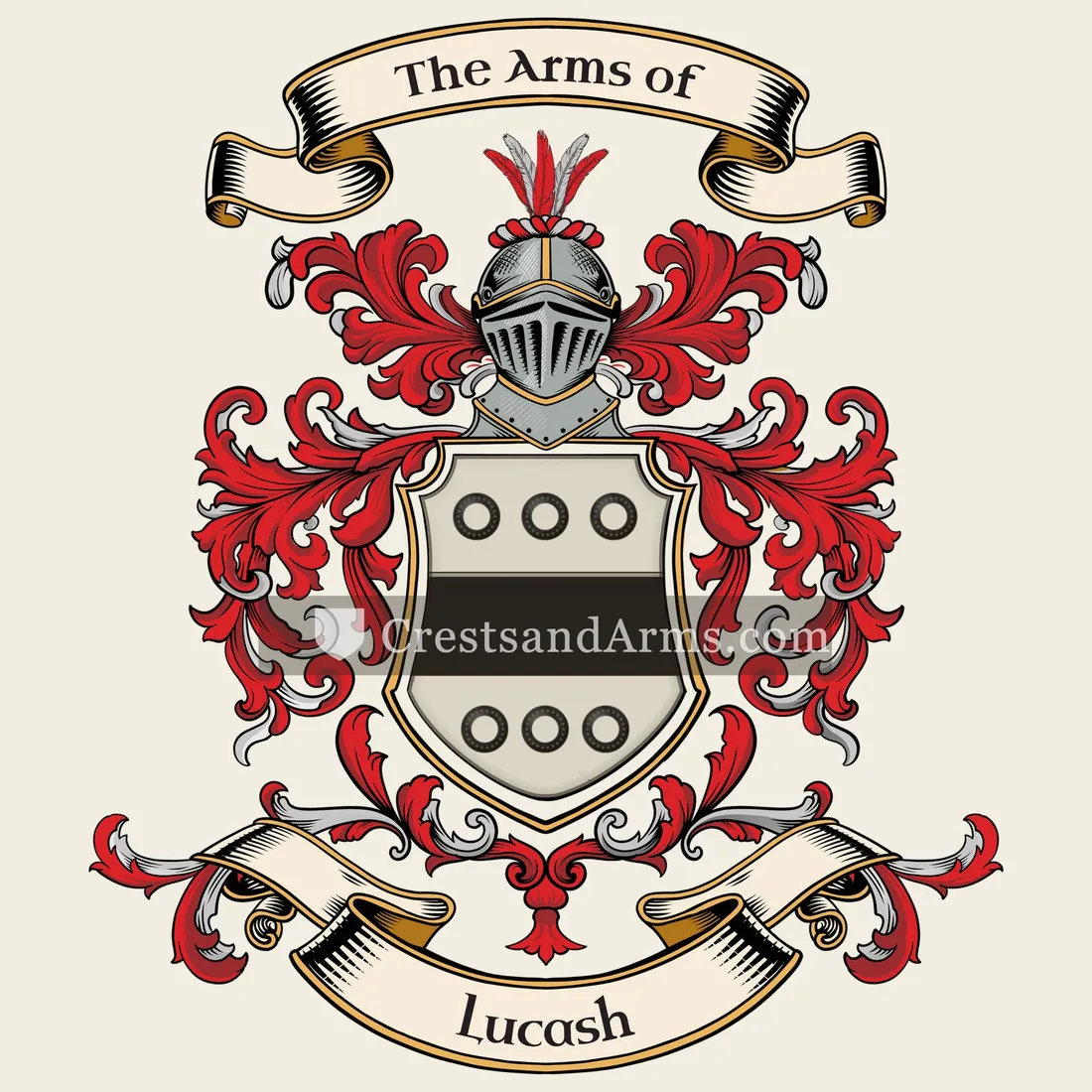
fessThe military belt, and readiness to serve
ringFidelity, and a promise kept
Colours
Silver (Argent)Means: Peace and sincerity
Black (Sable)Means: Constancy
Historical info
Source
Sir Bernard Burke, The General Armory of England, Scotland, Ireland and Wales, London: Harrison & Sons, 1884
Blazon (the actual original written record)
“Ar. a fess betw. six annulets sa”
Englandc. 1563
Digital archive packCoat of arms PNG, gold border print PDF, vector SVG and the certificate of authenticity. Sent to your email in minutes.
Map of England showing where the Lucash arms are recorded
The Lucash arms were recorded in England, c. 1563.
Arms such as these were typically recorded in York.
Yorkshire is the largest of the English counties, and it held more gentry families than any other. Land there was split among a great many households rather than a few, so a great many of them carried arms.
This is where the arms were entered in the register. Families often moved to other parts of the country, so the same name can turn up in more than one region.
The body that granted and recorded arms in England in this period.
Elizabeth I of England
Sovereign of the period
Elizabeth I of England
1558–1603
Reigning in France when the Lucash arms are first recorded.
How Arms Worked in England
English heraldry allowed arms to be shared by all legitimate descendants of the original owner. These symbols were treated as personal property that moved through the generations to all children. While the eldest son kept the original design, other family members could use the same shield without needing to change it or register their own unique versions.
Granting authority
The College of Arms in London has regulated the use of coats of arms throughout England and Wales since 1484.
How they got arms
Families typically obtained their coats of arms through a formal grant from the Crown or by proving their ancient right to them.
Where arms were recorded
All official coats of arms are recorded in the registers kept at the College of Arms, which date back to the fifteenth century.
The family's standing
Recorded among the armigerous families of England.
Origin & History of the Lucash Family in England
The surname Lucash is a variant of the name Lucas, which traces its origins to the Latin name Lucas, meaning a person from Lucania. By the time the name appeared in the historical records of York in 1563, it had already been shaped by centuries of linguistic evolution across Europe. In medieval England, surnames often shifted in spelling based on how a local clerk heard the name pronounced or how a family chose to record it in parish registers. The presence of the Lucash family in York during the sixteenth century suggests they were part of a growing urban middle class in a city that served as a major center for trade and religion. Families in this region often worked as skilled craftsmen or merchants, contributing to the vibrant economic life of Northern England during the reign of Queen Elizabeth I. Over generations, the specific spelling of Lucash became a distinct identifier for this branch of the family, separating them from other groups who used more common variations like Lucas or Luck.
Lucash Meaning & Related Branches
Root word
Lucas
Derived from the Latin name Lucanus meaning from Lucania.
This name
LucashA variant of the name Luke, signifying a person who brings light or illumination.
also spelled
Lucass
Lucaz
Lucat
Lukas
Lukis
Documented Sources
J. B. Rietstap, Armorial Général, Gouda: G. B. van Goor Zonen, 1884–87
Lottin, Alain, Histoire des provinces françaises du Nord, 1989
Pirenne, Henri, Histoire de Belgique, 1902
Archives départementales du Nord, Série B: Cours et juridictions
Archives nationales de France, Série G: Administration diocésaine
Digital archive packCoat of arms PNG, gold border print PDF, vector SVG and the certificate of authenticity. Sent to your email in minutes.


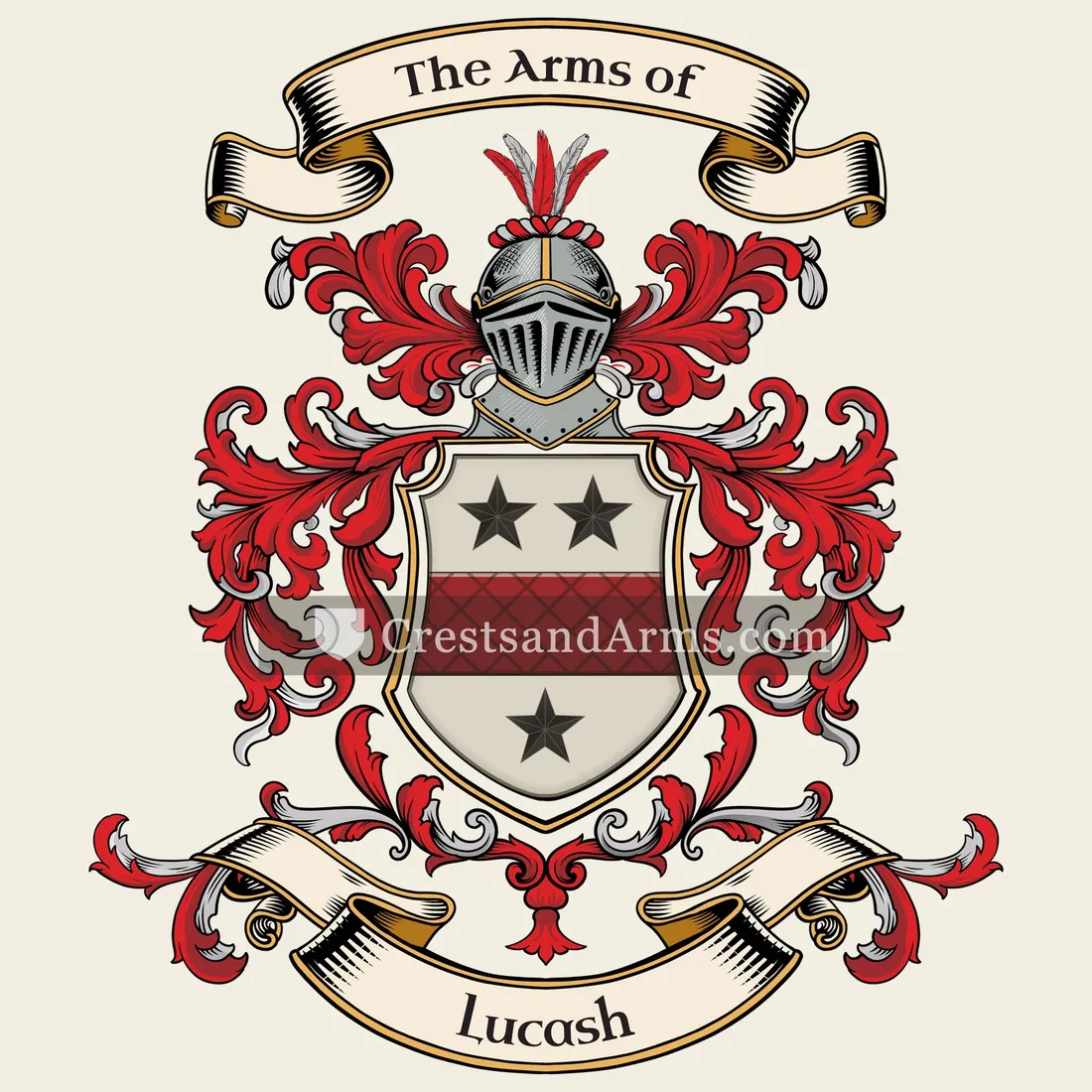
 fessThe military belt, and readiness to serve
 mulletThe third son, and a divine quality from above
 fessThe military belt, and readiness to serve
 mulletThe third son, and a divine quality from above


 bendDefence, and the scarf of a commander
 lionCourage, strength and royalty


 ringFidelity, and a promise kept