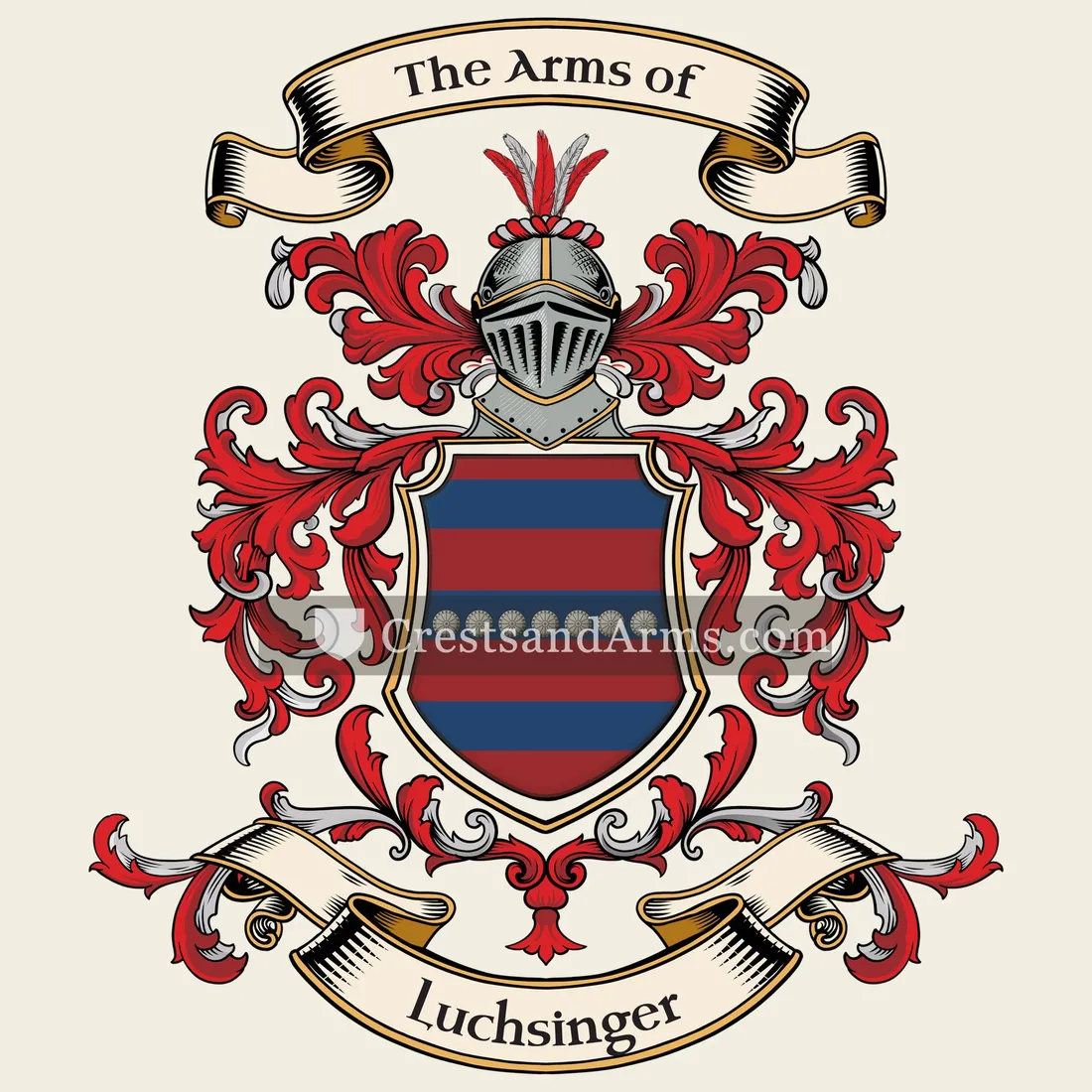
A record of documented arms, meaning and origin, researched for the Luchsinger family of Germany.
Reg. 0027 · German, J–L
Meaning of the Luchsinger family crest colors & symbols
Symbols on this shield
fessThe military belt, and readiness to serve
roundelA coin, and one who has been to the crusades
Colours
Red (Gules)Means: Military strength
Blue (Azure)Means: Loyalty and truth
Silver (Argent)Means: Peace and sincerity
Historical info
Source
J. B. Rietstap, Armorial Général, Gouda: G. B. van Goor Zonen, 1884–87
Blazon (the actual original written record)
“De gu. à trois fasces d'azur, ch. de sept bes. d'arg., 3, 3 et 1. C.: une plante de lentille, s'élevant d'un bes. d'arg., et fruitée de sept pièces au nat.; entre un vol de gu., chaque aile ch. de deux fasces d'azur, surch. de trois bes. d'arg., 2 et 1. L.: à dextre d'arg. et d'azur, à sen. d'arg. et de gu.”
SaxonySaxony, c. 1817
Digital archive packCoat of arms PNG, gold border print PDF, vector SVG and the certificate of authenticity. Sent to your email in minutes.
Map of Germany showing where the Luchsinger arms are recorded
The Luchsinger arms were recorded in Saxony, c. 1817.
Saxony had mines, trade and old landed families all at once. Silver made some fortunes and land held others, and both sorts of family kept arms, which is why Saxon names appear so often in the registers.
This is where the arms were entered in the register. Families often moved to other parts of the country, so the same name can turn up in more than one region.
The body that granted and recorded arms in Germany in this period.
Frederick William III of Prussia
Sovereign of the period
Frederick William III of Prussia
1797–1840
Reigning in Germany when the Luchsinger arms are first recorded.
How Arms Worked in Germany
Prussian heraldry was strictly tied to social rank and noble status rather than being a free choice for every citizen. These symbols were treated as permanent family property that moved through the generations to all legitimate heirs. If a family branch wanted to change their design to stand out, they had to apply for official permission to alter their specific version of the shield.
Granting authority
The Prussian Heroldsamt acted as the central state office that managed and strictly controlled all noble titles and coats of arms.
How they got arms
Families usually obtained their arms through formal royal grants or by proving their long-standing noble status to the state authorities.
Where arms were recorded
All official coats of arms were kept in the rolls of the Prussian Heroldsamt, which functioned from 1706 until 1918.
The family's standing
Recorded among the armigerous families of Saxony.
Origin & History of the Luchsinger Family in Germany
The name Luchsinger originates from the German-speaking regions of Europe, specifically emerging as a topographic surname that identifies a person from a place called Luchsingen. In the German language, the suffix "-er" typically denotes a person who hails from a specific town or village. While many branches of the family are famously associated with the Swiss canton of Glarus, historical records confirm that members of the Luchsinger family were well-established in the region of Saxony by 1817. During this era, families often moved across German-speaking territories for trade, agricultural work, or to seek new opportunities in growing industrial centers. By settling in Saxony, these early family members became part of a long tradition of migration that helped spread the name across Central Europe, linking their identity to both their ancestral roots and the evolving landscape of the nineteenth century.
Luchsinger Meaning & Related Branches
Root word
Luchs
A wild feline predator known as the lynx.
This name
LuchsingerRefers to someone who lived near a location associated with lynxes or possessed lynx-like traits.
also spelled
Lusinger
Lioosinger
Documented Sources
J. B. Rietstap, Armorial Général, Gouda: G. B. van Goor Zonen, 1884–87
Heer, Gottlieb Ingold, Glarner Geschichte in der Zeit des Umbruchs, 1948
Zopfi, Heinrich, Die Geschichte des Landes Glarus, 1852
Staatsarchiv des Kantons Glarus, Personenstandsregister der Gemeinde Luchsingen
Sächsisches Staatsarchiv, Kirchenbücher der evangelisch-lutherischen Landeskirche Sachsens
Digital archive packCoat of arms PNG, gold border print PDF, vector SVG and the certificate of authenticity. Sent to your email in minutes.


 fessThe military belt, and readiness to serve
 roundelA coin, and one who has been to the crusades
 fessThe military belt, and readiness to serve
 roundelA coin, and one who has been to the crusades