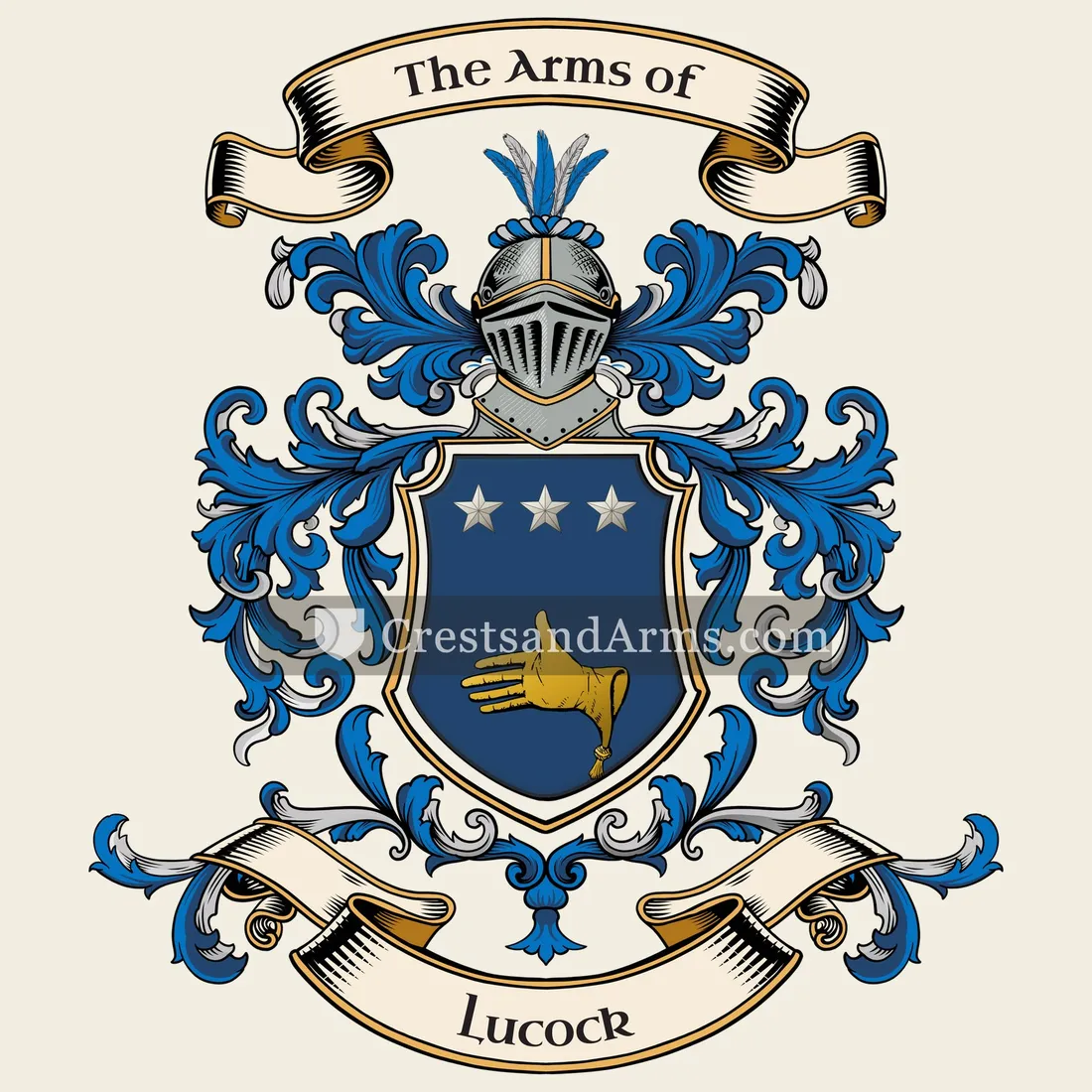
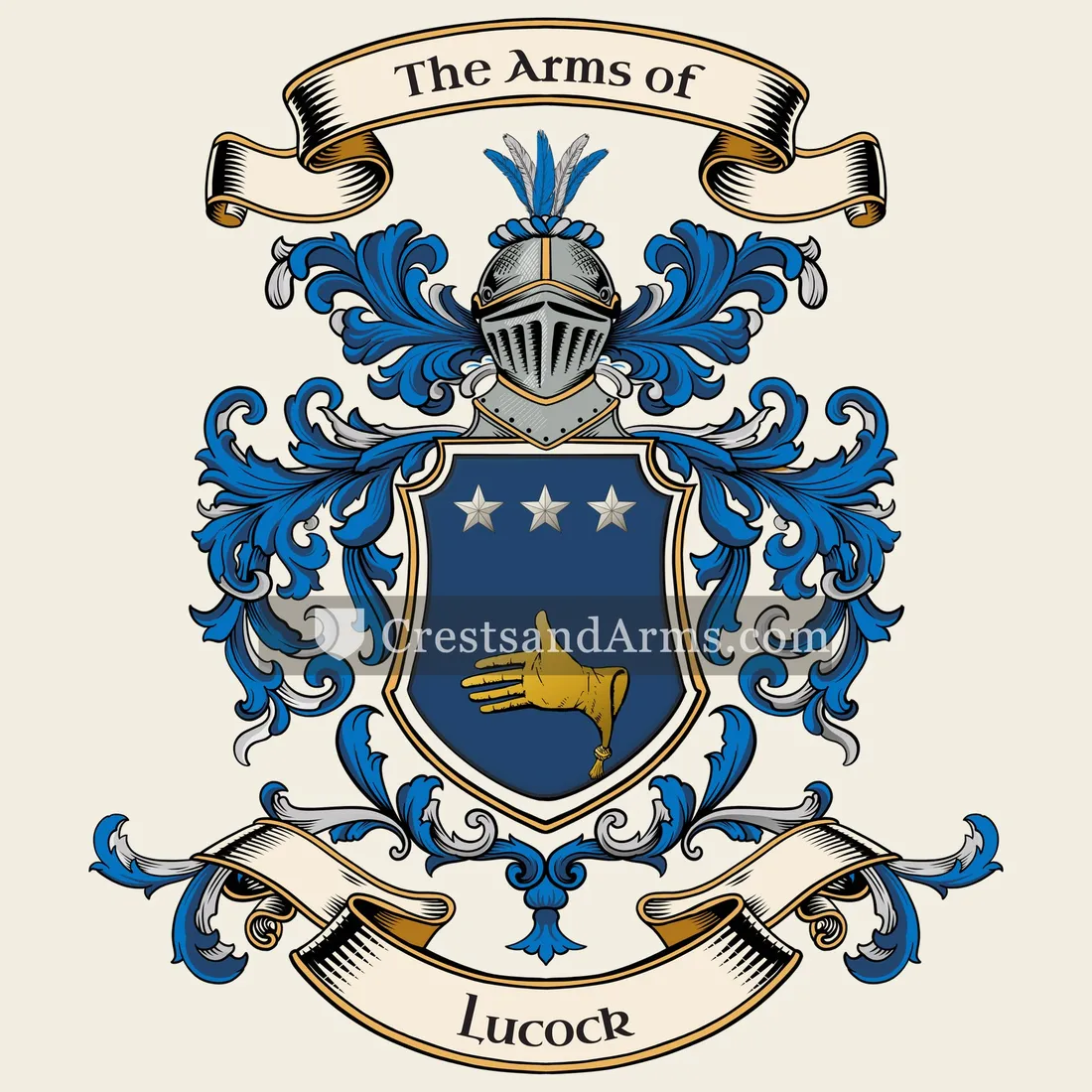
A record of documented arms, meaning and origin, researched for the Lucock family lines. Documented in 2 countries.
Reg. 1331 · Britain, J–L
Meaning of the Lucock family crest colors & symbols
Symbols on this shield
gauntletA challenge given and the readiness to meet it
mulletThe third son, and a divine quality from above
Colours
Blue (Azure)Means: Loyalty and truth
Gold (Or)Means: Generosity
Silver (Argent)Means: Peace and sincerity
Historical info
Source
J. B. Rietstap, Armorial Général, Gouda: G. B. van Goor Zonen, 1884–87
Blazon (the actual original written record)
“D'azur à un gantelet d'or, en pal, acc. de trois étoiles d'arg., rangées en chef. C.: un coq d'arg., semé de larmes de gu., la patte dextre appuyée sur un gantelet d'or, posé en bande, le tout soutenu d'une terrasse de sin. D.: VICTORIA.”
BritainLondres, c. 1857
Digital archive packCoat of arms PNG, gold border print PDF, vector SVG and the certificate of authenticity. Sent to your email in minutes.
Map of Britain showing where the Lucock arms are recorded
The Lucock arms were recorded in Londres, c. 1857.
Arms such as these were typically recorded in Kent.
Kent sits between London and the short crossing to Europe, and the trade passing through made it wealthy. Merchant families bought land with that money, and it was landowners who took coats of arms.
This is where the arms were entered in the register. Families often moved to other parts of the country, so the same name can turn up in more than one region.
The body that granted and recorded arms in Britain in this period.
Victoria
Sovereign of the period
Victoria
1837–1901
Reigning in Britain when the Lucock arms are first recorded.
How Arms Worked in Britain
English heraldry allowed arms to be shared by all legitimate descendants of the original owner. These symbols were treated as personal property that moved through the generations to all children. While the eldest son kept the original design, other family members could use the same shield without needing to change it or register their own unique versions.
Granting authority
The College of Arms in London has regulated the use of coats of arms throughout England and Wales since 1484.
How they got arms
Families typically obtained their coats of arms through a formal grant from the Crown or by proving their ancient right to them.
Where arms were recorded
All official coats of arms are recorded in the registers kept at the College of Arms, which date back to the fifteenth century.
The family's standing
Recorded among the armigerous families of Britain.
Origin & History of the Lucock Family in Britain
The surname Lucock is a topographical and patronymic name that traces its roots back to the medieval period in England. It is widely believed to be a diminutive form of the name Luke, with the suffix "cock" added to denote a younger or smaller version of the person. By the mid-19th century, the family had established a notable presence in the county of Kent. During this time, the region was undergoing significant social and industrial shifts, and families like the Lucocks were often involved in local trades or agricultural work that defined the English countryside. While the name remained relatively rare, its persistence in historical records from the 1850s suggests that the family was well-integrated into the local community life of southeastern England. These early records provide a clear snapshot of a family that contributed to the steady growth and development of the Kentish landscape during the Victorian era.
Meaning of the Lucock family crest colors & symbols
Symbols on this shield
gauntletA challenge given and the readiness to meet it
mulletThe third son, and a divine quality from above
Colours
Blue (Azure)Means: Loyalty and truth
Gold (Or)Means: Generosity
Silver (Argent)Means: Peace and sincerity
Historical info
Source
Sir Bernard Burke, The General Armory of England, Scotland, Ireland and Wales, London: Harrison & Sons, 1884
Blazon (the actual original written record)
“Az. a gauntlet or, in chief three mullets ar”
KentSpeldhurst · Kent, c. 1620
Digital archive packCoat of arms PNG, gold border print PDF, vector SVG and the certificate of authenticity. Sent to your email in minutes.
Map of England showing where the Lucock arms are recorded
The Lucock arms were recorded in Kent, c. 1620.
Kent sits between London and the short crossing to Europe, and the trade passing through made it wealthy. Merchant families bought land with that money, and it was landowners who took coats of arms.
This is where the arms were entered in the register. Families often moved to other parts of the country, so the same name can turn up in more than one region.
The body that granted and recorded arms in England in this period.
James VI and I
Sovereign of the period
James VI and I
1603–1625
Reigning in Britain when the Lucock arms are first recorded.
How Arms Worked in England
English heraldry allowed arms to be shared by all legitimate descendants of the original owner. These symbols were treated as personal property that moved through the generations to all children. While the eldest son kept the original design, other family members could use the same shield without needing to change it or register their own unique versions.
Granting authority
The College of Arms in London has regulated the use of coats of arms throughout England and Wales since 1484.
How they got arms
Families typically obtained their coats of arms through a formal grant from the Crown or by proving their ancient right to them.
Where arms were recorded
All official coats of arms are recorded in the registers kept at the College of Arms, which date back to the fifteenth century.
The family's standing
Recorded among the armigerous families of Kent.
Origin & History of the Lucock Family in England
The surname Lucock is a patronymic name, meaning it originated as a way to identify a person as the son of someone named Luke. During the medieval period in England, it was common for families to adopt nicknames or variations of popular given names to distinguish themselves within a community. By the time members of the family were recorded in Kent in 1620, the name had already been established for several generations as a localized identifier. These early settlers in Kent likely worked in agriculture or local trades, which was typical for families living in the rural parishes of the seventeenth century. As the family grew, they became part of the social fabric of the region, contributing to the local economy and parish life. The movement of the family name from its origins as a simple reference to a father’s name into a formal surname reflects the broader shift in how English families organized their identities during the late Middle Ages and the early modern period.
Lucock Meaning & Related Branches
Root word
Luke
Derived from the Greek name Loukas meaning man from Lucania.
This name
LucockA diminutive form indicating son of Luke or a person from the region of Lucania.
also spelled
Lococke
Locok
Locoke
Documented Sources
J. B. Rietstap, Armorial Général, Gouda: G. B. van Goor Zonen, 1884–87
Reaney, P.H., A Dictionary of British Surnames, 1958
The National Archives, General Register Office: Births, Marriages and Deaths, 1857
Kent History and Library Centre, Parish Registers of Kent, 1857
Digital archive packCoat of arms PNG, gold border print PDF, vector SVG and the certificate of authenticity. Sent to your email in minutes.


 gauntletA challenge given and the readiness to meet it
 mulletThe third son, and a divine quality from above
 gauntletA challenge given and the readiness to meet it
 mulletThe third son, and a divine quality from above