Map of France showing where the Ludin arms are recorded
The Ludin arms were recorded in Franche-Comte, c. 1663.
Franche-Comte sat between France and the Empire and changed hands more than once. Border families held their land under arms and expected to defend it, so a shield was a practical thing rather than an ornament.
This is where the arms were entered in the register. Families often moved to other parts of the country, so the same name can turn up in more than one region.
The body that granted and recorded arms in France in this period.
Louis XIV of France
Sovereign of the period
Louis XIV of France
1643–1715
Reigning in France when the Ludin arms are first recorded.
How Arms Worked in France
In France, a coat of arms was a mark of honor that passed down through the male line to all legitimate descendants. Families often used the same shield without changes to show their shared heritage. If a branch wanted to stand out, they could add a small mark to their shield to show their specific place in the family tree.
Granting authority
The Juge d'armes de France acted as the official authority that regulated and verified coats of arms across the country.
How they got arms
Families typically inherited their arms from ancestors, though they could also receive them through royal grants or by proving their noble status.
Where arms were recorded
Coats of arms were officially recorded in the Armorial Général de France, which began its main collection in the year 1696.
The family's standing
Recorded among the armigerous families of Franche-Comte.
Origin & History of the Ludin Family in France
The history of the Ludin family in France is deeply rooted in the rugged landscape of the Franche-Comté region. By the year 1663, records confirm that members of the family were already established within this area, which was a territory defined by its complex history of shifting borders between the French Crown and the Holy Roman Empire. The name likely emerged as a localized identifier for individuals living in or near the Jura Mountains, where families often took on names that reflected their specific village or valley origins. During the seventeenth century, the people of Franche-Comté lived through significant political transitions, and the Ludin family would have been part of a resilient community that maintained its traditions despite the pressures of regional conflict. Their presence in local administrative and parish records from this period suggests they were integrated into the social fabric of the province, working as landowners or tradespeople who helped shape the identity of the eastern French frontier.
Coat of Arms & Family Crest Details
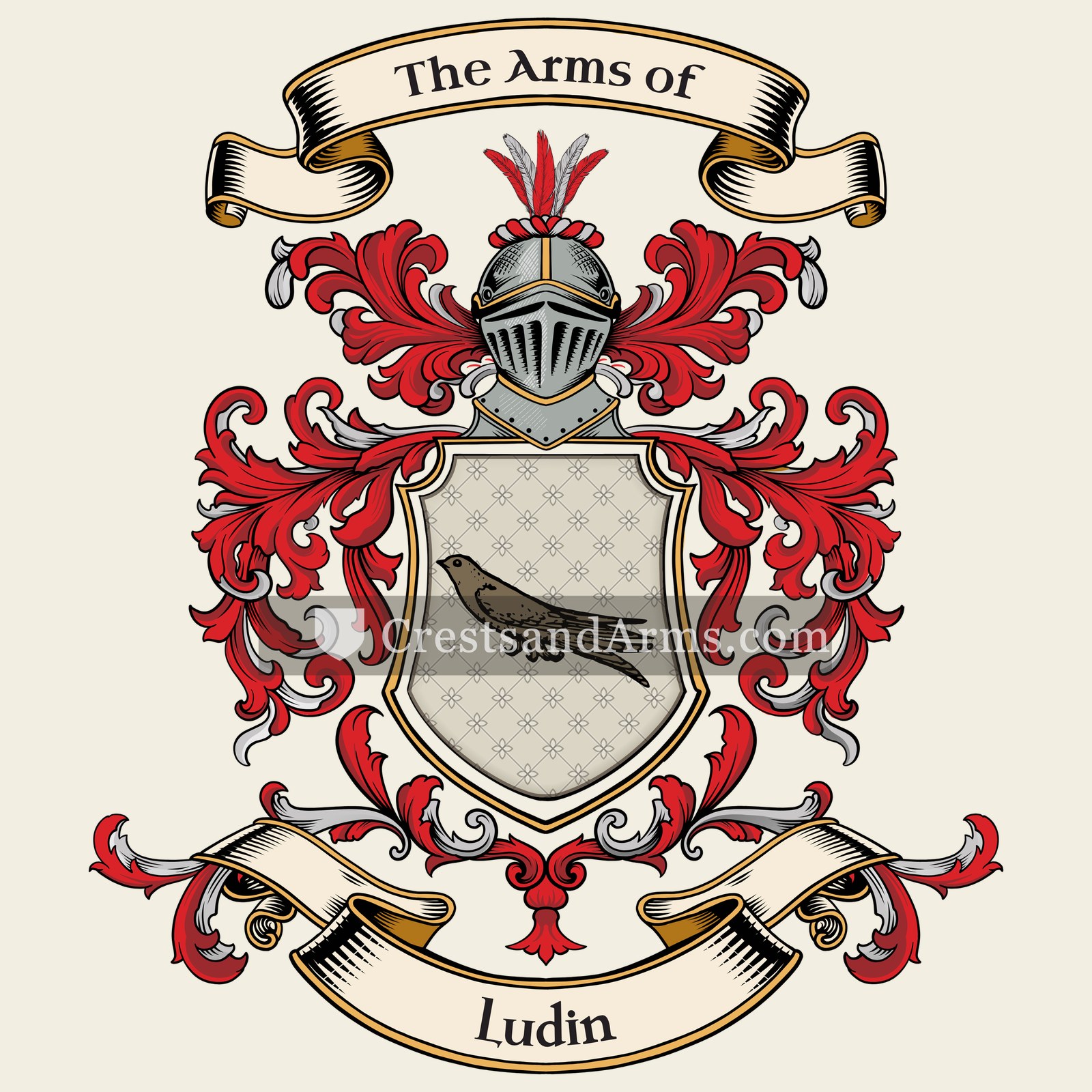
Symbols on this shield
martletA younger son, who must win his own land
Colours
Silver (Argent)Means: Peace and sincerity
Historical info
Source
J. B. Rietstap, Armorial Général, Gouda: G. B. van Goor Zonen, 1884–87
Blazon (the actual original written record)
“D'arg. à un oiseau de couleur brunâtre, posé sur un chicot au nat., en fasce, poussant à dextre et à sen. une branche feuillée de sin., celle à dextre en bande et celle à sen. en barre. C.: les meubles de l'écu (sans branches). L. d'arg. et de gu.”
SwitzerlandBâle, c. 1745
Digital archive packCoat of arms PNG, gold border print PDF, vector SVG and the certificate of authenticity. Sent to your email in minutes.
Map of Switzerland showing where the Ludin arms are recorded
The Ludin arms were recorded in Bâle, c. 1745.
This is where the arms were entered in the register. Families often moved to other parts of the country, so the same name can turn up in more than one region.
The body that granted and recorded arms in Switzerland in this period.
How Arms Worked in Switzerland
In Switzerland, coats of arms were not restricted to the nobility and were often adopted by common citizens and families. These symbols were passed down through generations to show family identity. When branches of a family grew, they often changed small details of the design to distinguish their own line from the original group.
Granting authority
Cantonal and civic authorities managed the use of coats of arms within their specific regions and local jurisdictions.
How they got arms
Families typically assumed their own coats of arms based on local custom rather than receiving them from a central monarch.
Where arms were recorded
Arms were recorded in various cantonal and civic registers starting from the fourteenth century throughout the Swiss region.
The family's standing
Recorded among the armigerous families of Switzerland.
Origin & History of the Ludin Family in Switzerland
The family name Ludin has deep roots in the Swiss city of Basel, where records confirm members of the family were well-established by 1745. During this period, Basel was a thriving center for trade and intellectual life, and the Ludin family was integrated into the local urban fabric. The name is often associated with the Alemannic linguistic region, suggesting that the family likely descended from Germanic settlers who moved into the Rhine valley centuries earlier. As citizens of Basel, members of the Ludin family participated in the city’s guild system, which was the backbone of Swiss social and economic life at the time. By the mid-18th century, the family was recognized as part of the established burgher class, meaning they held specific rights and responsibilities within the city walls. Their presence in the historical registers of Basel reflects a long tradition of civic involvement and stability in a region that served as a vital crossroads for European culture and commerce.
Related Branches & Arms
Root word
Ludovicus
Latinized form of the Germanic name meaning famous warrior.
This name
LudinA patronymic surname derived from the personal name Ludin, a diminutive of Ludovic.
also spelled
Luedin
Ludinn
Documented Sources
J. B. Rietstap, Armorial Général, Gouda: G. B. van Goor Zonen, 1884–87
Archives départementales du Doubs, Série B: Cours et juridictions
Gauthier, Jules, Histoire de la Franche-Comté, 1898
Piquard, Maurice, La Franche-Comté sous les rois de France, 1948
Digital archive packCoat of arms PNG, gold border print PDF, vector SVG and the certificate of authenticity. Sent to your email in minutes.


 fessThe military belt, and readiness to serve
 fessThe military belt, and readiness to serve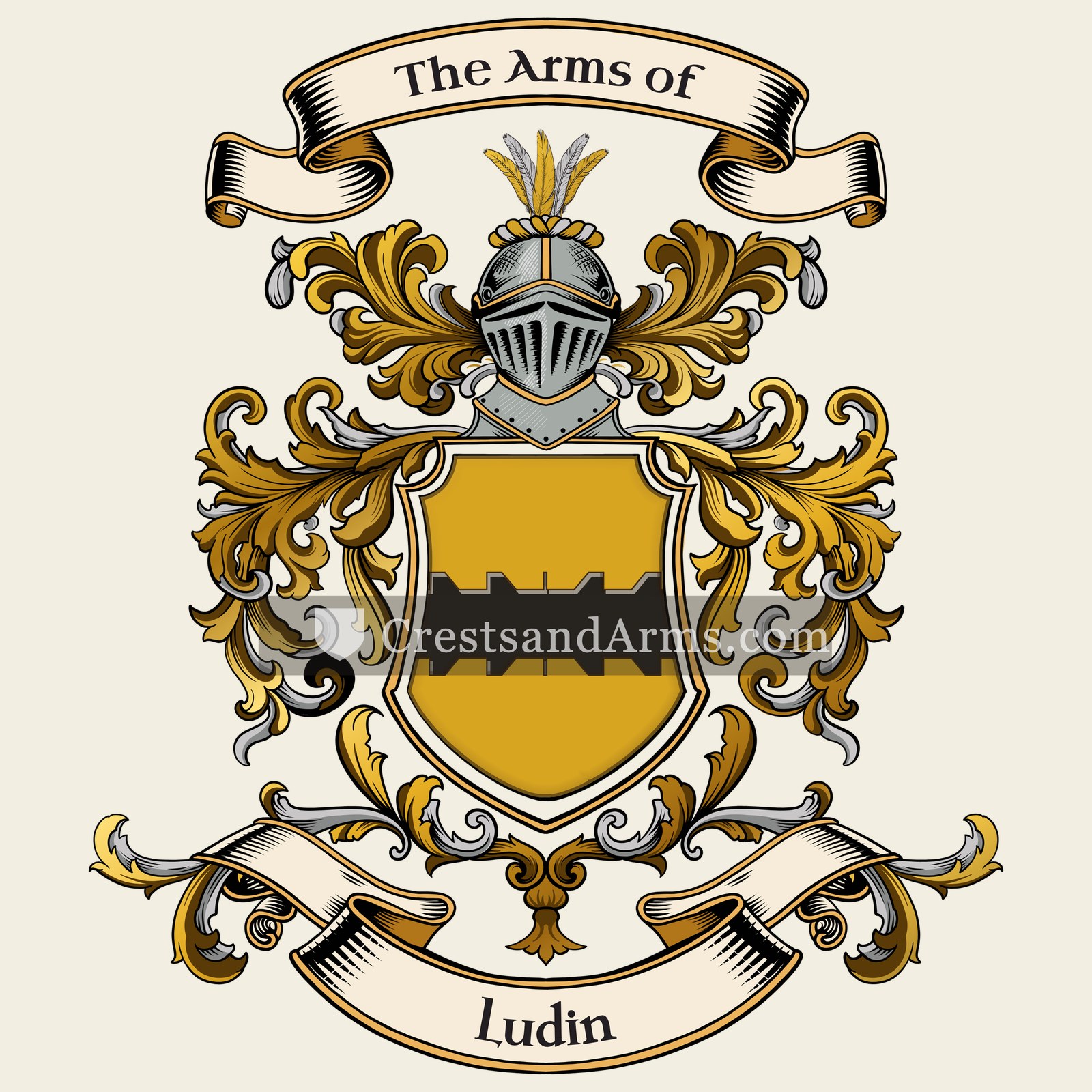


 martletA younger son, who must win his own land