Map of Germany showing where the Luedtke arms are recorded
The Luedtke arms were recorded in Brandenburg, c. 1642.
Brandenburg was sandy farming country around Berlin, held in large estates by families who served as officers. Land and military service each brought arms, and most families there had both.
This is where the arms were entered in the register. Families often moved to other parts of the country, so the same name can turn up in more than one region.
The body that granted and recorded arms in Germany in this period.
Ferdinand III, Holy Roman Emperor
Sovereign of the period
Ferdinand III, Holy Roman Emperor
1637–1657
Reigning in Germany when the Luedtke arms are first recorded.
How Arms Worked in Germany
In the Holy Roman Empire, coats of arms were often granted to individuals by the Emperor or his representatives. These arms were then passed down through the generations to all legitimate descendants of the original holder. Younger branches of a family usually kept the same shield design without needing to change it, as the arms belonged to the entire lineage.
Granting authority
The Holy Roman Emperor held the sole power to grant new coats of arms throughout his vast imperial territories.
How they got arms
Families typically obtained their coats of arms through a formal imperial grant or by proving their noble status to the authorities.
Where arms were recorded
These grants were officially recorded in the Imperial Chancery registers, which began keeping formal records of such honors during the Middle Ages.
The family's standing
Recorded among the armigerous families of Brandenburg.
Origin & History of the Luedtke Family in Germany
The surname Luedtke finds its roots in the northern regions of Germany, particularly within the historic territory of Brandenburg. The name is a diminutive form of the Germanic name Ludolf, which combines the elements for "people" and "wolf." By the time the family appears in written records in Brandenburg in 1642, the region was still recovering from the widespread devastation of the Thirty Years' War. During this era, families like the Luedtkes were often tied to the land as farmers or local tradespeople. As the population shifted and rebuilt during the mid-17th century, the name became firmly established among the rural communities of the Prussian heartland. This period of history was defined by a transition toward more structured record-keeping by local parishes, which helped solidify the spelling and transmission of the name across generations in the German countryside.
Coat of Arms & Family Crest Details
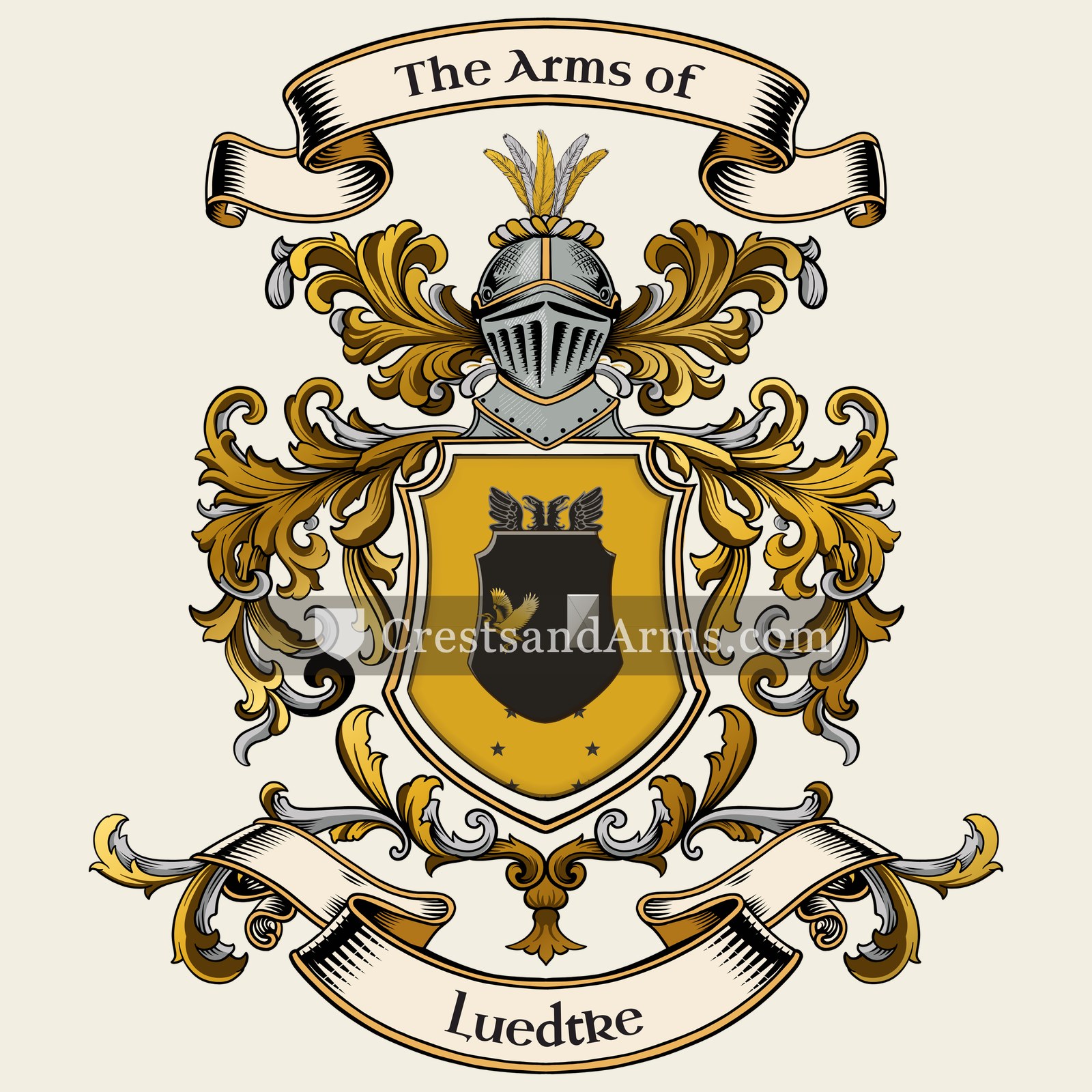
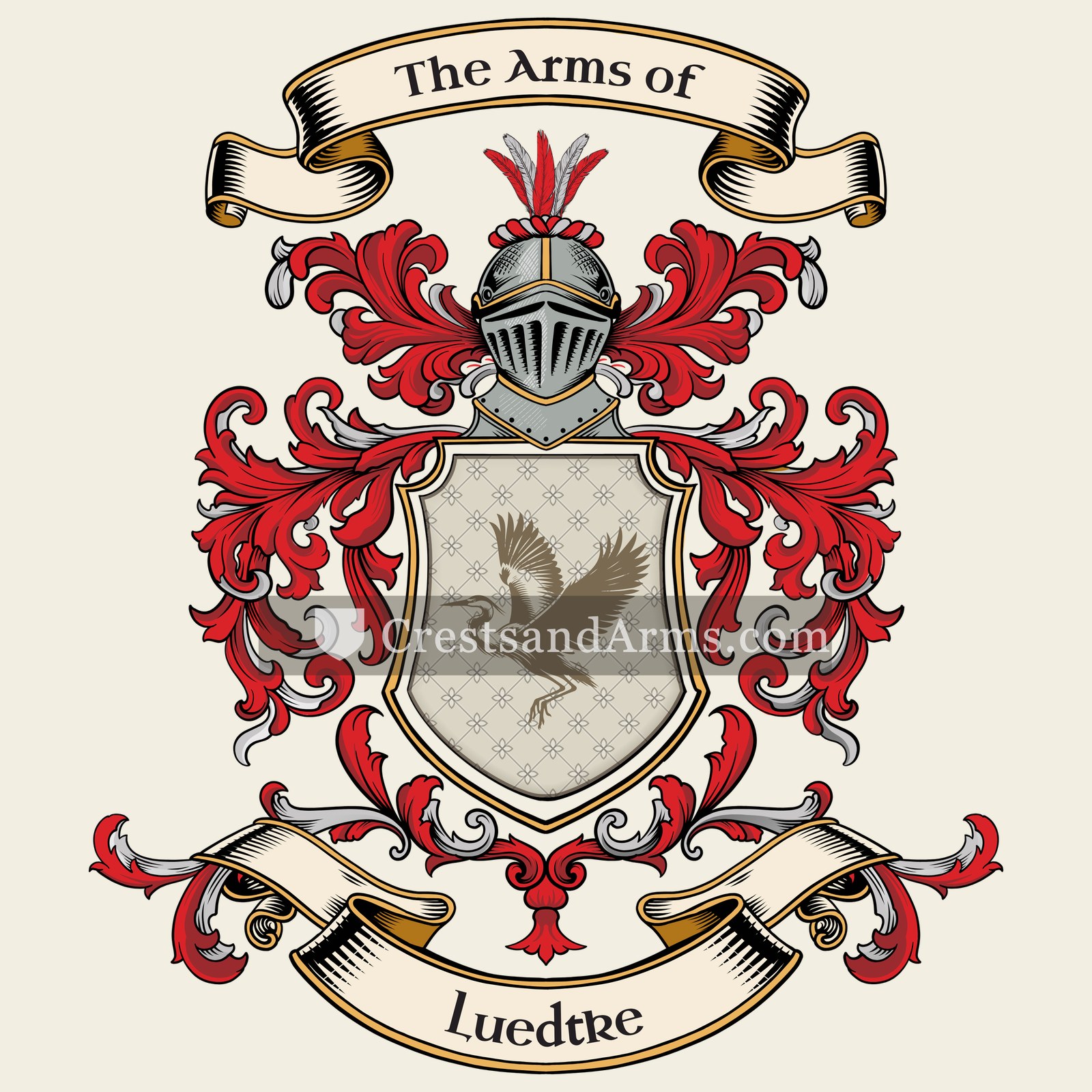
Symbols on this shield
heronPatience and quiet watchfulness
billetThe sealed letter, and a message delivered
eagleNobility, strength and a keen mind
anchorHope, and steadfastness in trouble
mulletThe third son, and a divine quality from above
Colours
Gold (Or)Means: Generosity
Black (Sable)Means: Constancy
Historical info
Source
J. B. Rietstap, Armorial Général, Gouda: G. B. van Goor Zonen, 1884–87
Blazon (the actual original written record)
“Coupé: au 1 d'or à l'aigle ép. iss. de sa., bq. d'or, languée de gu., chaque tête cour. d'or, surm. d'une couronne impériale aux rubans flottants d'azur; au 2 d'or à une ancre de sa., l'or chapé-ployé d'azur, ch. à dextre de huit étoiles d'or, 3, 3 et 2 et à sen. de deux bannières d'arg. au saut. d'azur, passées en saut., et une boule d'or, br. sur le point d'intersection des hampes. Sur le tout d'or à une grue de sa., bq. et m. de gu., tenant une vigilance au nat. Trois cq. cour. C.: 1° la grue du surtout, cont.; 2° une aigle ép. entière, pareille à l'aigle iss. du 1, portant sur son estomac un écusson de gu., bordé d'or et ch. d'un A d'or; 3° un vol, l'aile dextre d'azur semée d'étoiles d'or et ch. des bannières en saut. du 2 avec la boule br., l'aile sen. d'or ch. d'une ancre de sa. L. des 1 et 2 cq., d'or et de sa.; du 3, d'or et d'azur. T.: deux hommes d'armes, cuirassés d'arg., le haut-de-chausses d'azur rayé d'or, les bas d'azur, les souliers de sa., l'épée à la hanche, coiffés de morions d'arg., tenant chacun un drapeau d'arg. au saut. d'azur. D.: VIGILANS SERVIT.”
RussiaEsthonie, c. 1866
Digital archive packCoat of arms PNG, gold border print PDF, vector SVG and the certificate of authenticity. Sent to your email in minutes.
Map of Russia showing where the Luedtke arms are recorded
The Luedtke arms were recorded in Esthonie, c. 1866.
Arms such as these were typically recorded in Moscow.
Moscow held the Russian court, and rank there came from service rather than land. Families who served the Tsar were entered in the registers of nobility, and that entry is where their arms are recorded.
This is where the arms were entered in the register. Families often moved to other parts of the country, so the same name can turn up in more than one region.
The body that granted and recorded arms in Russia in this period.
Alexander II of Russia
Sovereign of the period
Alexander II of Russia
1855–1881
Reigning in Germany when the Luedtke arms are first recorded.
How Arms Worked in Russia
Russian heraldry was strictly tied to the nobility and the state service system. Families proved their ancient status or earned new rank to receive an official grant from the Tsar. These symbols were then inherited by all legitimate children of the noble line. If a family lacked proof of their status, they were often excluded from the official records entirely.
Granting authority
The Herald Master's Office acted as the central state body that strictly regulated and verified all noble heraldic symbols.
How they got arms
Families typically received their arms through a formal state grant or by proving their noble status to the government authorities.
Where arms were recorded
All approved coats of arms were officially recorded in the General Armorial of the Noble Families of the Russian Empire starting in 1797.
The family's standing
Recorded among the armigerous families of Russia.
Origin & History of the Luedtke Family in Russia
The Luedtke family name originates from the Low German regions of Northern Europe, where it evolved as a diminutive form of the name Ludolf. By the mid-19th century, members of the family had migrated eastward into the Russian Empire, establishing a presence in Moscow by 1866. During this era, many families of German descent moved to Russia to serve as skilled professionals, merchants, or engineers in a rapidly industrializing society. These individuals often integrated into the local urban culture while maintaining their distinct linguistic and cultural heritage. Living in Moscow during the 1860s placed the Luedtke family in the heart of a bustling imperial capital that was undergoing significant social and economic change. Their presence in the city suggests they were part of the professional class that helped bridge the gap between Western European expertise and the expanding Russian economy of the late tsarist period.
Luedtke Meaning & Related Branches
Root word
Ludwig
Derived from the Germanic elements for famous and warrior.
This name
LuedtkeA diminutive form indicating a descendant or follower of the famous warrior.
also spelled
Luetke
Lutkie
Documented Sources
J. B. Rietstap, Armorial Général, Gouda: G. B. van Goor Zonen, 1884–87
Bahlow, Hans, Deutsches Namenlexikon: Familien- und Vornamen nach Ursprung und Sinn erklärt, 1967
Heintze, Albert, Die deutschen Familien-Namen: geschichtlich, geographisch, sprachlich, 1903
Brandenburgisches Landeshauptarchiv, Generalverzeichnis der Kirchenbücher der Mark Brandenburg, 1640–1650
Digital archive packCoat of arms PNG, gold border print PDF, vector SVG and the certificate of authenticity. Sent to your email in minutes.


 heronPatience and quiet watchfulness
 heronPatience and quiet watchfulness


 billetThe sealed letter, and a message delivered
 eagleNobility, strength and a keen mind
 anchorHope, and steadfastness in trouble
 mulletThe third son, and a divine quality from above