Map of France showing where the Lukas arms are recorded
The Lukas arms were recorded in Flandre, c. 1663.
Flandre grew rich on cloth, and its towns were among the busiest in Europe. Merchant families bought land with their profits and took arms to go with it, so trade put as many names in the registers here as land did.
This is where the arms were entered in the register. Families often moved to other parts of the country, so the same name can turn up in more than one region.
The body that granted and recorded arms in France in this period.
Louis XIV of France
Sovereign of the period
Louis XIV of France
1643–1715
Reigning in France when the Lukas arms are first recorded.
How Arms Worked in France
In France, a coat of arms was a mark of honor that passed down through the male line to all legitimate descendants. Families often used the same shield without changes to show their shared heritage. If a branch wanted to stand out, they could add a small mark to their shield to show their specific place in the family tree.
Granting authority
The Juge d'armes de France acted as the official authority that regulated and verified coats of arms across the country.
How they got arms
Families typically inherited their arms from ancestors, though they could also receive them through royal grants or by proving their noble status.
Where arms were recorded
Coats of arms were officially recorded in the Armorial Général de France, which began its main collection in the year 1696.
The family's standing
Recorded among the armigerous families of Flandre.
Origin & History of the Lukas Family in France
The family name Lukas has deep roots in the historical region of Flanders, which straddled the border of modern-day France and Belgium. By 1663, records show that members of the family were already established in this area, living through a time of significant political change as the region transitioned under the influence of the French Crown. The name itself is a variation of the ancient Greek name Loukas, which means a person from Lucania. During the seventeenth century, families in Flanders often used these variations to reflect their connection to local religious traditions and the widespread influence of the Latin language in official documents. Because Flanders was a hub for trade and craftsmanship, the early Lukas family likely participated in the vibrant guild systems that defined the social and economic life of the French-Flemish borderlands. Their presence in the region during this period suggests they were part of the hardworking population that helped shape the distinct cultural identity of northern France.
Meaning of the Lukas family crest colors & symbols
Symbols on this shield
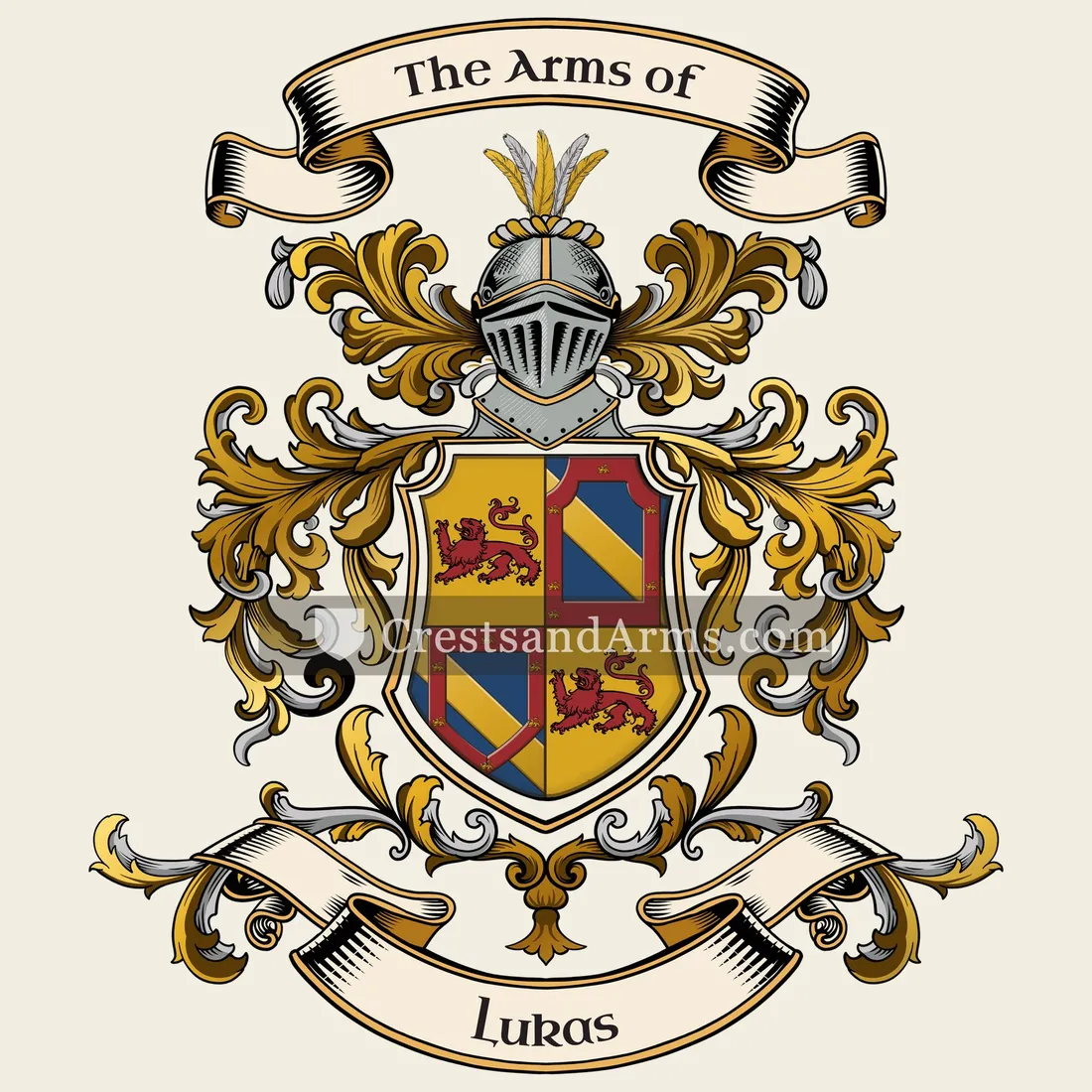
bendDefence, and the scarf of a commander
lionCourage, strength and royalty
Colours
Gold (Or)Means: Generosity
Blue (Azure)Means: Loyalty and truth
Red (Gules)Means: Military strength
Historical info
Source
J. B. Rietstap, Armorial Général, Gouda: G. B. van Goor Zonen, 1884–87
Blazon (the actual original written record)
“Ec.: aux 1 et 4 d'or au lion de gu.; aux 2 et 3 d'azur à la bande d'or et à la bord. de gu., ch. de six lions d'or, 3 à chaque flanc, l'un sur l'autre.”
AndalusiaAndalusia, c. 1455
Digital archive packCoat of arms PNG, gold border print PDF, vector SVG and the certificate of authenticity. Sent to your email in minutes.
Map of Spain showing where the Lukas arms are recorded
The Lukas arms were recorded in Andalusia, c. 1455.
Andalusia was the last part of Spain taken back from the Moors, and the land was shared out among the men who took it. A grant of land came with a grant of arms, so the region produced a great many.
This is where the arms were entered in the register. Families often moved to other parts of the country, so the same name can turn up in more than one region.
The body that granted and recorded arms in Spain in this period.
Alfonso V of Aragon
Sovereign of the period
Alfonso V of Aragon
1416–1458
Reigning in France when the Lukas arms are first recorded.
How Arms Worked in Spain
In Spain, a coat of arms was considered a form of property that belonged to the entire family line. These arms were passed down from a father to all his children equally. Younger branches of the family usually kept the original design without needing to add any special marks to distinguish their specific line.
Granting authority
The Cronista Rey de Armas was the official body that regulated and granted coats of arms throughout Spain.
How they got arms
Families often obtained their arms through royal grants or by proving their noble status to the official heraldic authority.
Where arms were recorded
Coats of arms were officially recorded in the registers of the Cronista Rey de Armas starting in 1496.
The family's standing
Recorded among the armigerous families of Andalusia.
Origin & History of the Lukas Family in Spain
The name Lukas traces its roots to the ancient Greek name Loukas, which eventually evolved into the Latin form Lucas before spreading across Europe. By the mid-15th century, the family established a notable presence in the region of Andalusia, Spain. During this era, Andalusia was a vibrant crossroads of cultures where the family likely integrated into the local administrative and social structures of the time. Records from 1455 confirm that individuals bearing this name were active participants in the economic life of southern Spain, likely serving as merchants or landowners during the final decades of the Nasrid Kingdom of Granada. As the family settled into this Mediterranean landscape, they became part of the complex demographic shifts that defined the Iberian Peninsula before the turn of the century. Their presence in Andalusia suggests a history tied to the agricultural and trade networks that sustained the region during the late Middle Ages.
Meaning of the Lukas family crest colors & symbols
Symbols on this shield
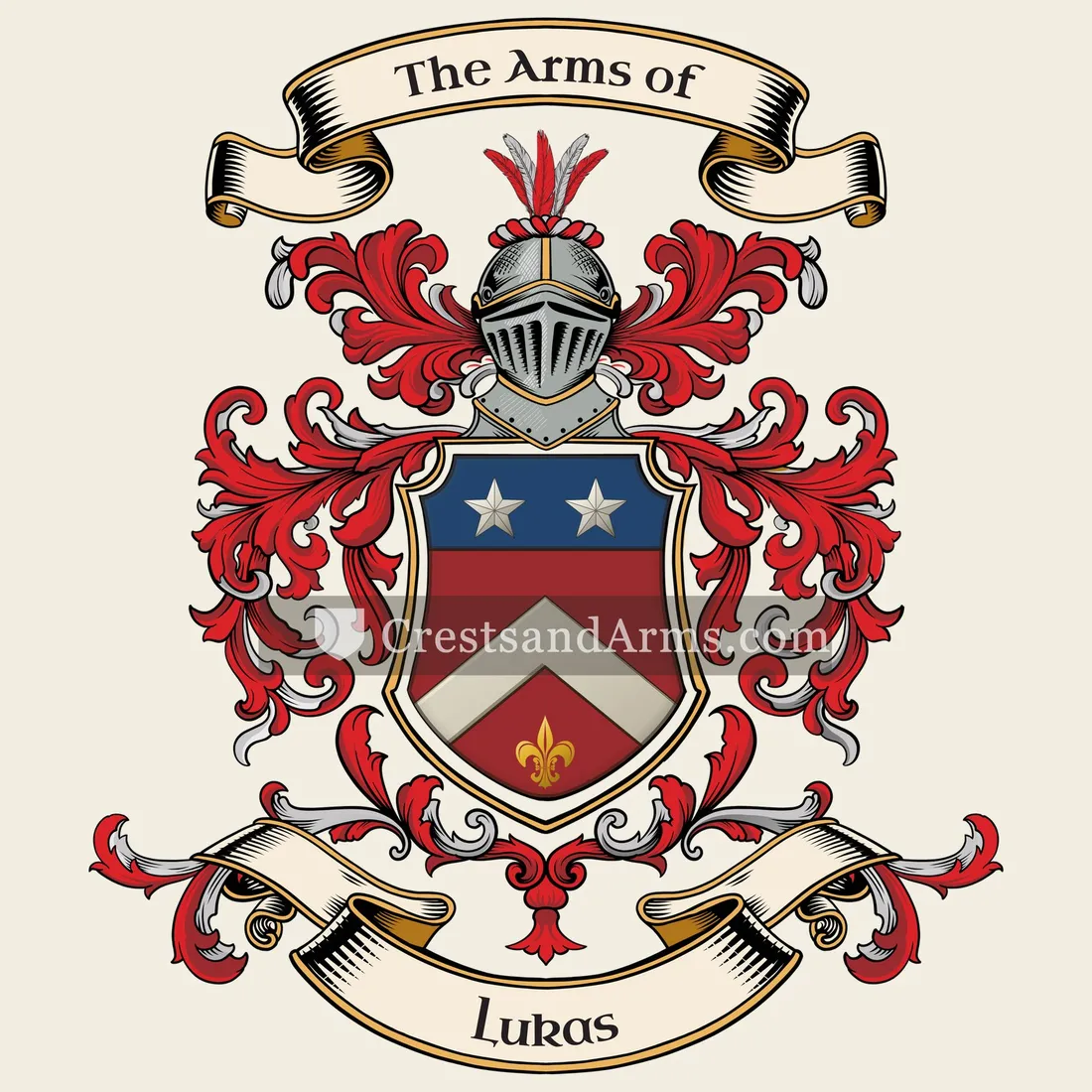
chevronProtection, and faithful service completed
chiefAuthority, wisdom and dominion
fleur de lisPurity, light, and the sixth son
mulletThe third son, and a divine quality from above
Colours
Red (Gules)Means: Military strength
Silver (Argent)Means: Peace and sincerity
Blue (Azure)Means: Loyalty and truth
Gold (Or)Means: Generosity
Historical info
Source
J. B. Rietstap, Armorial Général, Gouda: G. B. van Goor Zonen, 1884–87
Blazon (the actual original written record)
“De gu. au chev. d'arg., acc. en p. d'une fleur-de-lis d'or; au chef d'azur, ch. de deux étoiles (3) d'arg.”
SwitzerlandNeufchâtel, c. 1745
Digital archive packCoat of arms PNG, gold border print PDF, vector SVG and the certificate of authenticity. Sent to your email in minutes.
Map of Switzerland showing where the Lukas arms are recorded
The Lukas arms were recorded in Neufchâtel, c. 1745.
This is where the arms were entered in the register. Families often moved to other parts of the country, so the same name can turn up in more than one region.
The body that granted and recorded arms in Switzerland in this period.
How Arms Worked in Switzerland
In Switzerland, coats of arms were not restricted to the nobility and were often adopted by common citizens and families. These symbols were passed down through generations to show family identity. When branches of a family grew, they often changed small details of the design to distinguish their own line from the original group.
Granting authority
Cantonal and civic authorities managed the use of coats of arms within their specific regions and local jurisdictions.
How they got arms
Families typically assumed their own coats of arms based on local custom rather than receiving them from a central monarch.
Where arms were recorded
Arms were recorded in various cantonal and civic registers starting from the fourteenth century throughout the Swiss region.
The family's standing
Recorded among the armigerous families of Switzerland.
Origin & History of the Lukas Family in Switzerland
The name Lukas is a variation of the ancient Greek name Lucas, which means a person from Lucania or a bringer of light. In the context of Switzerland, the name became established as a patronymic, meaning it was passed down from a father to his children as a way to identify their lineage. By the mid-18th century, the family had firmly planted roots in the region of Neuchâtel. At this time, Neuchâtel was a unique principality that maintained deep ties to the Prussian monarchy while functioning as a Swiss canton. Families like the Lukas clan often worked in local trades or agriculture, contributing to the steady growth of the region’s economy. Because the area served as a crossroads for trade and religious refugees, the presence of the Lukas family in 1745 suggests they were part of a stable community that valued record-keeping and civic participation. Over time, the name evolved alongside the local dialects, reflecting the linguistic blend of French and German influences that define the history of the Swiss cantons.
Lukas Meaning & Related Branches
Root word
Loukas
Greek name derived from the region of Lucania meaning from Lucania
This name
LukasA French variant of the name meaning light-giving or illuminated
also spelled
Lucass
Lucaz
Lucat
Lukas
Lukis
Documented Sources
J. B. Rietstap, Armorial Général, Gouda: G. B. van Goor Zonen, 1884–87
Dauzat, Albert, Dictionnaire étymologique des noms de famille et prénoms de France, 1951
Morlet, Marie-Thérèse, Dictionnaire étymologique des noms de famille, 1991
Archives départementales du Nord, Série E (Registres paroissiaux et d'état civil)
Archives de l'État à Mons, Fonds de l'Intendance de Flandre
Digital archive packCoat of arms PNG, gold border print PDF, vector SVG and the certificate of authenticity. Sent to your email in minutes.


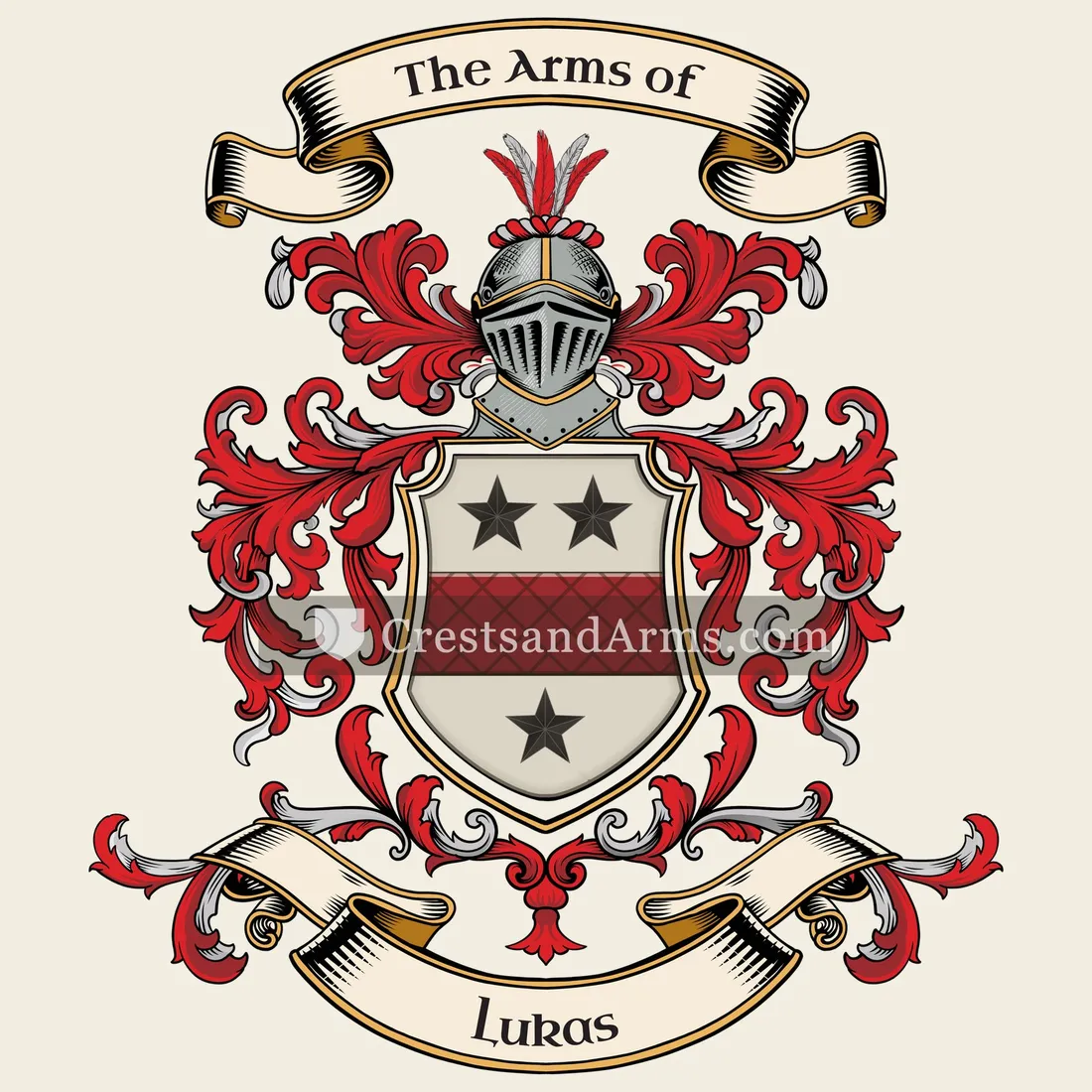
 fessThe military belt, and readiness to serve
 mulletThe third son, and a divine quality from above
 fessThe military belt, and readiness to serve
 mulletThe third son, and a divine quality from above


 bendDefence, and the scarf of a commander
 lionCourage, strength and royalty


 chevronProtection, and faithful service completed
 chiefAuthority, wisdom and dominion
 fleur de lisPurity, light, and the sixth son