Map of France showing where the Luker arms are recorded
The Luker arms were recorded in Bretagne, c. 1663.
More families held coats of arms in Bretagne than anywhere else in France. The land was divided into many small estates rather than a few large ones, so far more households counted as gentry, and each needed a shield of its own to be told apart.
This is where the arms were entered in the register. Families often moved to other parts of the country, so the same name can turn up in more than one region.
The body that granted and recorded arms in France in this period.
Louis XIV of France
Sovereign of the period
Louis XIV of France
1643–1715
Reigning in France when the Luker arms are first recorded.
How Arms Worked in France
In France, a coat of arms was a mark of honor that passed down through the male line to all legitimate descendants. Families often used the same shield without changes to show their shared heritage. If a branch wanted to stand out, they could add a small mark to their shield to show their specific place in the family tree.
Granting authority
The Juge d'armes de France acted as the official authority that regulated and verified coats of arms across the country.
How they got arms
Families typically inherited their arms from ancestors, though they could also receive them through royal grants or by proving their noble status.
Where arms were recorded
Coats of arms were officially recorded in the Armorial Général de France, which began its main collection in the year 1696.
The family's standing
Recorded among the armigerous families of Bretagne.
Origin & History of the Luker Family in France
The history of the Luker name in France is deeply tied to the rugged landscape and maritime culture of the Bretagne region. By the year 1663, records confirm that members of this family were already established within the local community, living among the coastal populations of northwestern France. During this period, families in Bretagne often identified themselves through their specific trade or their connection to the local parish. The name likely evolved from regional dialects spoken in the area, reflecting the linguistic blend of Breton and early French common to the seventeenth century. Life for the Luker family at this time would have centered on the seasonal rhythms of the Atlantic coast, where they participated in the agricultural and seafaring traditions that defined the Breton way of life. This early presence suggests that the family was well integrated into the social fabric of the province long before the major political shifts of the following centuries.
Coat of Arms & Family Crest Details
Symbols on this shield
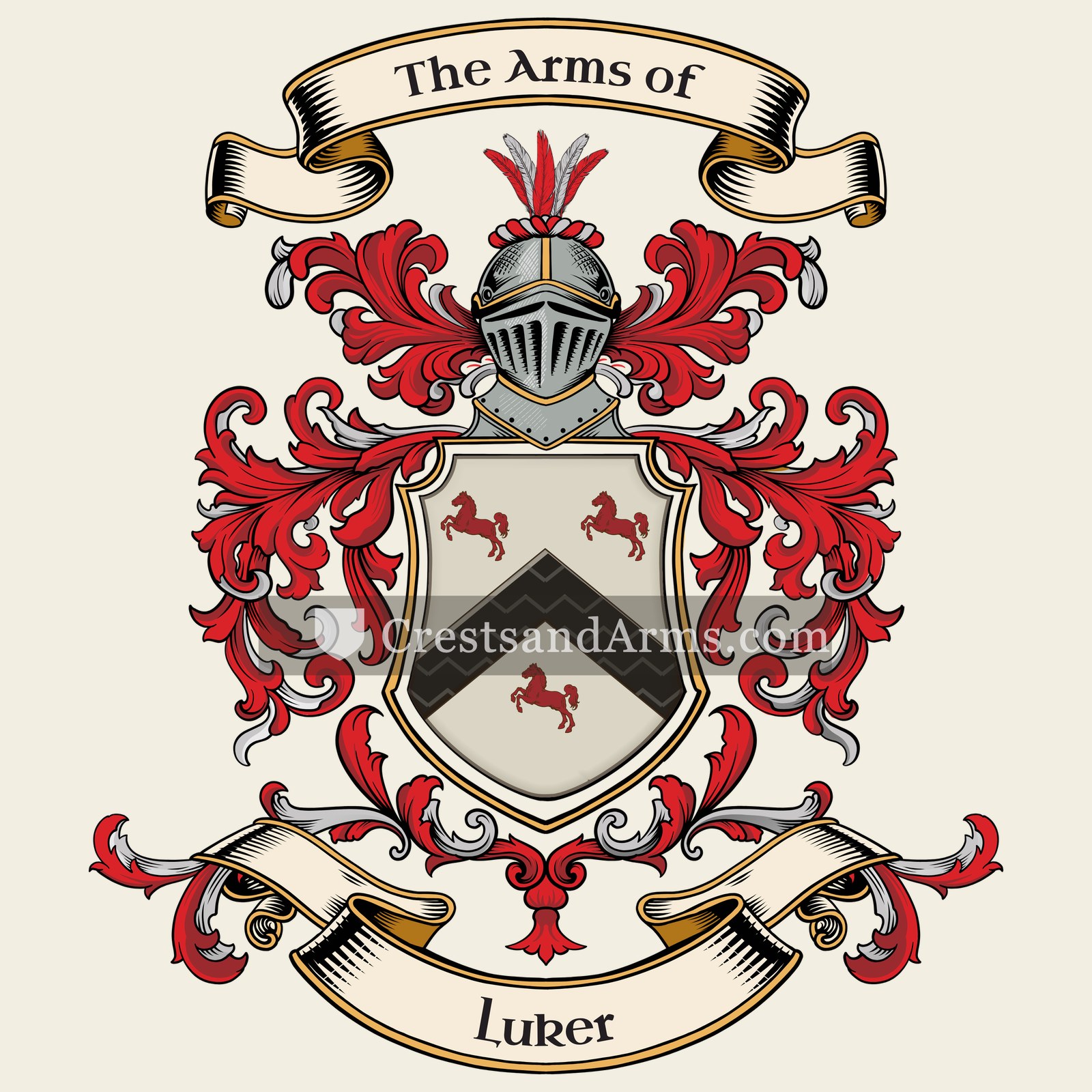
chevronProtection, and faithful service completed
horseReadiness to serve king and country
Colours
Silver (Argent)Means: Peace and sincerity
Black (Sable)Means: Constancy
Red (Gules)Means: Military strength
Historical info
Source
Sir Bernard Burke, The General Armory of England, Scotland, Ireland and Wales, London: Harrison & Sons, 1884
Blazon (the actual original written record)
“Ar. a chev. sa. betw. three nags' heads erased gu. bridled or”
TipperaryDrangan · Tipperary, c. 1530
Digital archive packCoat of arms PNG, gold border print PDF, vector SVG and the certificate of authenticity. Sent to your email in minutes.
Map of Ireland showing where the Luker arms are recorded
The Luker arms were recorded in Tipperary, c. 1530.
Tipperary was the best grazing land in Ireland, held by a small number of powerful families. Land of that value stayed in the same hands, and unbroken holding is what puts a name in the records.
This is where the arms were entered in the register. Families often moved to other parts of the country, so the same name can turn up in more than one region.
The body that granted and recorded arms in Ireland in this period.
Henry VIII of England
Sovereign of the period
Henry VIII of England
1509–1547
Reigning in France when the Luker arms are first recorded.
How Arms Worked in Ireland
The Ulster King of Arms granted coats of arms to individuals who proved their social standing and good character. These symbols were typically inherited by all legitimate descendants of the original holder. If a family branch wanted a unique look, they could apply for a specific change to their design through the office to ensure their identity remained distinct.
Granting authority
The Ulster King of Arms acted as the official body that regulated and issued all coats of arms throughout Ireland.
How they got arms
Families obtained their arms through formal grants issued by the office after proving their eligibility and paying the required fees.
Where arms were recorded
All official grants were recorded in the registers held by the Ulster King of Arms starting from the year 1552.
The family's standing
Recorded among the armigerous families of Tipperary.
Origin & History of the Luker Family in Ireland
The history of the Luker family in Ireland is deeply rooted in the fertile lands of County Tipperary, where records confirm their presence as early as 1530. During this period, the name was often associated with families living in the southern regions of the country, particularly near the border of Tipperary and Waterford. The name likely evolved from an occupational or descriptive nickname, reflecting the linguistic shifts occurring as English and Irish naming traditions began to blend in the sixteenth century. Families like the Lukers were typically involved in local agriculture and community life, serving as tenants or landholders who helped shape the rural landscape of the province of Munster. As the sixteenth century progressed, the family became firmly established within the local social structure, maintaining their ties to the Tipperary region through generations of change and political upheaval.
Luker Meaning & Related Branches
Root word
Luc
Derived from the Latin lux meaning light.
This name
LukerA locative surname for someone who lived near a place named Luc.
also spelled
Lukerr
Lukere
Looker
Lukear
Related arms
Lucarsame arms
Lookervariant spelling
Documented Sources
J. B. Rietstap, Armorial Général, Gouda: G. B. van Goor Zonen, 1884–87
Archives départementales du Morbihan, Série B (Archives de la justice seigneuriale)
Archives départementales du Finistère, Série E (Documents familiaux et notariaux)
Galliou, Patrick, Histoire de la Bretagne, 1983
Le Moyne de La Borderie, Arthur, Histoire de Bretagne, 1896
Digital archive packCoat of arms PNG, gold border print PDF, vector SVG and the certificate of authenticity. Sent to your email in minutes.


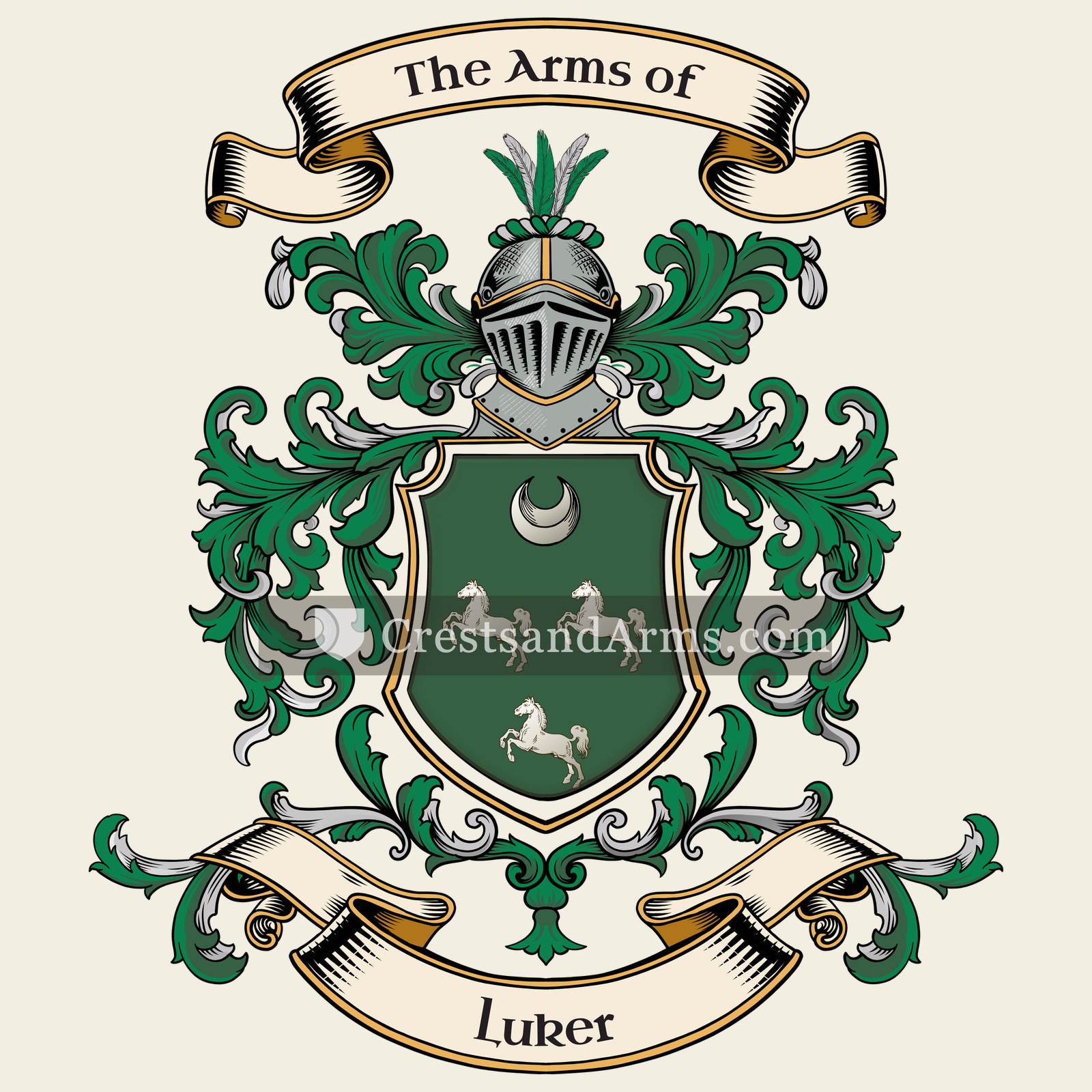
 horseReadiness to serve king and country
 crescentHonour by the sovereign, and the second son
 horseReadiness to serve king and country
 crescentHonour by the sovereign, and the second son


 chevronProtection, and faithful service completed