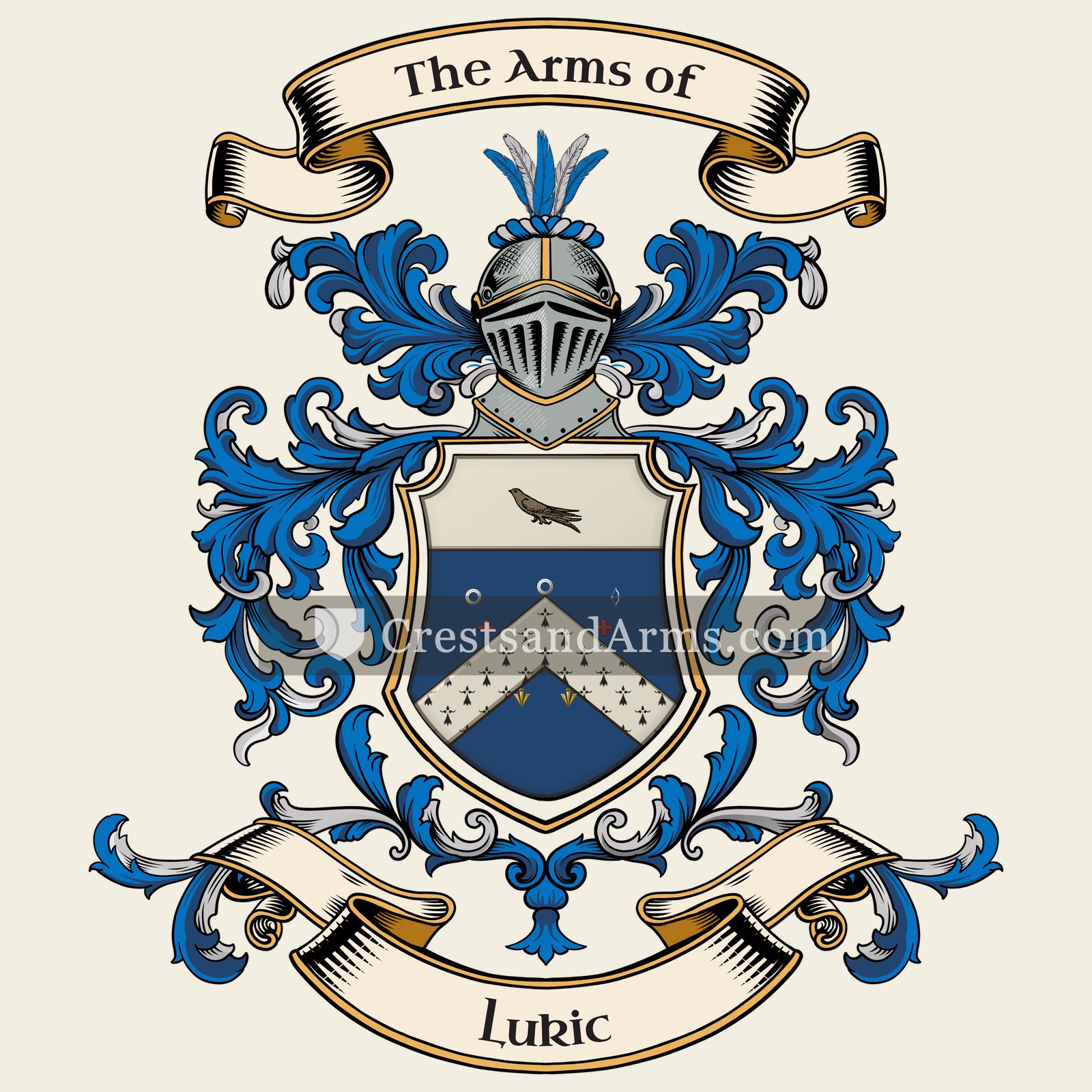
A record of documented arms, meaning and origin, researched for the Lukic family of Guernsey.
Reg. 7389 · Guernsey, J–L
Coat of Arms & Family Crest Details
Symbols on this shield
chevronProtection, and faithful service completed
chiefAuthority, wisdom and dominion
cross symbolChristian faith and service
ringFidelity, and a promise kept
bowReadiness, and the strength held in reserve
arrowReadiness for battle, and affliction endured
martletA younger son, who must win his own land
Colours
Blue (Azure)Means: Loyalty and truth
ErmineMeans: Dignity
Silver (Argent)Means: Peace and sincerity
Gold (Or)Means: Generosity
Red (Gules)Means: Military strength
Historical info
Source
Sir Bernard Burke, The General Armory of England, Scotland, Ireland and Wales, London: Harrison & Sons, 1884
Blazon (the actual original written record)
“Az. a chev. erm. betw. two annulets in chief and in base a bow lying fesseways ar. crossed by two arrows in saltire, points downwards or, feathered of the third, on a chief of the second a Cornish chough ppr. betw. two crosses crosslet fitchy gu”
GuernseyGuernsey, c. 1688
Digital archive packCoat of arms PNG, gold border print PDF, vector SVG and the certificate of authenticity. Sent to your email in minutes.
The body that granted and recorded arms in Guernsey in this period.
James II of England
Sovereign of the period
James II of England
1685–1688
Reigning in Guernsey when the Lukic arms are first recorded.
How Arms Worked in Guernsey
Arms in the Channel Islands were granted and recorded by the College of Arms in London, under the same law of arms as England. They could be used by all legitimate descendants of the original owner: the eldest son kept the original design, and other family members used the same shield without registering a version of their own.
Granting authority
The College of Arms in London has regulated the use of coats of arms for Guernsey and the other Channel Islands since 1484.
How they got arms
Families typically obtained their coats of arms through a formal grant from the Crown or by proving their ancient right to them.
Where arms were recorded
All official coats of arms are recorded in the registers kept at the College of Arms, which date back to the fifteenth century.
The family's standing
Recorded among the armigerous families of Guernsey.
Origin & History of the Lukic Family in Guernsey
The surname Lukić is a patronymic name originating from the South Slavic regions, derived from the given name Luka, which is the Slavic form of Luke. The suffix "ić" signifies "son of," meaning the name originally identified a person as the son of Luka. While the name is deeply rooted in the Balkans, members of the family established a presence in the Channel Islands by 1688. Historical records from Guernsey indicate that these early settlers were likely part of the broader movement of people across European maritime trade routes during the late seventeenth century. These individuals integrated into the local island society, adapting to the unique legal and cultural environment of Guernsey while maintaining their ancestral identity. This migration highlights how families from Eastern Europe navigated the complex social landscapes of Western Europe during the early modern period.
Related Branches & Arms
Root word
Luka
Derived from the Latin name Lucas meaning person from Lucania.
This name
LukicA patronymic surname meaning son of Luke or son of the light.
also spelled
Lukys
Lukies
Lukie
Documented Sources
Sir Bernard Burke, The General Armory of England, Scotland, Ireland and Wales, London: Harrison & Sons, 1884
Guernsey Archives, Baptisms, Marriages and Burials of the Island of Guernsey
The National Archives (UK), State Papers Domestic: Channel Islands
Skok, Petar, Etimologijski rječnik hrvatskoga ili srpskoga jezika (1971)
Lemprière, Raoul, A History of the Channel Islands (1974)
Digital archive packCoat of arms PNG, gold border print PDF, vector SVG and the certificate of authenticity. Sent to your email in minutes.


 chevronProtection, and faithful service completed
 chiefAuthority, wisdom and dominion
 cross symbolChristian faith and service
 ringFidelity, and a promise kept
 bowReadiness, and the strength held in reserve
 arrowReadiness for battle, and affliction endured
 martletA younger son, who must win his own land
 chevronProtection, and faithful service completed
 chiefAuthority, wisdom and dominion
 cross symbolChristian faith and service
 ringFidelity, and a promise kept
 bowReadiness, and the strength held in reserve
 arrowReadiness for battle, and affliction endured
 martletA younger son, who must win his own land