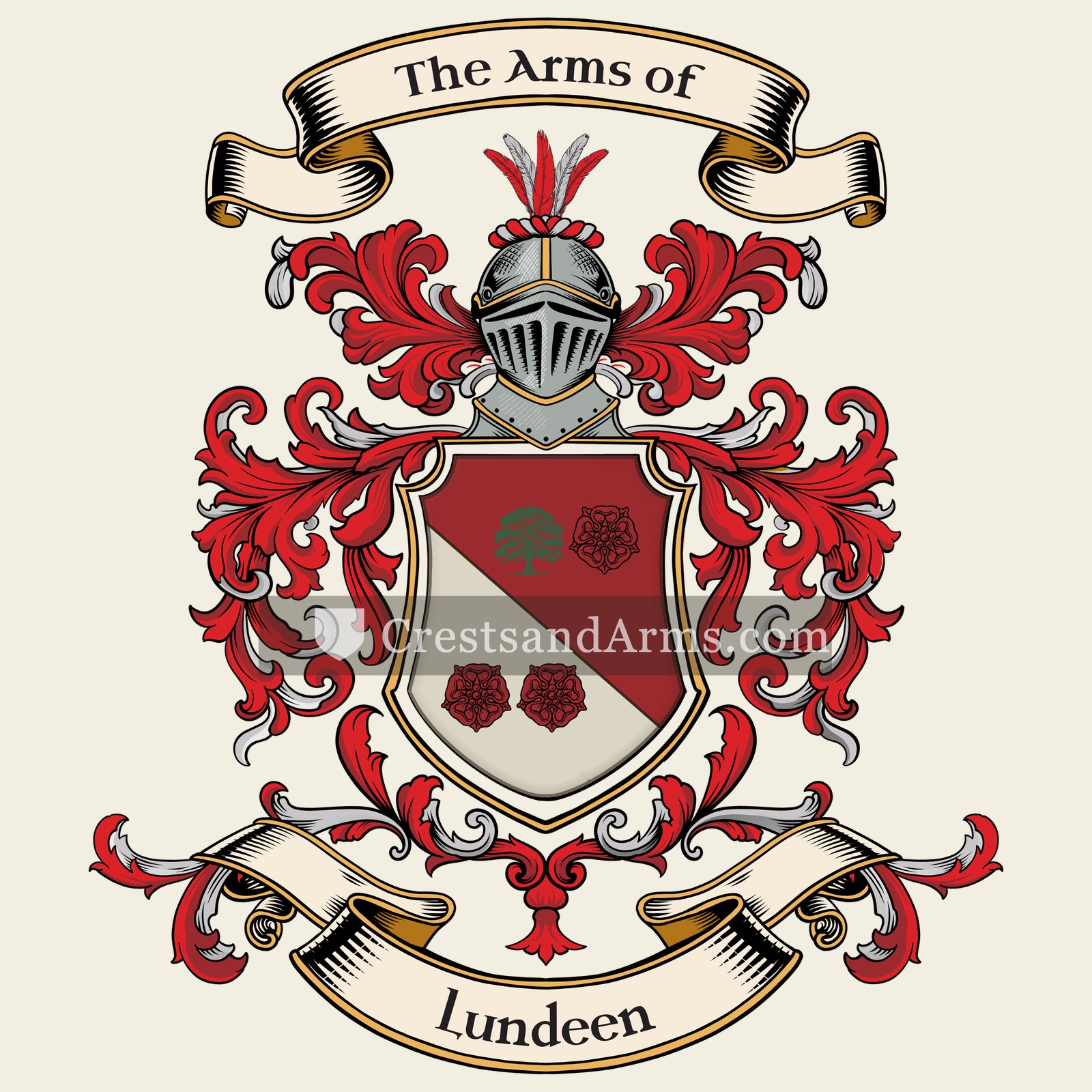
A record of documented arms, meaning and origin, researched for the Lundeen family of Belgium.
Reg. 0325 · Belgian, J–L
Coat of Arms & Family Crest Details
Symbols on this shield
treeLife, endurance and deep roots
roseThe seventh son, and beauty with grace
Colours
Silver (Argent)Means: Peace and sincerity
Red (Gules)Means: Military strength
Green (Vert)Means: Hope
Historical info
Source
J. B. Rietstap, Armorial Général, Gouda: G. B. van Goor Zonen, 1884–87
Blazon (the actual original written record)
“Tranché d'arg. sur gu.; à un chicot de sin., en bande, br. sur le tranché, poussant trois roses, une de gu. à sen. sur l'arg., et deux d'arg. à dextre sur le gu. C.: cinq pl. d'aut., alt. de gu. et d'arg. L. de gu. et d'arg.”
BelgiumAnvers, c. 1679
Digital archive packCoat of arms PNG, gold border print PDF, vector SVG and the certificate of authenticity. Sent to your email in minutes.
Map of Belgium showing where the Lundeen arms are recorded
The Lundeen arms were recorded in Anvers, c. 1679.
This is where the arms were entered in the register. Families often moved to other parts of the country, so the same name can turn up in more than one region.
The body that granted and recorded arms in Belgium in this period.
Charles II of Spain
Sovereign of the period
Charles II of Spain
1665–1700
Reigning in Belgium when the Lundeen arms are first recorded.
How Arms Worked in Belgium
In Belgium, a coat of arms is considered personal property that is passed down through the male line to legitimate descendants. Families often use the same shield design across generations to show their shared heritage. If a branch of the family wants to change the design, they must apply for an official update to their specific version of the arms.
Granting authority
The Conseil héraldique is the official body that regulates and approves all coats of arms in Belgium.
How they got arms
Families obtain their coats of arms through formal royal grants or by confirming their historical right to use existing designs.
Where arms were recorded
All approved coats of arms are officially recorded in the public registers of the Conseil héraldique since 1844.
The family's standing
Recorded among the armigerous families of Belgium.
Origin & History of the Lundeen Family in Belgium
The family name Lundeen is rooted in the linguistic traditions of Scandinavia, where it originated as a topographic surname. The name is derived from the Old Norse word "lundr," which refers to a small grove or a wooded area, combined with the suffix "een" or "en," which often served as a definite article or a locative marker. By the late 17th century, the family had established a presence in Anvers, a region that served as a significant crossroads for trade and migration. During this period, individuals often adopted surnames based on the specific landscapes they inhabited or managed, suggesting that the early Lundeens were likely associated with the wooded lands near their home. This connection to the local geography helped define their identity as they moved through the social and economic shifts of the 1600s.
Related Branches & Arms
Root word
Lund
Old Norse word for a sacred grove or small forest.
This name
LundeenA topographical surname denoting someone who lived near a sacred grove or woodland area.
also spelled
Lundenn
Documented Sources
J. B. Rietstap, Armorial Général, Gouda: G. B. van Goor Zonen, 1884–87
Hellquist, Elof, Svensk etymologisk ordbok, 1922
National Archives of Sweden (Riksarkivet), Kyrkoarkiv: Födelse- och dopböcker, 1679
Otterbjörk, Roland, Svenska förnamn: Kortfattat namnlexikon, 1964
Digital archive packCoat of arms PNG, gold border print PDF, vector SVG and the certificate of authenticity. Sent to your email in minutes.


 treeLife, endurance and deep roots
 roseThe seventh son, and beauty with grace
 treeLife, endurance and deep roots
 roseThe seventh son, and beauty with grace