Map of Germany showing where the Lundquist arms are recorded
The Lundquist arms were recorded in Pomerania, c. 1792.
Pomerania was flat farming country on the Baltic coast, held in large estates by a small number of families. They kept their land for generations, and generations of landholding is what fills the registers.
This is where the arms were entered in the register. Families often moved to other parts of the country, so the same name can turn up in more than one region.
The body that granted and recorded arms in Germany in this period.
Leopold II, Holy Roman Emperor
Sovereign of the period
Leopold II, Holy Roman Emperor
1790–1792
Reigning in Germany when the Lundquist arms are first recorded.
How Arms Worked in Germany
In the Holy Roman Empire, coats of arms were often granted to individuals by the Emperor or his representatives. These arms were then passed down through the generations to all legitimate descendants of the original holder. Younger branches of a family usually kept the same shield design without needing to change it, as the arms belonged to the entire lineage.
Granting authority
The Holy Roman Emperor held the sole power to grant new coats of arms throughout his vast imperial territories.
How they got arms
Families typically obtained their coats of arms through a formal imperial grant or by proving their noble status to the authorities.
Where arms were recorded
These grants were officially recorded in the Imperial Chancery registers, which began keeping formal records of such honors during the Middle Ages.
The family's standing
Recorded among the armigerous families of Pomerania.
Origin & History of the Lundquist Family in Germany
The surname Lundquist is a classic example of a Swedish ornamental name, which was formed by combining two distinct nature-related words. The first part, "lund," refers to a grove or a small forest, while the second part, "quist," translates to a twig or a branch. During the late 18th century, families in the Baltic region often adopted these types of descriptive names to reflect the natural beauty of their surroundings. By 1792, members of the Lundquist family were already established in Pomerania, a region that served as a vital cultural bridge between Scandinavia and Northern Germany. Because Pomerania was under Swedish control for much of this era, it was common for families to carry Swedish-style surnames while living and working within the local German-speaking communities. This movement of people across the Baltic Sea helped spread the name throughout the coastal provinces, where the family likely worked in agriculture or trade within the bustling port towns of the time.
Lundquist Meaning & Related Branches
Root word
Lund
A grove or small forest of trees.
This name
LundquistDerived from a dweller near a grove combined with the suffix for son.
also spelled
Lyndequist
Lindquist
Lindequistt
Documented Sources
J. B. Rietstap, Armorial Général, Gouda: G. B. van Goor Zonen, 1884–87
Hanks, Patrick, Dictionary of American Family Names, 2003
Hellquist, Elof, Svensk etymologisk ordbok, 1922
Landesarchiv Greifswald, Kirchenbücher der schwedischen Zeit in Pommern, 1792
Digital archive packCoat of arms PNG, gold border print PDF, vector SVG and the certificate of authenticity. Sent to your email in minutes.


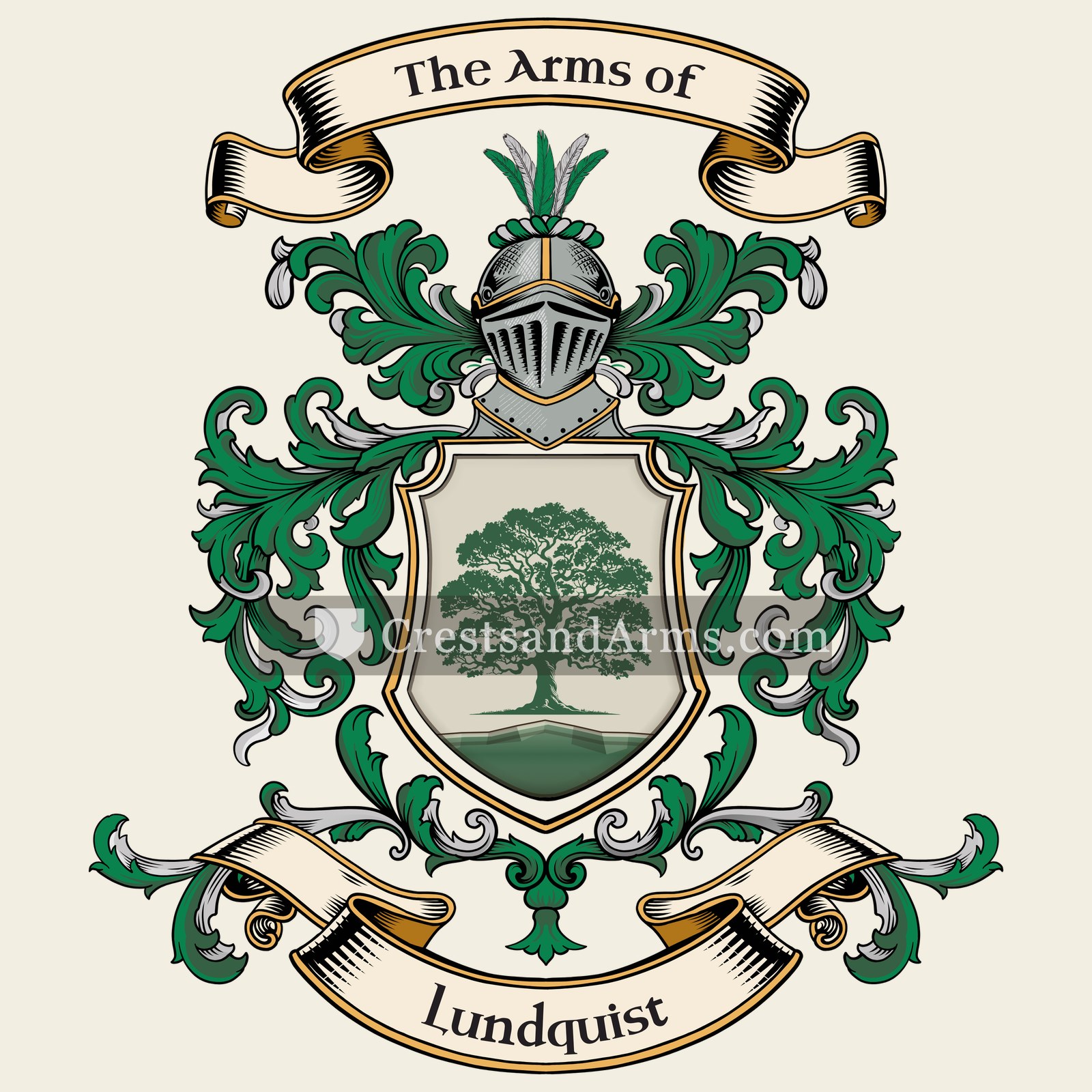
 mountThe ground held, and steadfastness upon it
 treeLife, endurance and deep roots
 mountThe ground held, and steadfastness upon it
 treeLife, endurance and deep roots