Map of England showing where the Lunsford arms are recorded
The Lunsford arms were recorded in Warwick, c. 1620.
Warwickshire lay in the middle of England, and its landed families were spread evenly across it rather than gathered in one corner. A great many held a single manor each, and each of those holdings brought its own claim to arms.
This is where the arms were entered in the register. Families often moved to other parts of the country, so the same name can turn up in more than one region.
The body that granted and recorded arms in England in this period.
James VI and I
Sovereign of the period
James VI and I
1603–1625
Reigning in England when the Lunsford arms are first recorded.
How Arms Worked in England
English heraldry allowed arms to be shared by all legitimate descendants of the original owner. These symbols were treated as personal property that moved through the generations to all children. While the eldest son kept the original design, other family members could use the same shield without needing to change it or register their own unique versions.
Granting authority
The College of Arms in London has regulated the use of coats of arms throughout England and Wales since 1484.
How they got arms
Families typically obtained their coats of arms through a formal grant from the Crown or by proving their ancient right to them.
Where arms were recorded
All official coats of arms are recorded in the registers kept at the College of Arms, which date back to the fifteenth century.
The family's standing
Recorded among the armigerous families of Warwick.
Origin & History of the Lunsford Family in England
The Lunsford family name originates from the historic county of Sussex in England, where it was linked to a specific manor known as Lunsford in the parish of Etchingham. The name itself is derived from Old English terms describing a ford located near a grove or a clearing. By the early seventeenth century, members of the family had established a presence in Warwick, Virginia, as part of the initial waves of English settlement in the American colonies. These early settlers were often involved in the administration and development of the new territory, helping to build the foundations of local government and agriculture. As they moved from the English countryside to the frontier of the Chesapeake Bay, the family maintained their connection to their ancestral roots while adapting to the challenges of life in a rapidly expanding colonial society.
Lunsford Meaning & Related Branches
Root word
Lund-ford
A grove or wooded area located by a river crossing.
This name
LunsfordRefers to someone who lived near a ford situated by a woodland or grove.
also spelled
Lunsfurd
Documented Sources
Sir Bernard Burke, The General Armory of England, Scotland, Ireland and Wales, London: Harrison & Sons, 1884
Lower, Mark Antony, Patronymica Britannica: A Dictionary of the Family Names of the United Kingdom, 1860
Nugent, Nell Marion, Cavaliers and Pioneers: Abstracts of Virginia Land Patents and Grants, 1623-1666, 1934
The National Archives, Kew, State Papers Colonial, America and West Indies, CO 1
Library of Virginia, Land Office Patents and Grants
Digital archive packCoat of arms PNG, gold border print PDF, vector SVG and the certificate of authenticity. Sent to your email in minutes.


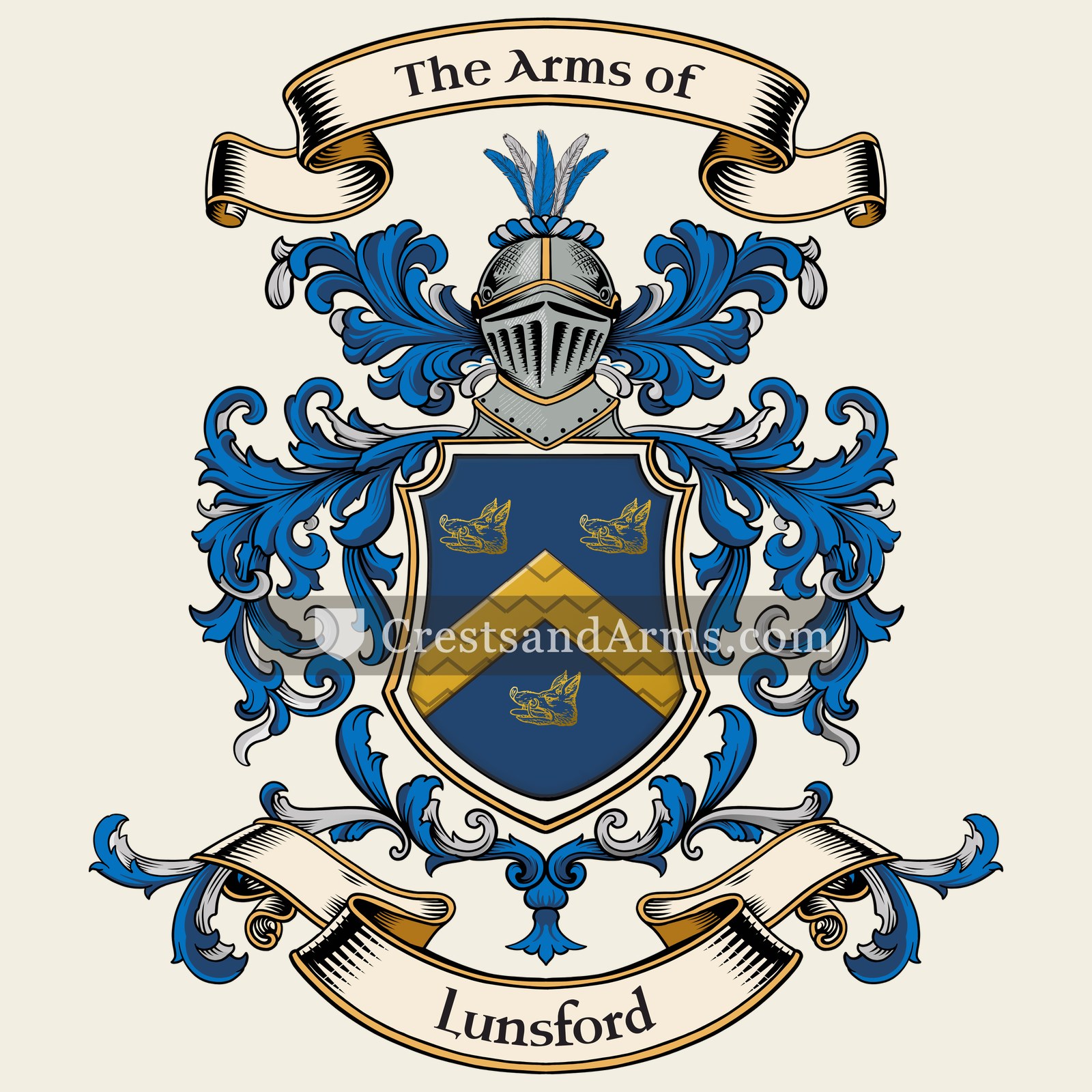
 chevronProtection, and faithful service completed
 boars headA fierce fighter who battles to the end
 chevronProtection, and faithful service completed
 boars headA fierce fighter who battles to the end