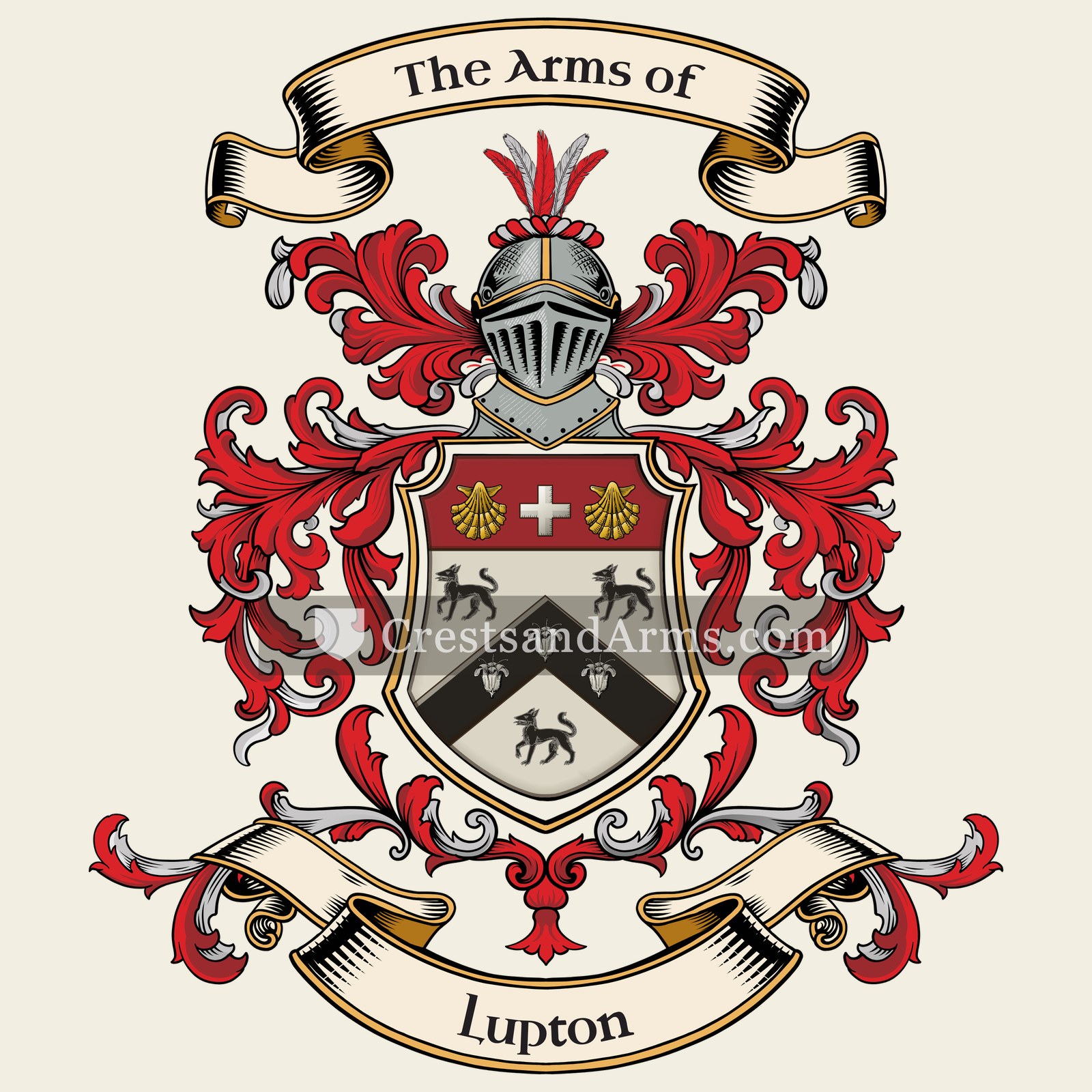
A record of documented arms, meaning and origin, researched for the Lupton family of England.
Reg. 0922 · English, J–L
Coat of Arms & Family Crest Details
Symbols on this shield
chevronProtection, and faithful service completed
chiefAuthority, wisdom and dominion
cross symbolChristian faith and service
lilyPurity and the promise of resurrection
wolfReward from long service and hard work
escallopThe pilgrim's shell, and a long journey made
Colours
Silver (Argent)Means: Peace and sincerity
Black (Sable)Means: Constancy
Red (Gules)Means: Military strength
Gold (Or)Means: Generosity
Historical info
Source
Sir Bernard Burke, The General Armory of England, Scotland, Ireland and Wales, London: Harrison & Sons, 1884
Blazon (the actual original written record)
“Ar. a chev. sa. charged with three white lilies leaved vert betw. as many wolves' heads erased of the second, langued gu. on a chief of the last a Tau of St. Anthony betw. two escallops or”
OxfordThame · Oxford, c. 1620
Digital archive packCoat of arms PNG, gold border print PDF, vector SVG and the certificate of authenticity. Sent to your email in minutes.
Map of England showing where the Lupton arms are recorded
The Lupton arms were recorded in Oxford, c. 1620.
Oxfordshire was farming country with the university at its centre, and both produced families of standing. Scholars and lawyers who did well bought manors nearby, and holding a manor was the ordinary route to a coat of arms.
This is where the arms were entered in the register. Families often moved to other parts of the country, so the same name can turn up in more than one region.
The body that granted and recorded arms in England in this period.
James VI and I
Sovereign of the period
James VI and I
1603–1625
Reigning in England when the Lupton arms are first recorded.
How Arms Worked in England
English heraldry allowed arms to be shared by all legitimate descendants of the original owner. These symbols were treated as personal property that moved through the generations to all children. While the eldest son kept the original design, other family members could use the same shield without needing to change it or register their own unique versions.
Granting authority
The College of Arms in London has regulated the use of coats of arms throughout England and Wales since 1484.
How they got arms
Families typically obtained their coats of arms through a formal grant from the Crown or by proving their ancient right to them.
Where arms were recorded
All official coats of arms are recorded in the registers kept at the College of Arms, which date back to the fifteenth century.
The family's standing
Recorded among the armigerous families of Oxford.
Origin & History of the Lupton Family in England
The surname Lupton is a locative name, meaning it originated from a specific place rather than a trade or a personal characteristic. It is derived from the township of Lupton in the county of Westmorland, located in the northern part of England. The name itself combines the Old English word "lup," which likely referred to a specific type of plant or a local landmark, with "tun," meaning an enclosure, farmstead, or settlement. By the early 17th century, the family had expanded well beyond their northern roots. Records confirm that members of the Lupton family were established in Oxford by 1620, where they were integrated into the academic and civic life of the city. This migration reflects the broader movement of families during the Stuart period as they sought new opportunities in the growing intellectual and commercial hubs of southern England.
Related Branches & Arms
Root word
Lupus and Tun
Latin for wolf and Old English for an enclosed settlement or farm.
This name
LuptonRefers to a settlement or farmstead associated with a person named Wolf.
also spelled
Luptun
Related arms
Cozensrecorded with Lupton, same area
Knollysrecorded with Lupton, same area
Simonsrecorded with Lupton, same area
Warnerrecorded with Lupton, same area
Documented Sources
Sir Bernard Burke, The General Armory of England, Scotland, Ireland and Wales, London: Harrison & Sons, 1884
Bardsley, Charles Wareing, A Dictionary of English and Welsh Surnames, 1901
Ekwall, Eilert, The Concise Oxford Dictionary of English Place-Names, 1960
Oxfordshire History Centre, Oxford City Council Records: Quarter Sessions and Mayor’s Court, 1620
Digital archive packCoat of arms PNG, gold border print PDF, vector SVG and the certificate of authenticity. Sent to your email in minutes.


 chevronProtection, and faithful service completed
 chiefAuthority, wisdom and dominion
 cross symbolChristian faith and service
 lilyPurity and the promise of resurrection
 wolfReward from long service and hard work
 escallopThe pilgrim's shell, and a long journey made
 chevronProtection, and faithful service completed
 chiefAuthority, wisdom and dominion
 cross symbolChristian faith and service
 lilyPurity and the promise of resurrection
 wolfReward from long service and hard work
 escallopThe pilgrim's shell, and a long journey made