A record of documented arms, meaning and origin, researched for the Lusk family lines. Documented in 2 countries.
Reg. 7558 · Britain, J–L
Coat of Arms & Family Crest Details
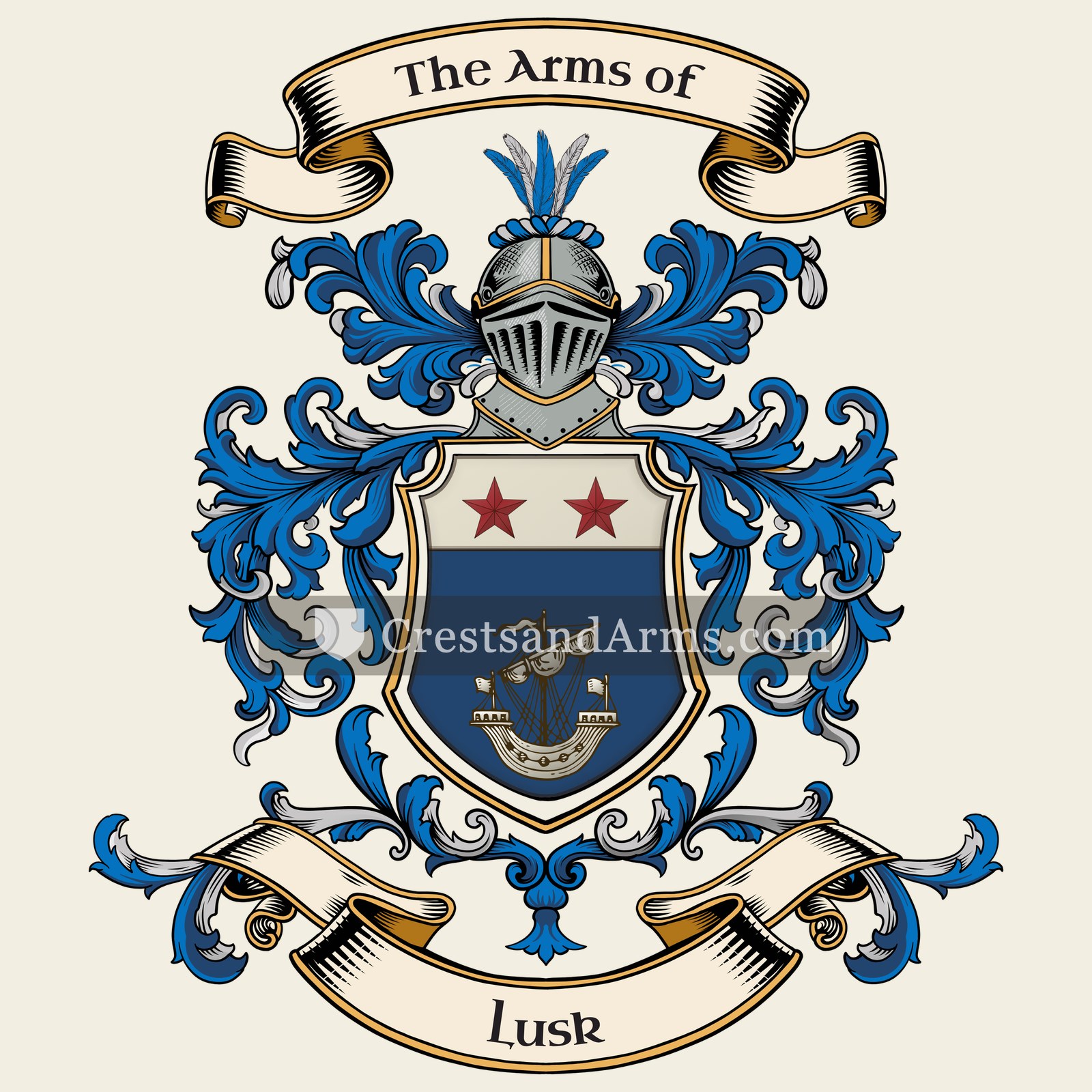
Symbols on this shield
chiefAuthority, wisdom and dominion
shipEnterprise, and a great voyage undertaken
mulletThe third son, and a divine quality from above
Colours
Blue (Azure)Means: Loyalty and truth
Silver (Argent)Means: Peace and sincerity
Red (Gules)Means: Military strength
Historical info
Source
J. B. Rietstap, Armorial Général, Gouda: G. B. van Goor Zonen, 1884–87
Blazon (the actual original written record)
“D'azur à une galère au nat., pavillonnée de gu.; au chef d'arg., ch. d'un ballot carré de sa., accosté de deux étoiles de gu. C.: la galère, surm. d'un arc-en-ciel au nat., mouv. de nuées. D.: LAUS DEO.”
BritainLondres, c. 1874
Digital archive packCoat of arms PNG, gold border print PDF, vector SVG and the certificate of authenticity. Sent to your email in minutes.
Map of Britain showing where the Lusk arms are recorded
The Lusk arms were recorded in Londres, c. 1874.
Arms such as these were typically recorded in Kent.
Kent sits between London and the short crossing to Europe, and the trade passing through made it wealthy. Merchant families bought land with that money, and it was landowners who took coats of arms.
This is where the arms were entered in the register. Families often moved to other parts of the country, so the same name can turn up in more than one region.
The body that granted and recorded arms in Britain in this period.
Victoria
Sovereign of the period
Victoria
1837–1901
Reigning in Britain when the Lusk arms are first recorded.
How Arms Worked in Britain
English heraldry allowed arms to be shared by all legitimate descendants of the original owner. These symbols were treated as personal property that moved through the generations to all children. While the eldest son kept the original design, other family members could use the same shield without needing to change it or register their own unique versions.
Granting authority
The College of Arms in London has regulated the use of coats of arms throughout England and Wales since 1484.
How they got arms
Families typically obtained their coats of arms through a formal grant from the Crown or by proving their ancient right to them.
Where arms were recorded
All official coats of arms are recorded in the registers kept at the College of Arms, which date back to the fifteenth century.
The family's standing
Recorded among the armigerous families of Britain.
Origin & History of the Lusk Family in Britain
The surname Lusk is believed to have originated as a locational name, likely derived from places in Scotland or Ireland, before spreading across the British Isles. While the family established a notable presence in the county of Kent by 1874, the roots of the name reach back much further into the medieval period. Historical records suggest that individuals bearing this name were often associated with specific geographic features or small settlements. Over several centuries, members of the family migrated from their ancestral regions to various parts of England, seeking new opportunities in trade and agriculture. By the Victorian era, the Lusk family had become well-integrated into the local communities of southern England, where they contributed to the social and economic development of the region.
Coat of Arms & Family Crest Details
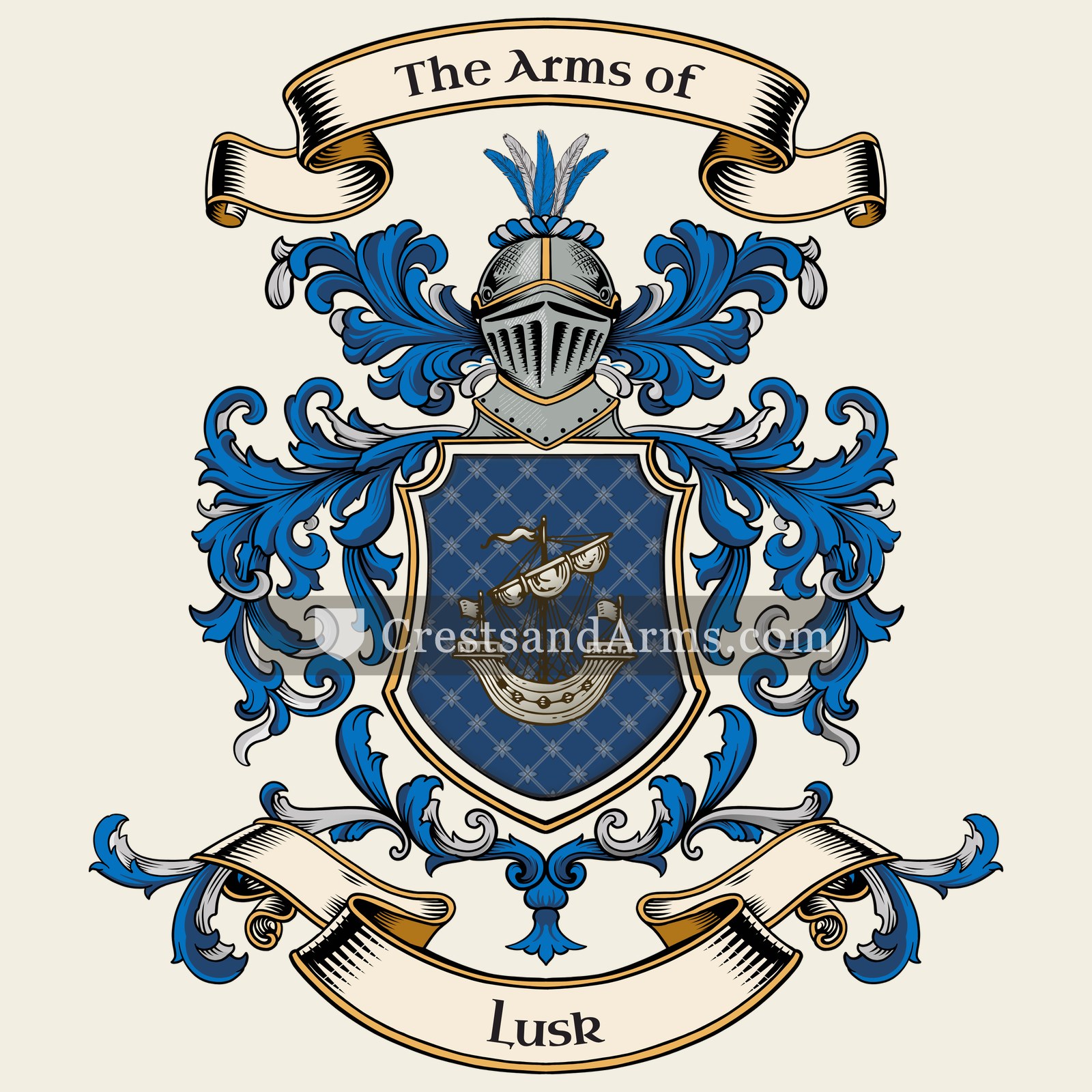
Symbols on this shield
shipEnterprise, and a great voyage undertaken
Colours
Blue (Azure)Means: Loyalty and truth
Historical info
Source
Sir Bernard Burke, The General Armory of England, Scotland, Ireland and Wales, London: Harrison & Sons, 1884
Blazon (the actual original written record)
“Az. an ancient ship with three masts, sails furled ppr. colours flying gu. on a”
HerefordColney Park · Hereford, c. 1620
Digital archive packCoat of arms PNG, gold border print PDF, vector SVG and the certificate of authenticity. Sent to your email in minutes.
Map of England showing where the Lusk arms are recorded
The Lusk arms were recorded in Hereford, c. 1620.
Herefordshire lay on the Welsh border, where land was held in return for military service. Families there were expected to arm and to fight, and a fighting household needed a shield it could be known by.
This is where the arms were entered in the register. Families often moved to other parts of the country, so the same name can turn up in more than one region.
The body that granted and recorded arms in England in this period.
James VI and I
Sovereign of the period
James VI and I
1603–1625
Reigning in Britain when the Lusk arms are first recorded.
How Arms Worked in England
English heraldry allowed arms to be shared by all legitimate descendants of the original owner. These symbols were treated as personal property that moved through the generations to all children. While the eldest son kept the original design, other family members could use the same shield without needing to change it or register their own unique versions.
Granting authority
The College of Arms in London has regulated the use of coats of arms throughout England and Wales since 1484.
How they got arms
Families typically obtained their coats of arms through a formal grant from the Crown or by proving their ancient right to them.
Where arms were recorded
All official coats of arms are recorded in the registers kept at the College of Arms, which date back to the fifteenth century.
The family's standing
Recorded among the armigerous families of Hereford.
Origin & History of the Lusk Family in England
The surname Lusk has roots that stretch back to the medieval period in England, where it likely functioned as a descriptive nickname or a locational identifier. By the early 17th century, the family had established a clear presence in the county of Herefordshire. Records from 1620 confirm that individuals bearing this name were living in this region, which was then a bustling area known for its agriculture and proximity to the Welsh border. During this era, families like the Lusks were often tied to the land, working as farmers or tradespeople within the local parish system. As the family grew, they became part of the social fabric of the English countryside, contributing to the local economy and community life long before the name spread to other parts of the world. Their history in Herefordshire reflects the typical experience of many English families who lived through the transition from the Elizabethan era into the Stuart period.
Related Branches & Arms
Root word
Lusca
A Gaelic or Old Norse term referring to a gap or inlet.
This name
LuskA topographic name for someone who lived near a gap, opening, or sea inlet.
also spelled
Luskie
Luskey
Documented Sources
J. B. Rietstap, Armorial Général, Gouda: G. B. van Goor Zonen, 1884–87
Black, George Fraser. The Surnames of Scotland: Their Origin, Meaning, and History. 1946
Reaney, Percy Hide. A Dictionary of British Surnames. 1958
The National Archives. Census Returns of England and Wales, 1871 and 1881. Series RG 10 and RG 11
Digital archive packCoat of arms PNG, gold border print PDF, vector SVG and the certificate of authenticity. Sent to your email in minutes.


 chiefAuthority, wisdom and dominion
 shipEnterprise, and a great voyage undertaken
 mulletThe third son, and a divine quality from above
 chiefAuthority, wisdom and dominion
 shipEnterprise, and a great voyage undertaken
 mulletThe third son, and a divine quality from above