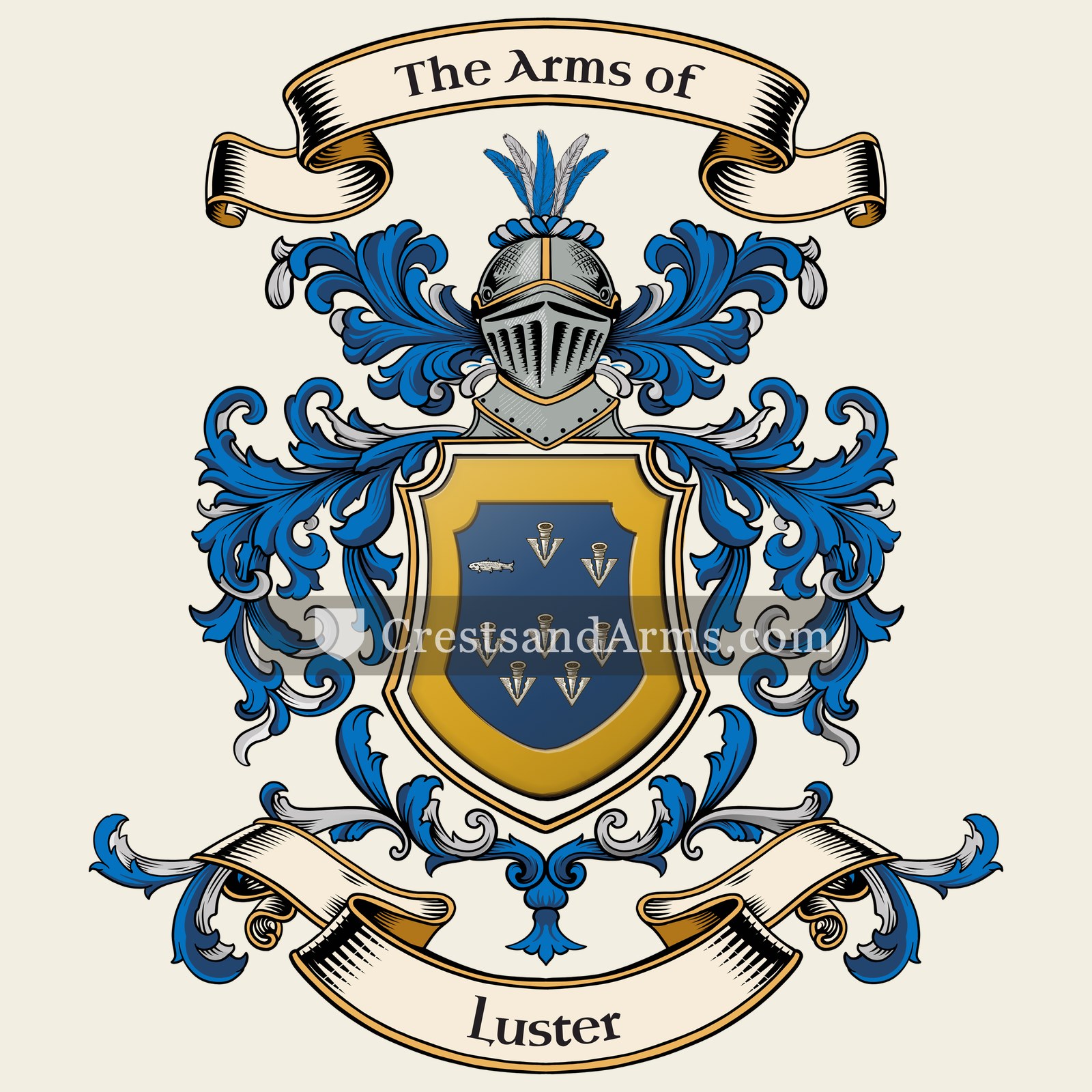
A record of documented arms, meaning and origin, researched for the Luster family of Sweden.
Reg. 8921 · Swedish, J–L
Coat of Arms & Family Crest Details
Symbols on this shield
fishA true and generous mind, and Christian faith
arms pheon arrowheadReadiness for battle, and the broad arrow of the sovereign
Colours
Blue (Azure)Means: Loyalty and truth
Gold (Or)Means: Generosity
Silver (Argent)Means: Peace and sincerity
Historical info
Source
J. B. Rietstap, Armorial Général, Gouda: G. B. van Goor Zonen, 1884–87
Blazon (the actual original written record)
“D'azur à une tête de poisson au nat., posée en pal, iss. d'une mer au nat. en p. et tenant en sa bouche un manche d'or soutenant une tablette du même sommée de sept fers de flèche accostés d'arg. L'écu bordé d'or. Brl. d'azur et d'or. C.: le meuble sommé des fers de flèche, entre quatre pl. d'aut. de sa. L. d'azur et d'or.”
Swedenc. 1700
Digital archive packCoat of arms PNG, gold border print PDF, vector SVG and the certificate of authenticity. Sent to your email in minutes.
Map of Sweden showing where the Luster arms are recorded
The Luster arms were recorded in Sweden, c. 1700.
Arms such as these were typically recorded in Stockholm.
Stockholm held the Swedish court and the House of Nobility, where every noble family's arms were entered and kept. Families ennobled for service registered there, which is why so many are recorded around the city.
This is where the arms were entered in the register. Families often moved to other parts of the country, so the same name can turn up in more than one region.
The body that granted and recorded arms in Sweden in this period.
Carl XII of Sweden
Sovereign of the period
Carl XII of Sweden
1697–1718
Reigning in Sweden when the Luster arms are first recorded.
How Arms Worked in Sweden
In Sweden, a coat of arms belonged to a noble family as a whole rather than just one individual. These arms were passed down through the generations to all legitimate descendants. Younger branches of the family used the same shield without needing to change it. This system ensured that the entire lineage shared the same identity and status under the law.
Granting authority
The Riddarhuset, or House of Nobility, regulated all noble coats of arms in Sweden under royal authority.
How they got arms
Families received their coats of arms through royal grants of nobility which were then officially registered with the House.
Where arms were recorded
Coats of arms were officially recorded in the Swedish House of Nobility register starting in the year 1626.
The family's standing
Recorded among the armigerous families of Sweden.
Origin & History of the Luster Family in Sweden
The surname Luster carries a history deeply rooted in the social landscape of eighteenth-century Stockholm. During the early 1700s, the name began to appear in official city records as Sweden underwent a period of significant urban growth and bureaucratic organization. Families bearing this name were often part of the emerging middle class, working as skilled craftsmen, merchants, or civil servants who helped maintain the city's infrastructure. Because surnames during this era were sometimes adopted to reflect a person’s trade or a specific location, the name likely served as a way to distinguish these individuals within the bustling capital. As the family established their roots in Stockholm, they became part of the city's evolving identity, contributing to the local economy and the daily life of a growing Nordic power.
Related Branches & Arms
Root word
Lust
A German and Swedish word meaning pleasure, desire, or joy.
This name
LusterAn ornamental surname derived from the word for pleasure or delight.
also spelled
Luster
Documented Sources
J. B. Rietstap, Armorial Général, Gouda: G. B. van Goor Zonen, 1884–87
Stockholm City Archives (Stockholms stadsarkiv), Mantalslängder (Tax Census Records) for Stockholm Parish
National Archives of Sweden (Riksarkivet), Kyrkoarkiv (Church Records) for Stockholm City
Lundkvist, Sven, Stockholms historia under 1700-talet (1974)
Nilsson, Göran B., Den svenska historien: Stormaktstiden och frihetstiden (1993)
Digital archive packCoat of arms PNG, gold border print PDF, vector SVG and the certificate of authenticity. Sent to your email in minutes.


 fishA true and generous mind, and Christian faith
 arms pheon arrowheadReadiness for battle, and the broad arrow of the sovereign
 fishA true and generous mind, and Christian faith
 arms pheon arrowheadReadiness for battle, and the broad arrow of the sovereign