A record of documented arms, meaning and origin, researched for the Luter family lines. Documented in 2 countries.
Reg. 4288 · Britain, J–L
Coat of Arms & Family Crest Details
Symbols on this shield
cross symbolChristian faith and service
roseThe seventh son, and beauty with grace
Colours
Blue (Azure)Means: Loyalty and truth
Silver (Argent)Means: Peace and sincerity
Historical info
Source
J. B. Rietstap, Armorial Général, Gouda: G. B. van Goor Zonen, 1884–87
Blazon (the actual original written record)
“D'azur à une rose d'arg., ch. d'un coeur de gu., surch. d'une croix du second émail; le tout renfermé dans un cyclamor d'or [Armes attribuées au docteur Martin Luther.]”
Britainc. 1700
Digital archive packCoat of arms PNG, gold border print PDF, vector SVG and the certificate of authenticity. Sent to your email in minutes.
Map of Britain showing where the Luter arms are recorded
The Luter arms were recorded in Britain, c. 1700.
Arms such as these were typically recorded in Kent.
Kent sits between London and the short crossing to Europe, and the trade passing through made it wealthy. Merchant families bought land with that money, and it was landowners who took coats of arms.
This is where the arms were entered in the register. Families often moved to other parts of the country, so the same name can turn up in more than one region.
The body that granted and recorded arms in Britain in this period.
William III of England
Sovereign of the period
William III of England
1694–1702
Reigning in Britain when the Luter arms are first recorded.
How Arms Worked in Britain
English heraldry allowed arms to be shared by all legitimate descendants of the original owner. These symbols were treated as personal property that moved through the generations to all children. While the eldest son kept the original design, other family members could use the same shield without needing to change it or register their own unique versions.
Granting authority
The College of Arms in London has regulated the use of coats of arms throughout England and Wales since 1484.
How they got arms
Families typically obtained their coats of arms through a formal grant from the Crown or by proving their ancient right to them.
Where arms were recorded
All official coats of arms are recorded in the registers kept at the College of Arms, which date back to the fifteenth century.
The family's standing
Recorded among the armigerous families of Britain.
Origin & History of the Luter Family in Britain
The surname Luter has deep roots in the English county of Kent, where records confirm families bearing the name were well-established by the year 1700. The name likely originated as a descriptive occupational title, referring to a person who played the lute, a popular stringed instrument during the medieval and early modern periods. In the social structure of rural Kent, families with this name were often integrated into the local parish systems, appearing frequently in church registers that tracked baptisms, marriages, and burials. Because Kent served as a primary gateway for trade and travel between England and the European continent, the Luter name may have also been influenced by linguistic shifts or migration patterns from nearby regions. Over time, these early Kentish families helped shape the local community, leaving behind a legacy that reflects the common working lives of English people during the eighteenth century.
Coat of Arms & Family Crest Details
Symbols on this shield
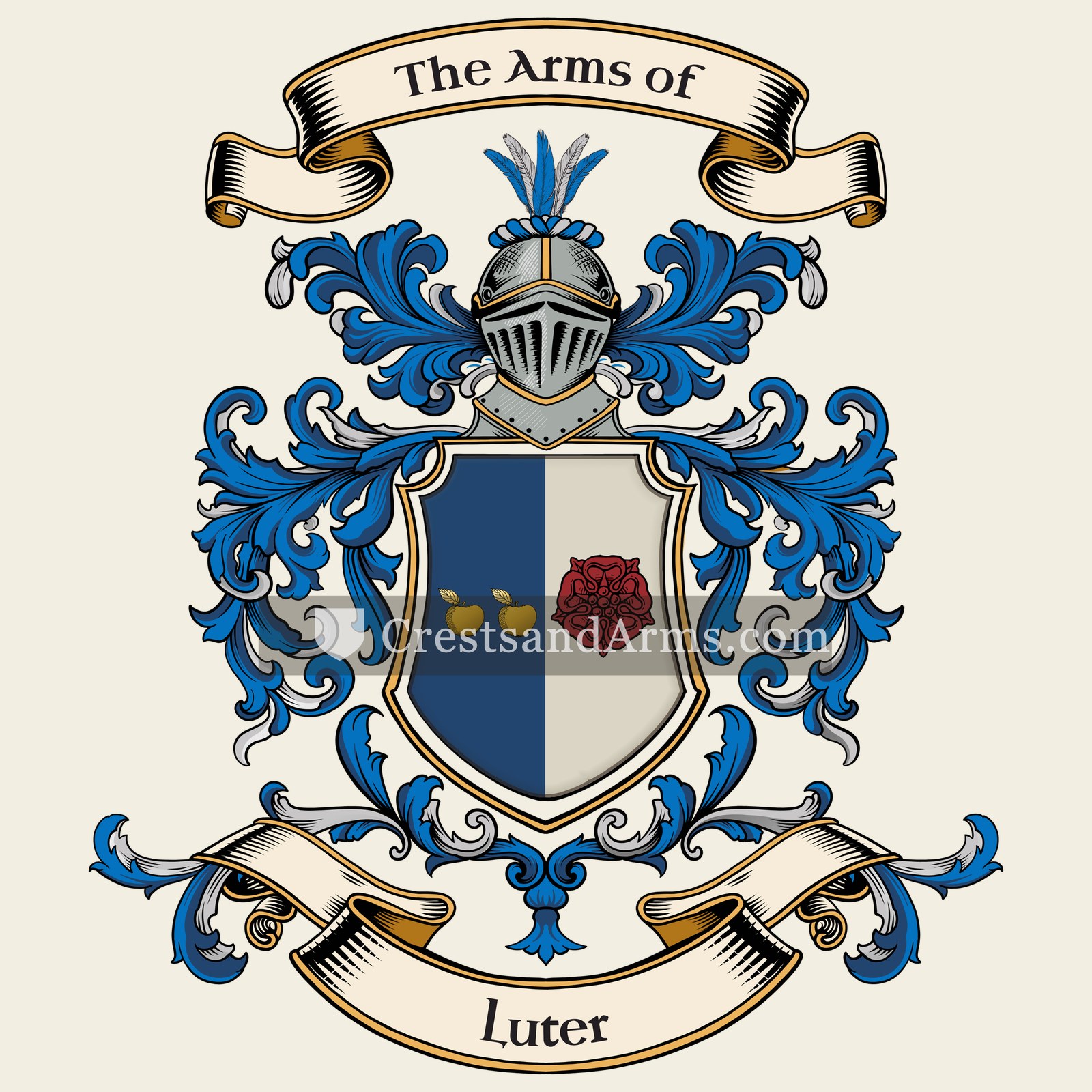
applePeace, plenty and long-standing settlement
roseThe seventh son, and beauty with grace
Colours
Blue (Azure)Means: Loyalty and truth
Silver (Argent)Means: Peace and sincerity
Gold (Or)Means: Generosity
Red (Gules)Means: Military strength
Historical info
Source
J. B. Rietstap, Armorial Général, Gouda: G. B. van Goor Zonen, 1884–87
Blazon (the actual original written record)
“d'azur sur arg.; l'azur ch. de deux pommes d'or, les queues en bas, et l'arg. d'une rose de gu., bout. d'or. C.: un homme barbu iss., coiffé d'une couronne de roses de gu., hab. d'un parti d'azur et d'arg., au rabat de l'un à l'autre, tenant de sa main dextre une rose de gu., bout. d'or, tigée et feuillée de sin., et de sa sen. une pomme d'or, tigée et feuillée de sin. L. d'arg. et d'azur [Descendants d'un frère du grand-père du réformateur.]”
SaxonySaxony, c. 1570
Digital archive packCoat of arms PNG, gold border print PDF, vector SVG and the certificate of authenticity. Sent to your email in minutes.
Map of Germany showing where the Luter arms are recorded
The Luter arms were recorded in Saxony, c. 1570.
Saxony had mines, trade and old landed families all at once. Silver made some fortunes and land held others, and both sorts of family kept arms, which is why Saxon names appear so often in the registers.
This is where the arms were entered in the register. Families often moved to other parts of the country, so the same name can turn up in more than one region.
The body that granted and recorded arms in Germany in this period.
Maximilian II, Holy Roman Emperor
Sovereign of the period
Maximilian II, Holy Roman Emperor
1564–1576
Reigning in Britain when the Luter arms are first recorded.
How Arms Worked in Germany
In the Holy Roman Empire, coats of arms were often granted to individuals by the Emperor or his representatives. These arms were then passed down through the generations to all legitimate descendants of the original holder. Younger branches of a family usually kept the same shield design without needing to change it, as the arms belonged to the entire lineage.
Granting authority
The Holy Roman Emperor held the sole power to grant new coats of arms throughout his vast imperial territories.
How they got arms
Families typically obtained their coats of arms through a formal imperial grant or by proving their noble status to the authorities.
Where arms were recorded
These grants were officially recorded in the Imperial Chancery registers, which began keeping formal records of such honors during the Middle Ages.
The family's standing
Recorded among the armigerous families of Saxony.
Origin & History of the Luter Family in Germany
The surname Luter is deeply rooted in the cultural and linguistic landscape of Saxony, where family members were documented as early as 1570. During this period, the name functioned as a regional variation of names derived from the Germanic personal name Liuthari, which translates to "people's army." The family likely emerged among the industrious populations of central Germany, a region experiencing significant social and religious shifts following the Reformation. As the name appeared in parish registers and local administrative records in the late 16th century, it reflected the common naming practices of the time, where surnames were often adapted to fit local dialects and phonetic preferences. By settling in Saxony, the early Luter family became part of a dense network of tradespeople and farmers who helped define the social fabric of the German heartland during the late Renaissance.
Related Branches & Arms
Root word
Lotharius
Derived from Germanic elements meaning loud or famous warrior.
This name
LuterAn occupational name for a lute player or a variant of the name Luther.
also spelled
Luter
Luthere
Luthar
Documented Sources
J. B. Rietstap, Armorial Général, Gouda: G. B. van Goor Zonen, 1884–87
C.W. Bardsley, A Dictionary of English and Welsh Surnames, 1901
Kent Archives, Archdeaconry of Canterbury Marriage Licences, 1680–1720
P.H. Reaney and R.M. Wilson, A Dictionary of English Surnames, 1991
Digital archive packCoat of arms PNG, gold border print PDF, vector SVG and the certificate of authenticity. Sent to your email in minutes.


 cross symbolChristian faith and service
 roseThe seventh son, and beauty with grace
 cross symbolChristian faith and service
 roseThe seventh son, and beauty with grace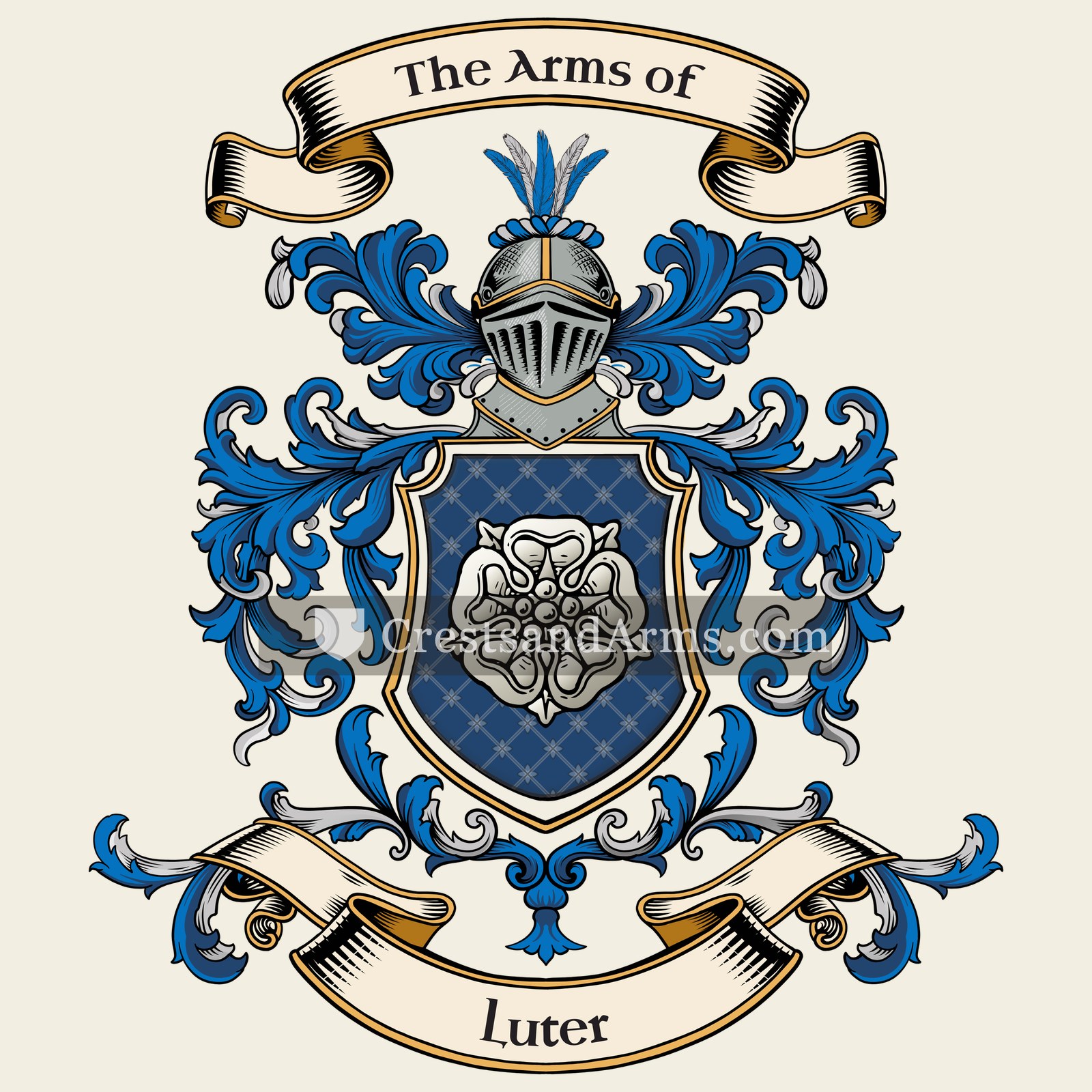


 applePeace, plenty and long-standing settlement