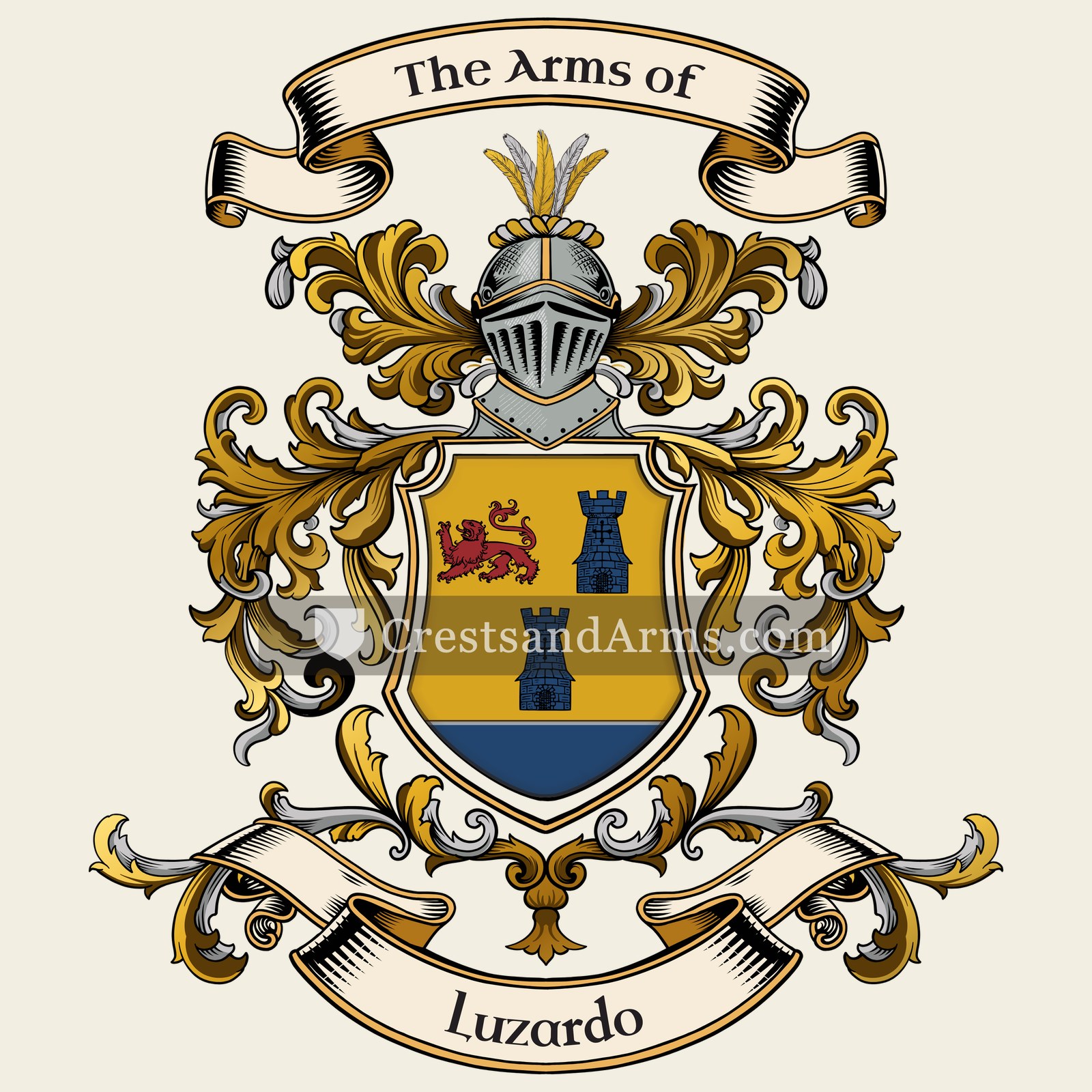
A record of documented arms, meaning and origin, researched for the Luzardo family of Italy.
Reg. 9834 · Italian, J–L
Coat of Arms & Family Crest Details
Symbols on this shield
lionCourage, strength and royalty
towerGrandeur and solidity, and a stronghold defended
Colours
Gold (Or)Means: Generosity
Blue (Azure)Means: Loyalty and truth
Red (Gules)Means: Military strength
Historical info
Source
J. B. Rietstap, Armorial Général, Gouda: G. B. van Goor Zonen, 1884–87
Blazon (the actual original written record)
“D'or à un mur crén. de quatre pièces d'azur, occupant la moitié inférieure de l'écu et sommé de deux tours du même, aj. de sa., à dextre et à sen.; le tout acc. au point du chef d'un rencontre de lynx de gu. Cq. cour. C.: un lynx iss. de gu., la tête posée de front. L.: à dextre d'or et d'azur, à sen. d'or et de gu.”
Italyc. 1884
Digital archive packCoat of arms PNG, gold border print PDF, vector SVG and the certificate of authenticity. Sent to your email in minutes.
Map of Italy showing where the Luzardo arms are recorded
The Luzardo arms were recorded in Italy, c. 1884.
Arms such as these were typically recorded in Venice.
Venice ran on trade, and its great families were merchants before they were anything else. The city kept a formal list of its noble houses, and a name on that list carried arms as a matter of record.
This is where the arms were entered in the register. Families often moved to other parts of the country, so the same name can turn up in more than one region.
The body that granted and recorded arms in Italy in this period.
Umberto I of Italy
Sovereign of the period
Umberto I of Italy
1878–1900
Reigning in Italy when the Luzardo arms are first recorded.
How Arms Worked in Italy
In the Italian states, coats of arms were often used by noble families to show their status and history. These symbols were passed down through the generations to all legitimate male descendants. Younger branches of a family usually kept the original design but sometimes added small changes to distinguish their specific line from the main branch.
Granting authority
Various local rulers and city governments controlled the use of coats of arms across the different Italian states.
How they got arms
Families often assumed their own arms or received them as official grants from local lords, popes, or city councils.
Where arms were recorded
Arms were recorded in local city archives or private family books rather than in one single national register.
The family's standing
Recorded among the armigerous families of Italy.
Origin & History of the Luzardo Family in Italy
The surname Luzardo carries a rich history that is deeply rooted in the cultural landscape of the Mediterranean. While the name is often associated with regions in Spain and Portugal, historical records confirm that members of the family were well-established in Venice by 1884. During this period, Venice served as a vital hub for trade and intellectual exchange, allowing families like the Luzardos to integrate into the city’s vibrant social and commercial life. The name likely evolved from regional dialects, reflecting the movement of people across coastal areas where maritime activity shaped family identities. By the late 19th century, the presence of the Luzardo family in such a significant Italian city highlights their role in the broader European migration patterns of the time. This period of history suggests that the family was part of a mobile class of individuals who contributed to the urban development and cultural diversity of Venice during the late nineteenth century.
Related Branches & Arms
Root word
Lucidus
Latin term meaning clear, bright, or shining.
This name
LuzardoDerived from a topographic reference to a bright or luminous place.
Documented Sources
J. B. Rietstap, Armorial Général, Gouda: G. B. van Goor Zonen, 1884–87
Archivio di Stato di Venezia, Stato Civile della Restaurazione, 1884
De Felice, Emidio, Dizionario dei cognomi italiani, 1978
Morghen, Raffaello, Storia del Medioevo, 1966
Digital archive packCoat of arms PNG, gold border print PDF, vector SVG and the certificate of authenticity. Sent to your email in minutes.


 lionCourage, strength and royalty
 towerGrandeur and solidity, and a stronghold defended
 lionCourage, strength and royalty
 towerGrandeur and solidity, and a stronghold defended