A record of documented arms, meaning and origin, researched for the Lynch family lines. Documented in 3 countries.
Reg. 6311 · French, J–L
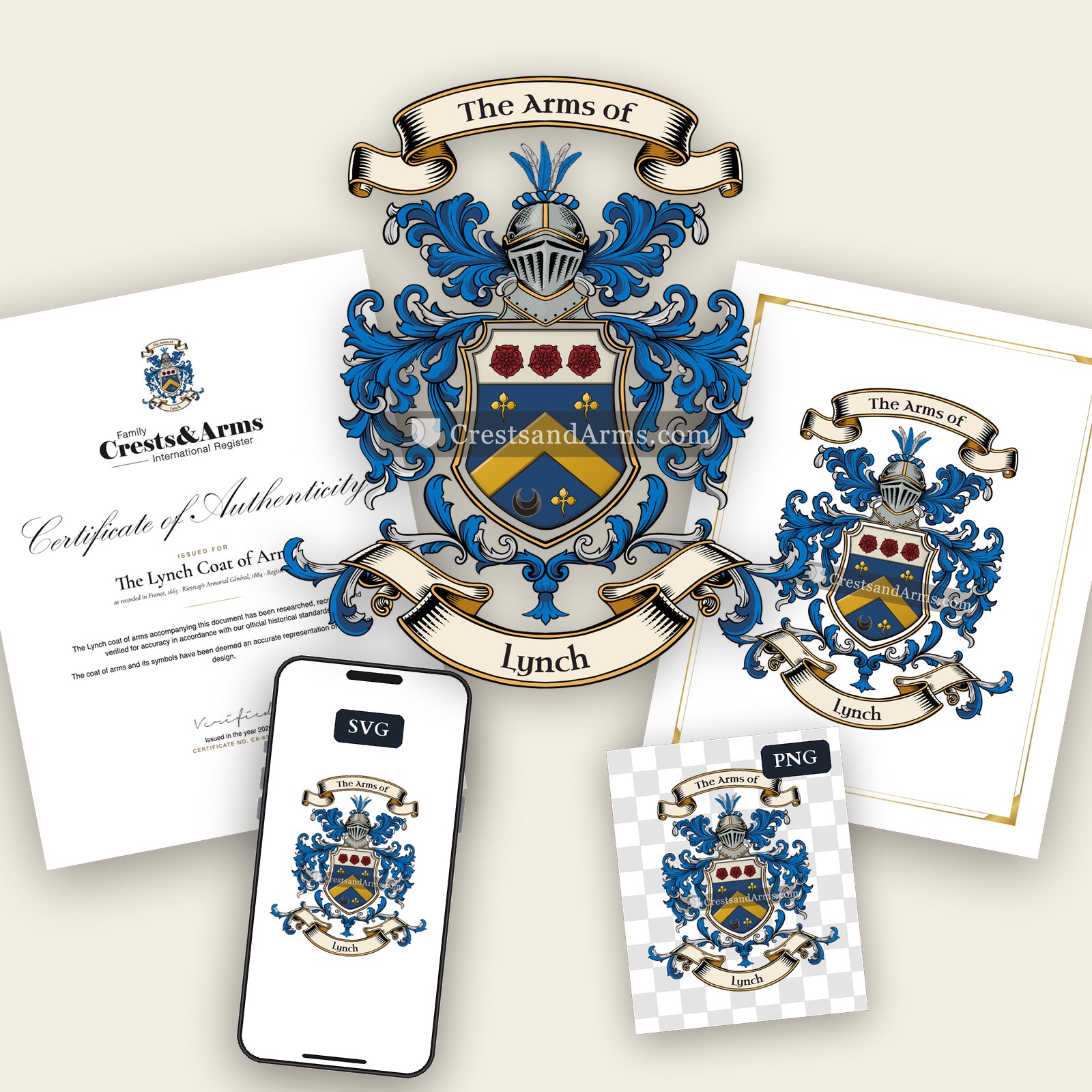
Coat of Arms & Family Crest Details
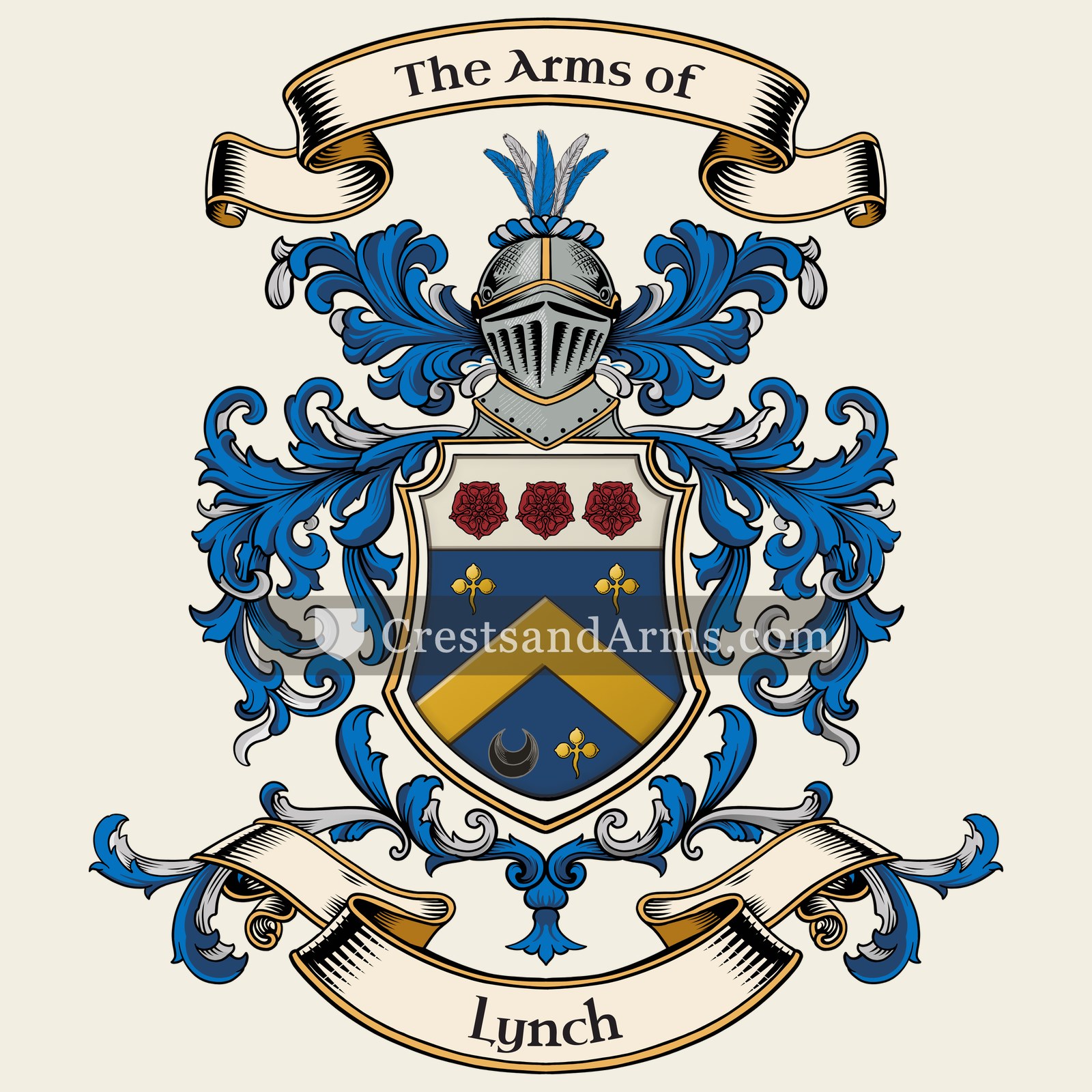
Symbols on this shield
chevronProtection, and faithful service completed
chiefAuthority, wisdom and dominion
crescentHonour by the sovereign, and the second son
trefoilPerpetuity, and the Trinity
roseThe seventh son, and beauty with grace
Colours
Blue (Azure)Means: Loyalty and truth
Gold (Or)Means: Generosity
Silver (Argent)Means: Peace and sincerity
Black (Sable)Means: Constancy
Red (Gules)Means: Military strength
Historical info
Source
J. B. Rietstap, Armorial Général, Gouda: G. B. van Goor Zonen, 1884–87
Blazon (the actual original written record)
“D'azur au chev. d'or, acc. de trois trèfles du même; au chef d'arg., ch. de trois roses de gu.; au croiss. de sa., br. sur la cime du chev. et sur le chef.”
GuyenneMartinique · Guyenne, c. 1663
Digital archive packCoat of arms PNG, gold border print PDF, vector SVG and the certificate of authenticity. Sent to your email in minutes.
Map of France showing where the Lynch arms are recorded
The Lynch arms were recorded in Guyenne, c. 1663.
Guyenne was the great wine country of south-western France, shipping claret to England for centuries. The trade made merchant families rich, they bought vineyards and estates with the money, and land of that kind brought arms with it.
This is where the arms were entered in the register. Families often moved to other parts of the country, so the same name can turn up in more than one region.
The body that granted and recorded arms in France in this period.
Louis XIV of France
Sovereign of the period
Louis XIV of France
1643–1715
Reigning in France when the Lynch arms are first recorded.
How Arms Worked in France
In France, a coat of arms was a mark of honor that passed down through the male line to all legitimate descendants. Families often used the same shield without changes to show their shared heritage. If a branch wanted to stand out, they could add a small mark to their shield to show their specific place in the family tree.
Granting authority
The Juge d'armes de France acted as the official authority that regulated and verified coats of arms across the country.
How they got arms
Families typically inherited their arms from ancestors, though they could also receive them through royal grants or by proving their noble status.
Where arms were recorded
Coats of arms were officially recorded in the Armorial Général de France, which began its main collection in the year 1696.
The family's standing
Recorded among the armigerous families of Guyenne.
Origin & History of the Lynch Family in France
The history of the Lynch family in France is deeply tied to the region of Guyenne, where members of the family established themselves by 1663. Originally of Irish descent, the family moved to the port city of Bordeaux to escape political and religious instability in their home country. They quickly integrated into the local merchant class by taking advantage of the city's thriving wine trade. Because of their success in international commerce, the family became a prominent part of the social and economic life in southwestern France. They eventually became known as the Lynch de Bordeaux, and they played a significant role in the development of the local economy for several generations. Their transition from Irish expatriates to influential French citizens highlights how immigrant families often shaped the growth of European port cities during the seventeenth century.
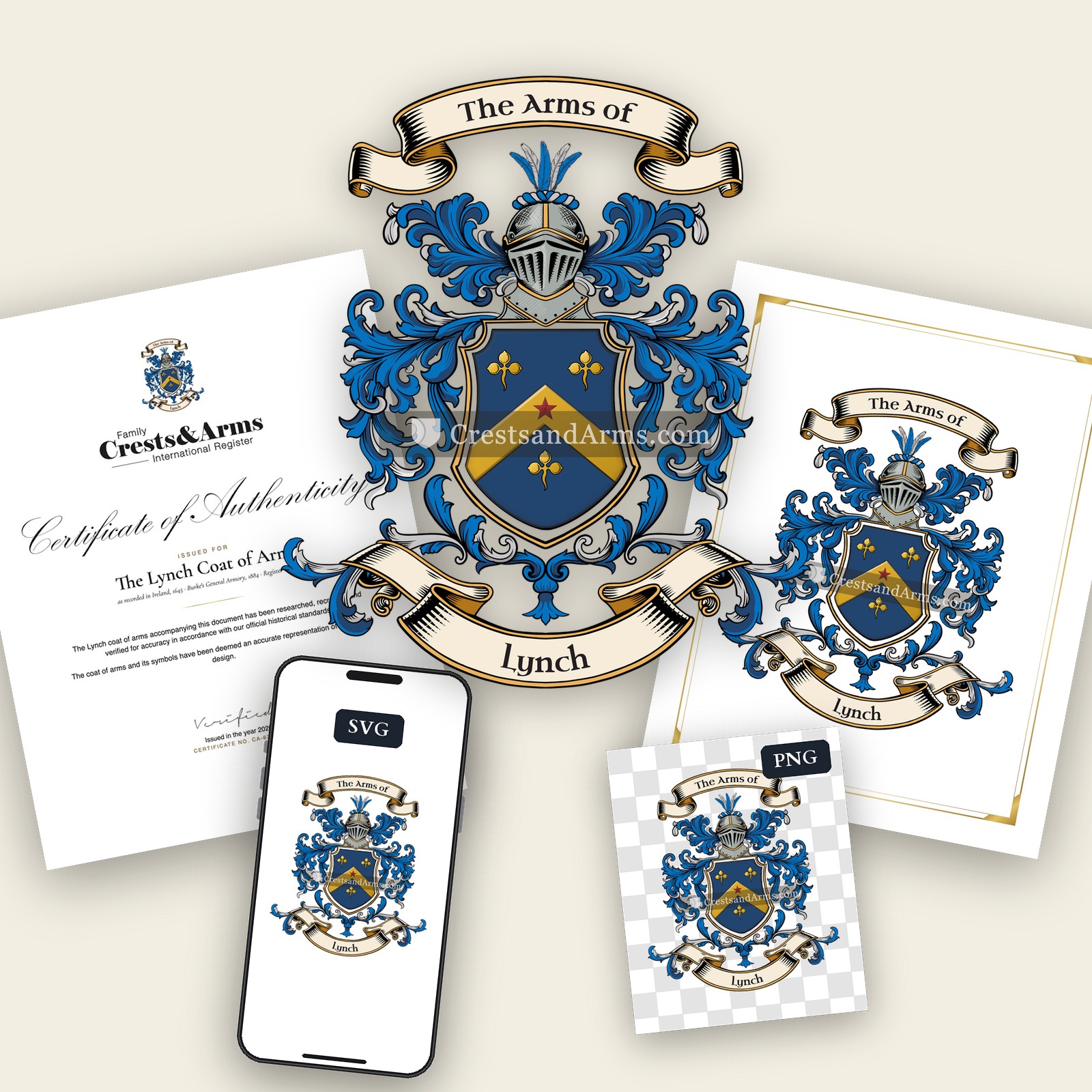
Coat of Arms & Family Crest Details
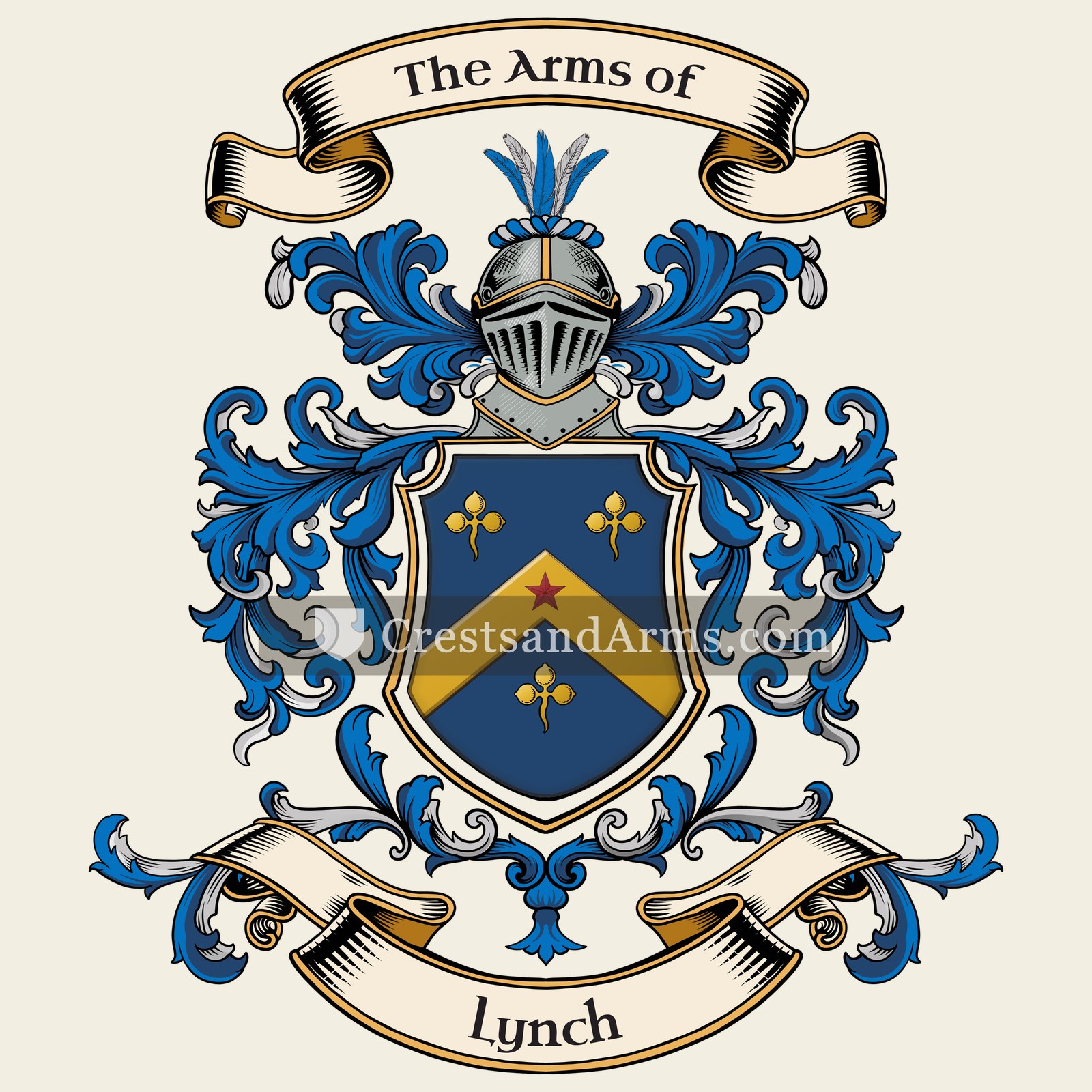
Symbols on this shield
chevronProtection, and faithful service completed
trefoilPerpetuity, and the Trinity
mulletThe third son, and a divine quality from above
Colours
Blue (Azure)Means: Loyalty and truth
Gold (Or)Means: Generosity
Red (Gules)Means: Military strength
Historical info
Source
Sir Bernard Burke, The General Armory of England, Scotland, Ireland and Wales, London: Harrison & Sons, 1884
Blazon (the actual original written record)
“Az. on a chev. betw. three trefoils slipped or, a mullet gu”
GalwayClydagh House · Galway, c. 1645
Digital archive packCoat of arms PNG, gold border print PDF, vector SVG and the certificate of authenticity. Sent to your email in minutes.
Map of Ireland showing where the Lynch arms are recorded
The Lynch arms were recorded in Galway, c. 1645.
Galway was western Irish country of poor land and a rich port. A small group of merchant families ran the town for centuries and held estates around it, and both kinds of property carried arms.
This is where the arms were entered in the register. Families often moved to other parts of the country, so the same name can turn up in more than one region.
The body that granted and recorded arms in Ireland in this period.
Charles I of England
Sovereign of the period
Charles I of England
1625–1649
Reigning in France when the Lynch arms are first recorded.
How Arms Worked in Ireland
The Ulster King of Arms granted coats of arms to individuals who proved their social standing and good character. These symbols were typically inherited by all legitimate descendants of the original holder. If a family branch wanted a unique look, they could apply for a specific change to their design through the office to ensure their identity remained distinct.
Granting authority
The Ulster King of Arms acted as the official body that regulated and issued all coats of arms throughout Ireland.
How they got arms
Families obtained their arms through formal grants issued by the office after proving their eligibility and paying the required fees.
Where arms were recorded
All official grants were recorded in the registers held by the Ulster King of Arms starting from the year 1552.
The family's standing
Recorded among the armigerous families of Galway.
Origin & History of the Lynch Family in Ireland
The surname Lynch is deeply connected to the history of Galway, where the family rose to prominence as one of the famous Tribes of Galway. These families were a group of merchant dynasties that controlled the town’s trade and local government for several centuries. By the time of the mid-seventeenth century, the Lynch family had already established themselves as a powerful force in the region, holding significant influence over both commerce and politics. Their presence in 1645 reflects a period when the family was deeply integrated into the social structure of the city. They were known for their extensive connections to continental Europe, which helped them maintain a successful network of trade across the Atlantic and beyond. This status allowed them to shape the development of Galway into a major port city, leaving a lasting mark on the urban landscape and the administrative history of western Ireland.
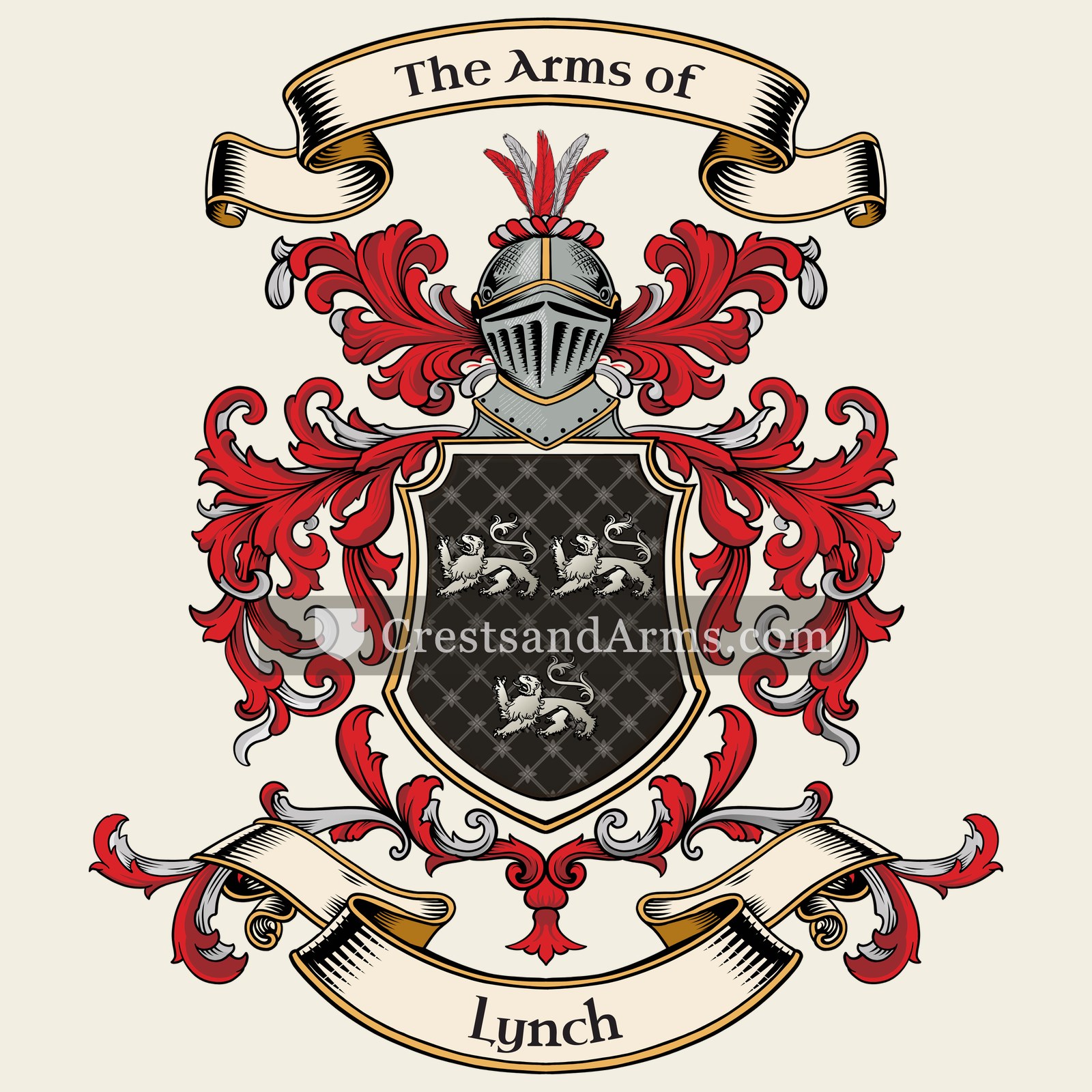
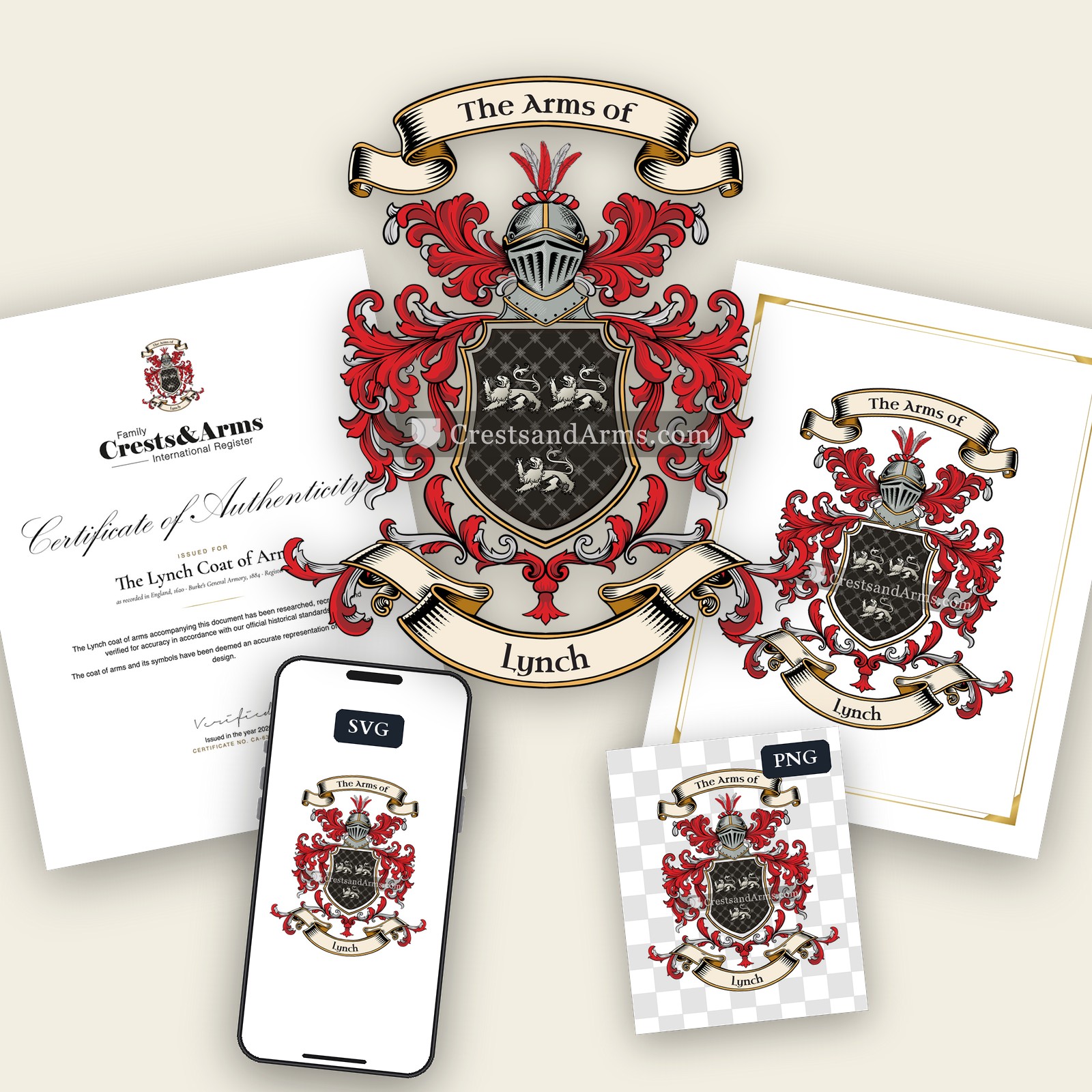
Coat of Arms & Family Crest Details
Symbols on this shield
lionCourage, strength and royalty
Colours
Black (Sable)Means: Constancy
Silver (Argent)Means: Peace and sincerity
Historical info
Source
Sir Bernard Burke, The General Armory of England, Scotland, Ireland and Wales, London: Harrison & Sons, 1884
Blazon (the actual original written record)
“Sa. three leopards ramp. ar. spotted of the field”
KentGroves · Kent, c. 1620
Digital archive packCoat of arms PNG, gold border print PDF, vector SVG and the certificate of authenticity. Sent to your email in minutes.
Map of England showing where the Lynch arms are recorded
The Lynch arms were recorded in Kent, c. 1620.
Kent sits between London and the short crossing to Europe, and the trade passing through made it wealthy. Merchant families bought land with that money, and it was landowners who took coats of arms.
This is where the arms were entered in the register. Families often moved to other parts of the country, so the same name can turn up in more than one region.
The body that granted and recorded arms in England in this period.
James VI and I
Sovereign of the period
James VI and I
1603–1625
Reigning in France when the Lynch arms are first recorded.
How Arms Worked in England
English heraldry allowed arms to be shared by all legitimate descendants of the original owner. These symbols were treated as personal property that moved through the generations to all children. While the eldest son kept the original design, other family members could use the same shield without needing to change it or register their own unique versions.
Granting authority
The College of Arms in London has regulated the use of coats of arms throughout England and Wales since 1484.
How they got arms
Families typically obtained their coats of arms through a formal grant from the Crown or by proving their ancient right to them.
Where arms were recorded
All official coats of arms are recorded in the registers kept at the College of Arms, which date back to the fifteenth century.
The family's standing
Recorded among the armigerous families of Kent.
Origin & History of the Lynch Family in England
The history of the Lynch name in England is deeply connected to the social and economic shifts of the seventeenth century. While the name has ancient roots, records confirm that family members were firmly established in the county of Kent by 1620. During this period, Kent served as a vital hub for trade and agriculture, placing the family in a region that was experiencing significant growth and movement. Many individuals with this surname were involved in the local parish life and the developing mercantile economy of southern England. Their presence in Kent suggests they were part of the steady migration of families who sought stability and opportunity in the fertile landscape of the English countryside. By settling in this area, the early Lynch family became part of the local fabric that helped shape the rural and commercial identity of the region during the early modern era.
Lynch Meaning & Related Branches
Root word
Linch
Derived from the Old English word for a ridge or riverbank.
This name
LynchAn anglicized form of the Irish surname O Loingsigh, meaning descendant of the mariner.
also spelled
Linch
Linche
Related arms
Adinesimilar arms
Moretonsimilar arms
Linchvariant spelling
Fishrecorded with Lynch, same area
Documented Sources
J. B. Rietstap, Armorial Général, Gouda: G. B. van Goor Zonen, 1884–87
Butel, Paul. Les Négociants bordelais, l'Europe et les îles au XVIIIe siècle. 1974
Dauzat, Albert. Dictionnaire étymologique des noms et prénoms de France. 1951
Archives départementales de la Gironde, Série B (Cours et juridictions)
Archives municipales de Bordeaux, Série HH (Affaires militaires et administration)
Digital archive packCoat of arms PNG, gold border print PDF, vector SVG and the certificate of authenticity. Sent to your email in minutes.


 chevronProtection, and faithful service completed
 chiefAuthority, wisdom and dominion
 crescentHonour by the sovereign, and the second son
 trefoilPerpetuity, and the Trinity
 roseThe seventh son, and beauty with grace
 chevronProtection, and faithful service completed
 chiefAuthority, wisdom and dominion
 crescentHonour by the sovereign, and the second son
 trefoilPerpetuity, and the Trinity
 roseThe seventh son, and beauty with grace


 mulletThe third son, and a divine quality from above


 lionCourage, strength and royalty