Map of England showing where the Lynn arms are recorded
The Lynn arms were recorded in Cambridge, c. 1620.
Cambridgeshire was flat, rich farming country with the university at its centre. Fen drainage made new land and new fortunes, and families who gained by it bought manors and took arms to match.
This is where the arms were entered in the register. Families often moved to other parts of the country, so the same name can turn up in more than one region.
The body that granted and recorded arms in England in this period.
James VI and I
Sovereign of the period
James VI and I
1603–1625
Reigning in England when the Lynn arms are first recorded.
How Arms Worked in England
English heraldry allowed arms to be shared by all legitimate descendants of the original owner. These symbols were treated as personal property that moved through the generations to all children. While the eldest son kept the original design, other family members could use the same shield without needing to change it or register their own unique versions.
Granting authority
The College of Arms in London has regulated the use of coats of arms throughout England and Wales since 1484.
How they got arms
Families typically obtained their coats of arms through a formal grant from the Crown or by proving their ancient right to them.
Where arms were recorded
All official coats of arms are recorded in the registers kept at the College of Arms, which date back to the fifteenth century.
The family's standing
Recorded among the armigerous families of Cambridge.
Origin & History of the Lynn Family in England
The family name Lynn is primarily topographical in origin, meaning it was originally used to describe people who lived near a specific natural landmark. The word is derived from the Old Gaelic term *linn*, which refers to a pool, a lake, or a waterfall. As people began to adopt permanent surnames in the British Isles, those residing near such features were often identified by their proximity to the water. By the early seventeenth century, members of the family had crossed the Atlantic to establish new lives in the American colonies. Historical records confirm that individuals bearing the Lynn name were present in Cambridge, Massachusetts, as early as 1620. These early settlers were part of the initial wave of migration that shaped the social and political landscape of New England, helping to build the foundations of the town during its first years of existence.
Lynn Meaning & Related Branches
Root word
Llyn
A Welsh word meaning a lake or pool of water.
This name
LynnDerived from a topographical feature referring to someone who lived near a lake.
also spelled
Lin
Linn
Linne
Related arms
Linnevariant spelling
Boltonrecorded with Lynn, same area
Burwellrecorded with Lynn, same area
Manglesrecorded with Lynn, same area
Documented Sources
Sir Bernard Burke, The General Armory of England, Scotland, Ireland and Wales, London: Harrison & Sons, 1884
Banks, Charles Edward, The English Ancestry and Homes of the Pilgrim Fathers, 1929
Pope, Charles Henry, The Pioneers of Massachusetts, 1900
Massachusetts State Archives, Colonial Records of the Massachusetts Bay Colony, 1620–1686
Digital archive packCoat of arms PNG, gold border print PDF, vector SVG and the certificate of authenticity. Sent to your email in minutes.


 bordureA difference between branches of one family
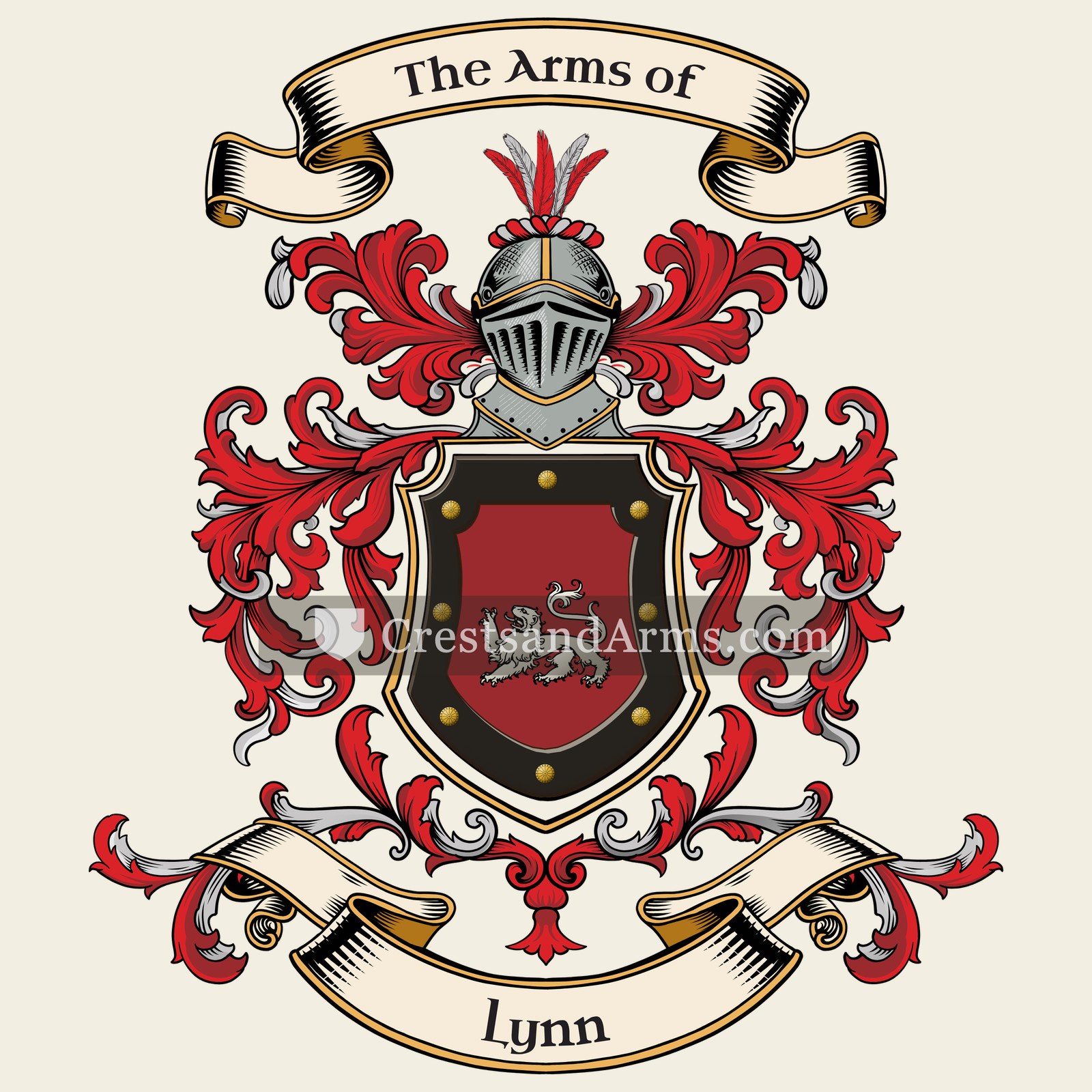
 lionCourage, strength and royalty
 roundelA coin, and one who has been to the crusades
 bordureA difference between branches of one family
 lionCourage, strength and royalty
 roundelA coin, and one who has been to the crusades