Map of Netherlands showing where the Lyster arms are recorded
The Lyster arms were recorded in Netherlands, c. 1815.
Arms such as these were typically recorded in Friesland.
Friesland was low, wet country on the northern coast of the Netherlands, farmed by families who had held the same land for centuries. Free landholders were unusually common there, and a free landholder could carry arms.
This is where the arms were entered in the register. Families often moved to other parts of the country, so the same name can turn up in more than one region.
Region
Friesland
First recorded
1815
Granting Authority for the Lyster Arms
Hoge Raad van Adel
Photograph made by me · CC BY-SA 3.0
The body that granted and recorded arms in Netherlands in this period.
William I of the Netherlands
Sovereign of the period
William I of the Netherlands
1815–1840
Reigning in Netherlands when the Lyster arms are first recorded.
How Arms Worked in Netherlands
In the Netherlands, coats of arms were often used by noble families and those who held specific public offices. These arms were passed down through the generations to legitimate descendants. Younger branches of a family usually kept the original design without needing to add special marks. This system ensured that the family identity remained clear and consistent over many years.
Granting authority
The Hoge Raad van Adel is the official body that regulates and manages noble titles and coats of arms in the Netherlands.
How they got arms
Families typically obtained their coats of arms through official royal grants or by proving their long-standing historical use of the symbols.
Where arms were recorded
Coats of arms are officially recorded in the registers held by the Hoge Raad van Adel, which began its work in 1814.
The family's standing
Recorded among the armigerous families of Netherlands.
Origin & History of the Lyster Family in Netherlands
The history of the Lyster family in the Netherlands is deeply connected to the northern province of Friesland, where records confirm their presence by 1815. During this period, the Netherlands underwent significant social changes following the end of the Napoleonic Wars and the establishment of the United Kingdom of the Netherlands. Families living in Friesland often navigated a unique cultural landscape, as the region maintained its own distinct Frisian language and traditions while integrating into the broader Dutch state. The name Lyster likely emerged through local naming customs or geographic identifiers common to the coastal regions of the North Sea. By the early nineteenth century, members of the family were part of a society transitioning toward modern civil registration, which helped solidify their formal identity in official government ledgers. This era marked a time when many families in the northern provinces began to document their lineage more strictly as the Dutch government standardized record-keeping practices across all provinces.
Coat of Arms & Family Crest Details
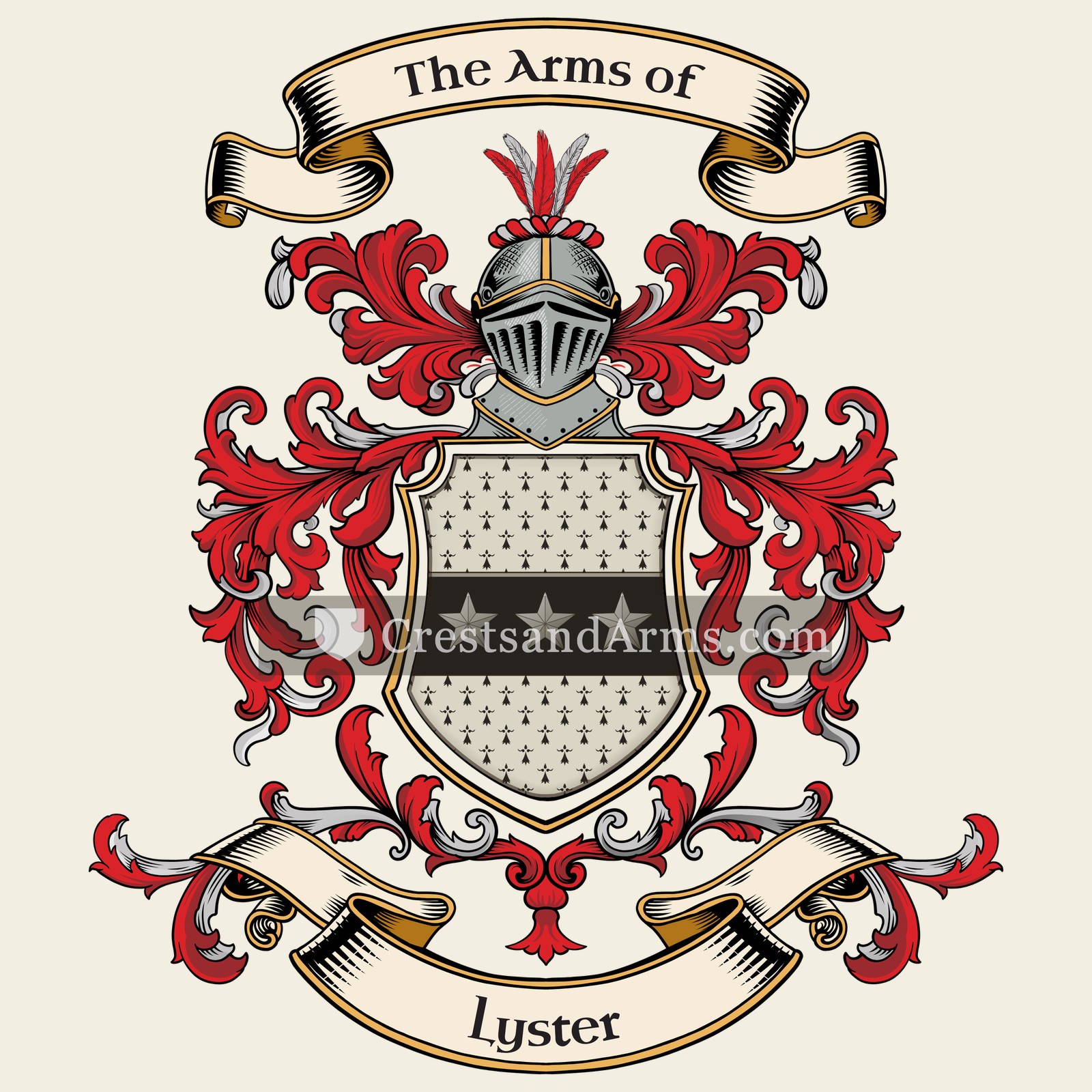
Symbols on this shield
fessThe military belt, and readiness to serve
mulletThe third son, and a divine quality from above
Colours
ErmineMeans: Dignity
Black (Sable)Means: Constancy
Silver (Argent)Means: Peace and sincerity
Historical info
Source
Sir Bernard Burke, The General Armory of England, Scotland, Ireland and Wales, London: Harrison & Sons, 1884
Blazon (the actual original written record)
“Erm. on a fesse sa. three mullets ar”
SalopRowton Castle · Salop, c. 1451
Digital archive packCoat of arms PNG, gold border print PDF, vector SVG and the certificate of authenticity. Sent to your email in minutes.
Map of England showing where the Lyster arms are recorded
The Lyster arms were recorded in Salop, c. 1451.
Shropshire lay on the Welsh border, and border country needed men who could fight. Families held their land in return for service, and service in arms is what a coat of arms was originally for.
This is where the arms were entered in the register. Families often moved to other parts of the country, so the same name can turn up in more than one region.
The body that granted and recorded arms in England in this period.
Henry VI of England
Sovereign of the period
Henry VI of England
1422–1461
Reigning in Netherlands when the Lyster arms are first recorded.
How Arms Worked in England
English heraldry allowed arms to be shared by all legitimate descendants of the original owner. These symbols were treated as personal property that moved through the generations to all children. While the eldest son kept the original design, other family members could use the same shield without needing to change it or register their own unique versions.
Granting authority
The College of Arms in London has regulated the use of coats of arms throughout England and Wales since 1484.
How they got arms
Families typically obtained their coats of arms through a formal grant from the Crown or by proving their ancient right to them.
Where arms were recorded
All official coats of arms are recorded in the registers kept at the College of Arms, which date back to the fifteenth century.
The family's standing
Recorded among the armigerous families of Salop.
Origin & History of the Lyster Family in England
The Lyster family name is deeply rooted in the history of the English county of Salop, which is also known as Shropshire. Records confirm that members of the family were well-established in this region by 1451. The name itself is thought to be an occupational surname, likely derived from the Middle English word "litster," which referred to a person who worked as a dyer of cloth. During the medieval period, the wool trade was the backbone of the English economy, and those involved in processing textiles often held significant standing in their local communities. By settling in the West Midlands, the Lyster family became part of the regional gentry, managing land and participating in the administrative life of the county. Their presence in Salop reflects the broader movement of families who built their influence through trade and local land ownership during the late Middle Ages.
Coat of Arms & Family Crest Details
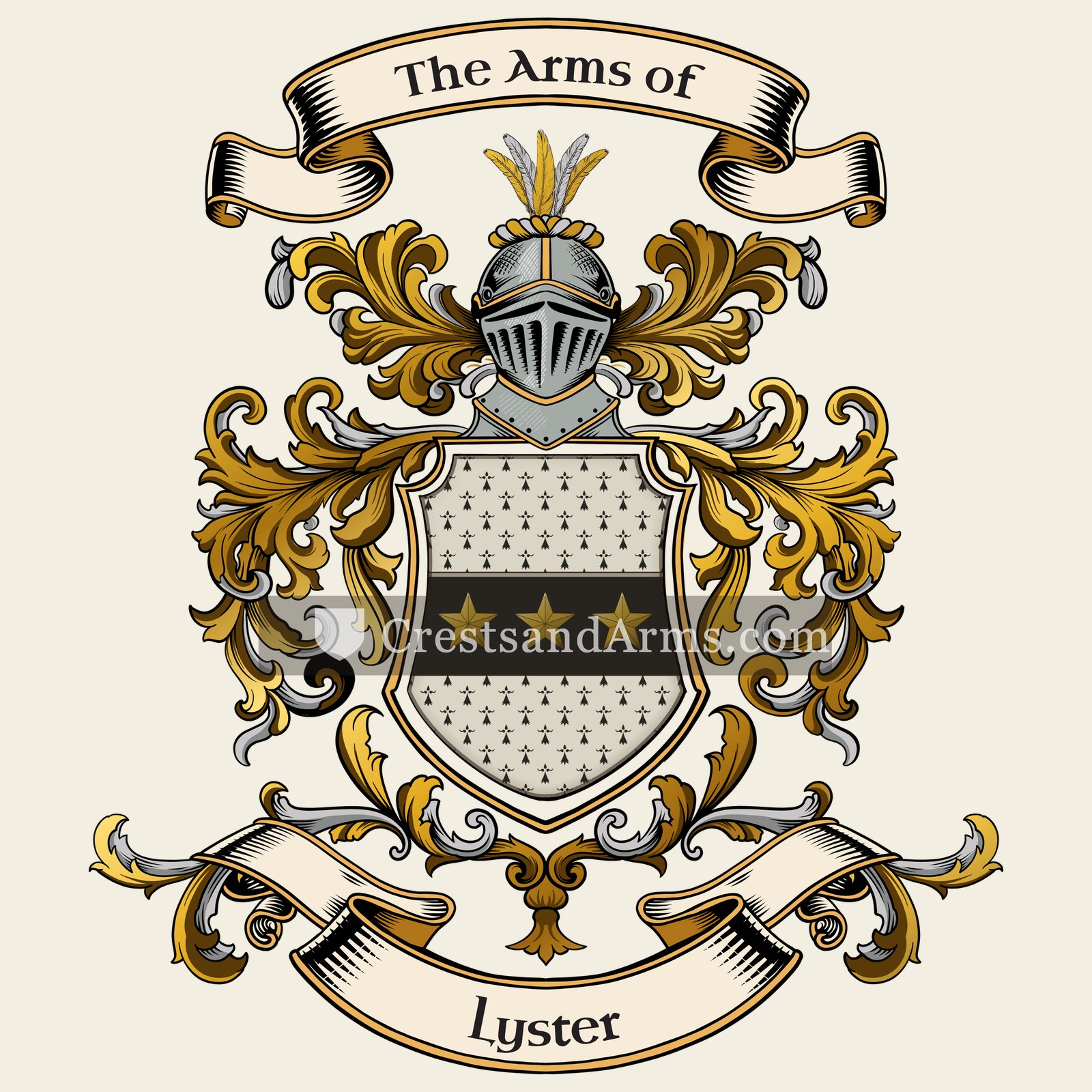
Symbols on this shield
fessThe military belt, and readiness to serve
mulletThe third son, and a divine quality from above
Colours
ErmineMeans: Dignity
Black (Sable)Means: Constancy
Gold (Or)Means: Generosity
Historical info
Source
Sir Bernard Burke, The General Armory of England, Scotland, Ireland and Wales, London: Harrison & Sons, 1884
Blazon (the actual original written record)
“Erm. on a fess sa. three mullets or”
RoscommonRoscommon, c. 1805
Digital archive packCoat of arms PNG, gold border print PDF, vector SVG and the certificate of authenticity. Sent to your email in minutes.
Map of Ireland showing where the Lyster arms are recorded
The Lyster arms were recorded in Roscommon, c. 1805.
Roscommon was midland Irish grazing country, held by old Irish families before the plantations and by settlers after. Both sorts held land, and holding land is what brought arms.
This is where the arms were entered in the register. Families often moved to other parts of the country, so the same name can turn up in more than one region.
The body that granted and recorded arms in Ireland in this period.
George III of Great Britain
Sovereign of the period
George III of Great Britain
1801–1820
Reigning in Netherlands when the Lyster arms are first recorded.
How Arms Worked in Ireland
The Ulster King of Arms granted coats of arms to individuals who proved their social standing and good character. These symbols were typically inherited by all legitimate descendants of the original holder. If a family branch wanted a unique look, they could apply for a specific change to their design through the office to ensure their identity remained distinct.
Granting authority
The Ulster King of Arms acted as the official body that regulated and issued all coats of arms throughout Ireland.
How they got arms
Families obtained their arms through formal grants issued by the office after proving their eligibility and paying the required fees.
Where arms were recorded
All official grants were recorded in the registers held by the Ulster King of Arms starting from the year 1552.
The family's standing
Recorded among the armigerous families of Roscommon.
Origin & History of the Lyster Family in Ireland
The Lyster family name in Ireland is deeply connected to the history of County Roscommon, where members of the family established themselves as prominent landowners by the early nineteenth century. The name itself is of English origin, derived from an occupational term for a dyer of cloth, but the family became firmly rooted in the Irish landscape through the acquisition of estates and participation in local administration. By 1805, the Lysters were well-entrenched in the social and political life of the region, often serving as magistrates or high sheriffs who managed the affairs of their local communities. Their presence in Roscommon reflects a broader pattern of families who moved to Ireland during periods of transition and eventually integrated into the local gentry. Over time, the family became synonymous with the development of their specific estates, leaving a lasting mark on the rural geography and administrative history of the west of Ireland.
Related Branches & Arms
Root word
Lister
An occupational term for a person who dyes cloth.
This name
LysterA topographic or occupational surname referring to a dyer of textiles.
also spelled
Lister
Lystre
Lystar
Related arms
Listervariant spelling
Litstervariant spelling
Documented Sources
J. B. Rietstap, Armorial Général, Gouda: G. B. van Goor Zonen, 1884–87
Tresoar (Fries Historisch en Letterkundig Centrum), Burgerlijke Stand van de provincie Friesland
Netherlands Nationaal Archief, Registers van de Burgerlijke Stand
Digital archive packCoat of arms PNG, gold border print PDF, vector SVG and the certificate of authenticity. Sent to your email in minutes.


 hammerHonest labour, and the smith's craft
 hammerHonest labour, and the smith's craft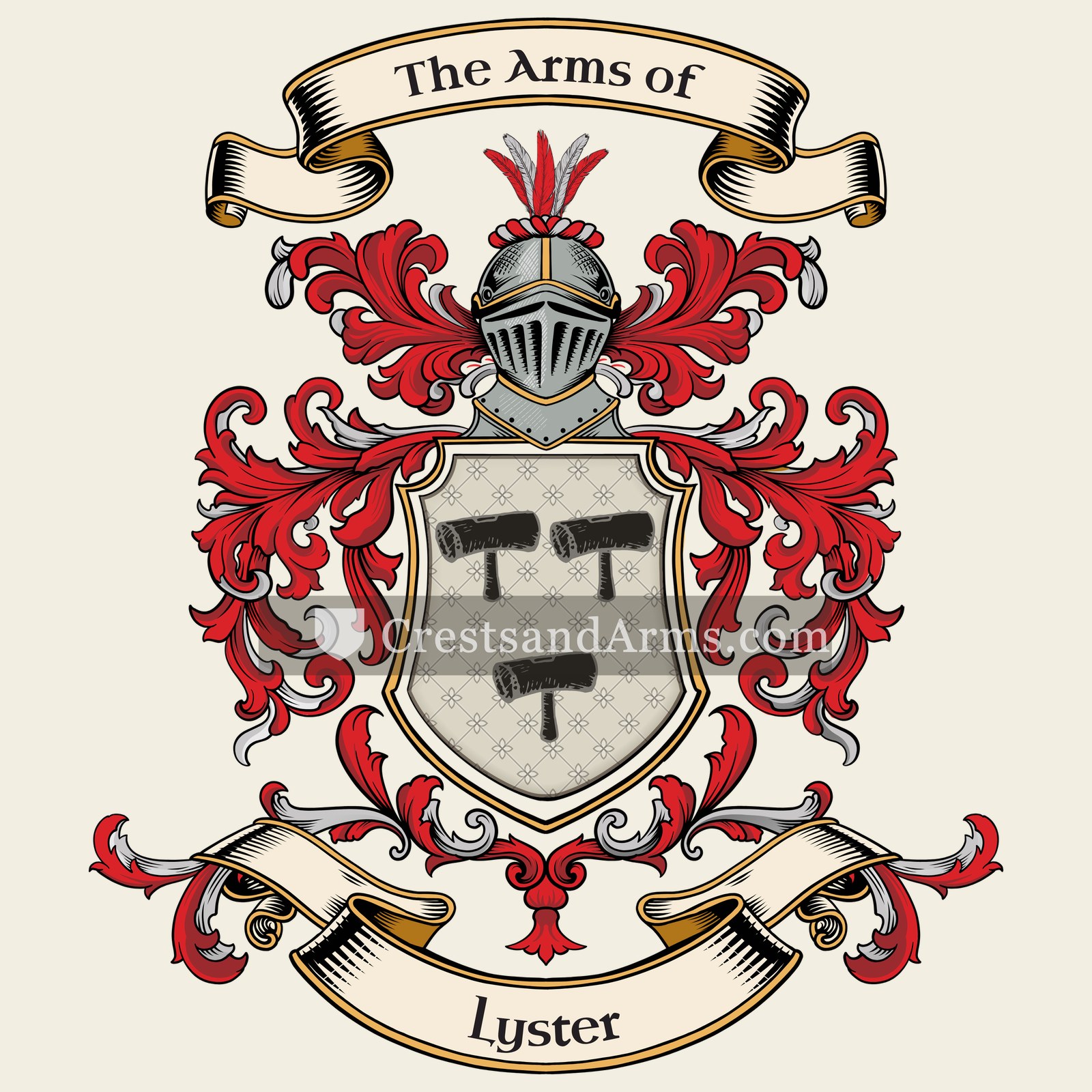


 fessThe military belt, and readiness to serve
 mulletThe third son, and a divine quality from above