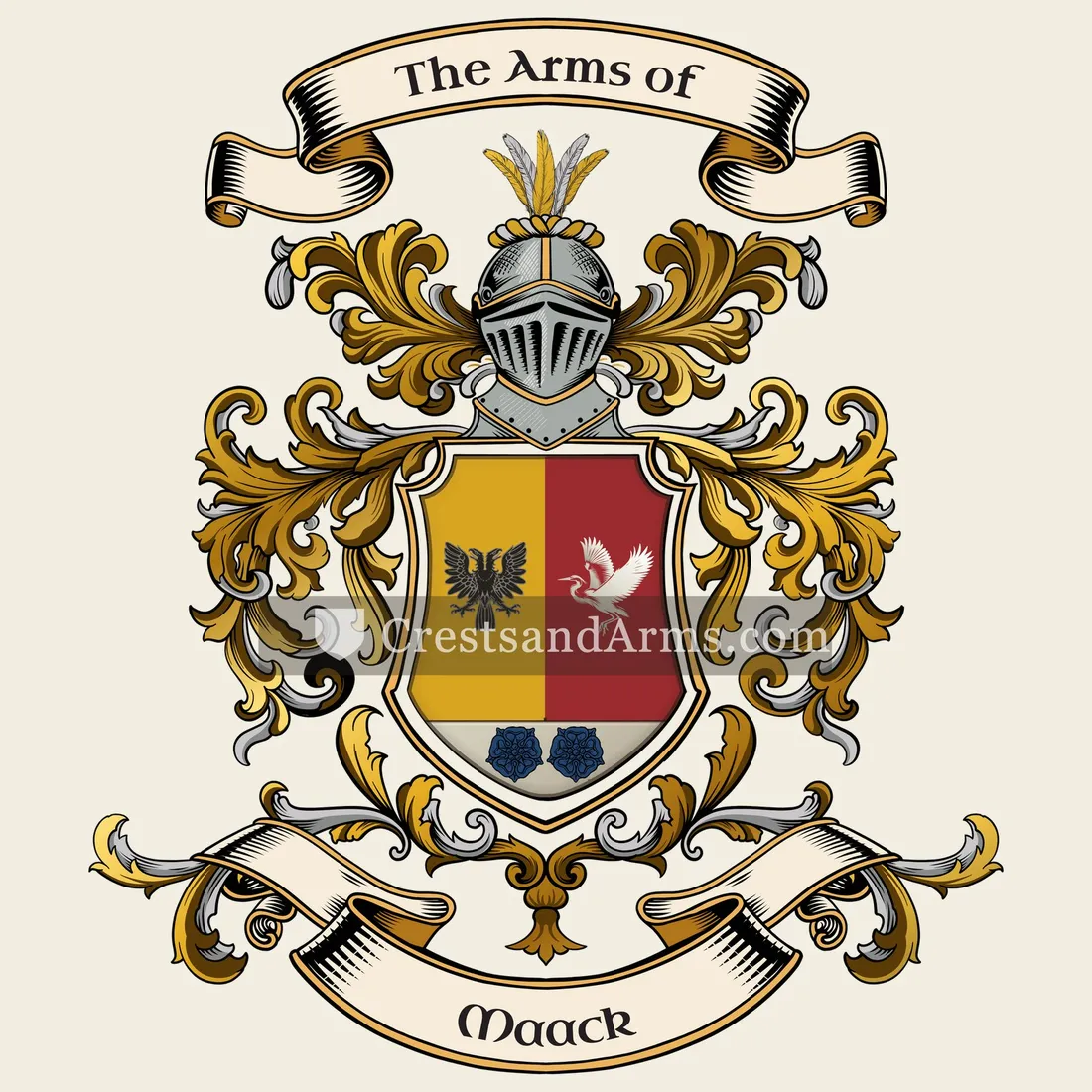
A record of documented arms, meaning and origin, researched for the Maack family of Germany.
Reg. 0264 · German, M–O
Meaning of the Maack family crest colors & symbols
Symbols on this shield
roseThe seventh son, and beauty with grace
eagleNobility, strength and a keen mind
heronPatience and quiet watchfulness
Colours
Gold (Or)Means: Generosity
Red (Gules)Means: Military strength
Silver (Argent)Means: Peace and sincerity
Blue (Azure)Means: Loyalty and truth
Black (Sable)Means: Constancy
Historical info
Source
J. B. Rietstap, Armorial Général, Gouda: G. B. van Goor Zonen, 1884–87
Blazon (the actual original written record)
“Parti: au 1 d'or à la demi-aigle de sa., bq. et m. du champ, mouv. du parti; au 2 de gu. à unegrue d'arg., la patte dextre levée, empoignant de sa sen. un serpent d'arg., ondoyant en fasce. A la champagne de l'écu d'arg., br. sur le parti et ch. de deux roses d'azur, rangées en fasce. Cq. cour. C.: une aigle iss. de sa., bq. d'or. L.: à dextre d'or et de sa., à sen. d'arg. et de gu.”
HolsteinHolstein, c. 1752
Digital archive packCoat of arms PNG, gold border print PDF, vector SVG and the certificate of authenticity. Sent to your email in minutes.
Map of Germany showing where the Maack arms are recorded
The Maack arms were recorded in Holstein, c. 1752.
Holstein was farming country between the North Sea and the Baltic, held in large estates. The same families kept the same land for generations, and generations of holding is what fills a register.
This is where the arms were entered in the register. Families often moved to other parts of the country, so the same name can turn up in more than one region.
The body that granted and recorded arms in Germany in this period.
Francis I, Holy Roman Emperor
Sovereign of the period
Francis I, Holy Roman Emperor
1745–1765
Reigning in Germany when the Maack arms are first recorded.
How Arms Worked in Germany
In the Holy Roman Empire, coats of arms were often granted to individuals by the Emperor or his representatives. These arms were then passed down through the generations to all legitimate descendants of the original holder. Younger branches of a family usually kept the same shield design without needing to change it, as the arms belonged to the entire lineage.
Granting authority
The Holy Roman Emperor held the sole power to grant new coats of arms throughout his vast imperial territories.
How they got arms
Families typically obtained their coats of arms through a formal imperial grant or by proving their noble status to the authorities.
Where arms were recorded
These grants were officially recorded in the Imperial Chancery registers, which began keeping formal records of such honors during the Middle Ages.
The family's standing
Recorded among the armigerous families of Holstein.
Origin & History of the Maack Family in Germany
The surname Maack is deeply rooted in the northern German region of Holstein, where records confirm the family was well-established by the middle of the eighteenth century. Linguists believe the name likely originated as a shortened form of names like Matthias or Markward, which were common throughout the Low German-speaking territories during the late Middle Ages. Families carrying this name were typically part of the rural population, often working as independent farmers or skilled tradespeople within the small villages of the duchy. Because Holstein was a crossroads for trade and agriculture, the Maack family lived in a society that valued community ties and local land ownership. Over generations, these ancestors helped shape the cultural landscape of the region by maintaining the traditions and language of the North German plains.
Maack Meaning & Related Branches
Root word
Mago
Old High German word for a kinsman or relative.
This name
MaackA patronymic or descriptive term referring to a member of a kin group.
also spelled
Mack
Mak
Related arms
Kovensimilar arms
Mitsehke-Collandesimilar arms
Rechtenhusensimilar arms
Mackvariant spelling
Documented Sources
J. B. Rietstap, Armorial Général, Gouda: G. B. van Goor Zonen, 1884–87
Kohlheim, Rosa and Volker Kohlheim, Duden Familiennamen: Herkunft und Bedeutung von 20.000 Nachnamen, 2005
Bahlow, Hans, Deutsches Namenlexikon: Familien- und Vornamen nach Ursprung und Sinn erklärt, 1967
Landesarchiv Schleswig-Holstein, Kirchenbücher der evangelisch-lutherischen Kirchengemeinden in Holstein, 1752
Digital archive packCoat of arms PNG, gold border print PDF, vector SVG and the certificate of authenticity. Sent to your email in minutes.


 roseThe seventh son, and beauty with grace
 eagleNobility, strength and a keen mind
 heronPatience and quiet watchfulness
 roseThe seventh son, and beauty with grace
 eagleNobility, strength and a keen mind
 heronPatience and quiet watchfulness