Map of France showing where the Macé arms are recorded
The Macé arms were recorded in Anjou, c. 1663.
Anjou was rich valley country along the Loire, with a dense scatter of small manors. Its gentry were numerous rather than wealthy, and even a modest holding was enough to justify a shield of one's own.
This is where the arms were entered in the register. Families often moved to other parts of the country, so the same name can turn up in more than one region.
The body that granted and recorded arms in France in this period.
Louis XIV of France
Sovereign of the period
Louis XIV of France
1643–1715
Reigning in France when the Macé arms are first recorded.
How Arms Worked in France
In France, a coat of arms was a mark of honor that passed down through the male line to all legitimate descendants. Families often used the same shield without changes to show their shared heritage. If a branch wanted to stand out, they could add a small mark to their shield to show their specific place in the family tree.
Granting authority
The Juge d'armes de France acted as the official authority that regulated and verified coats of arms across the country.
How they got arms
Families typically inherited their arms from ancestors, though they could also receive them through royal grants or by proving their noble status.
Where arms were recorded
Coats of arms were officially recorded in the Armorial Général de France, which began its main collection in the year 1696.
The family's standing
Recorded among the armigerous families of Anjou.
Origin & History of the Macé Family in France
The surname Macé has deep roots in the historical province of Anjou, where members of the family were firmly established by the year 1663. The name itself is considered a diminutive form of the name Mathieu, which was a common practice in medieval France to create affectionate or shortened versions of popular given names. During the seventeenth century, families in the Anjou region were often tied to the land through agricultural work or local trade, and the Macé name appears in various parish registers that tracked births, marriages, and deaths. These early records suggest that the family was part of the stable rural population that helped define the social fabric of western France. As the family grew, they became integrated into the local community, contributing to the cultural and economic life of the Loire Valley. By the mid-1600s, the name was already well-recognized in the region, reflecting a long history of settlement that predates the formal documentation found in later census and tax records.
Coat of Arms & Family Crest Details
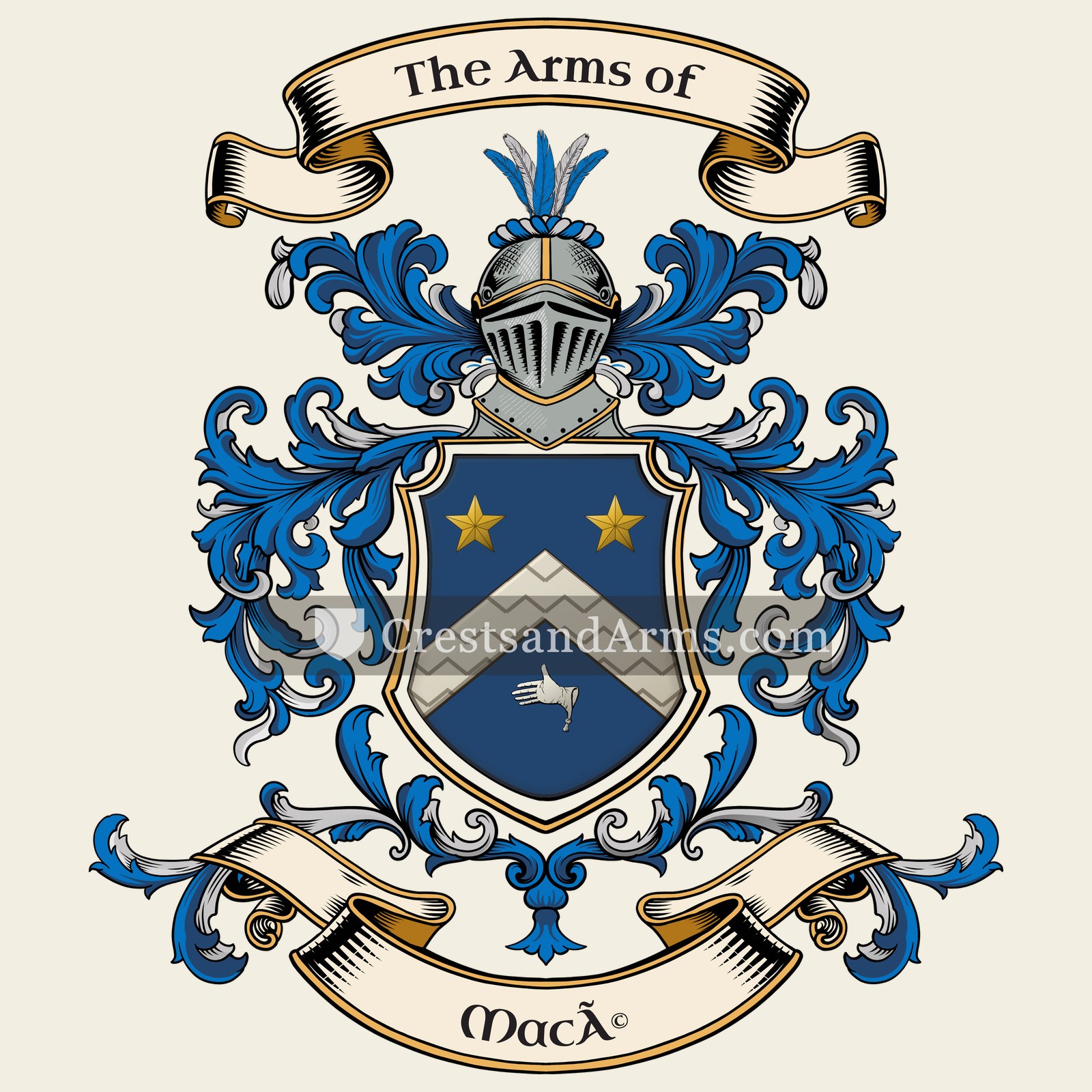
Symbols on this shield
chevronProtection, and faithful service completed
mulletThe third son, and a divine quality from above
gauntletA challenge given and the readiness to meet it
Colours
Blue (Azure)Means: Loyalty and truth
Silver (Argent)Means: Peace and sincerity
Gold (Or)Means: Generosity
Historical info
Source
Sir Bernard Burke, The General Armory of England, Scotland, Ireland and Wales, London: Harrison & Sons, 1884
Blazon (the actual original written record)
“Az. a chev. ar. betw. in chief two mullets or, and in base a dexter gauntlet lying fessways of the second, holding a mace erect of the third”
DevonExeter · Devon, c. 1620
Digital archive packCoat of arms PNG, gold border print PDF, vector SVG and the certificate of authenticity. Sent to your email in minutes.
Map of England showing where the Macé arms are recorded
The Macé arms were recorded in Devon, c. 1620.
Devon was a county of small manors and seafaring families. Its gentry were spread thickly across the countryside, and money made at sea often bought an estate, which in turn brought a coat of arms.
This is where the arms were entered in the register. Families often moved to other parts of the country, so the same name can turn up in more than one region.
The body that granted and recorded arms in England in this period.
James VI and I
Sovereign of the period
James VI and I
1603–1625
Reigning in France when the Macé arms are first recorded.
How Arms Worked in England
English heraldry allowed arms to be shared by all legitimate descendants of the original owner. These symbols were treated as personal property that moved through the generations to all children. While the eldest son kept the original design, other family members could use the same shield without needing to change it or register their own unique versions.
Granting authority
The College of Arms in London has regulated the use of coats of arms throughout England and Wales since 1484.
How they got arms
Families typically obtained their coats of arms through a formal grant from the Crown or by proving their ancient right to them.
Where arms were recorded
All official coats of arms are recorded in the registers kept at the College of Arms, which date back to the fifteenth century.
The family's standing
Recorded among the armigerous families of Devon.
Origin & History of the Macé Family in England
The family name Macé traces its roots to the medieval period in France, but it established a distinct presence in England by the early seventeenth century. Records confirm that members of the Macé family were living in the county of Devon by 1620. During this era, many families with French origins moved across the English Channel to seek new opportunities or to escape religious and political unrest on the continent. Settling in the coastal regions of Devon allowed these families to integrate into local trade and agricultural communities. Over time, the spelling and pronunciation of the name adapted to fit the English language, though it retained its connection to its ancestral heritage. By establishing themselves in the West Country, the early Macé settlers became part of the diverse social fabric that defined rural England during the reign of King James I.
Macé Meaning & Related Branches
Root word
Matthaeus
Derived from the Hebrew name Matityahu meaning gift of God.
This name
MacéA French patronymic surname originating as a diminutive form of Matthew.
also spelled
Masse
Maice
Masay
Mase
Macey
Related arms
Massevariant spelling
Maycevariant spelling
Austenrecorded with Macé, same area
Curteisrecorded with Macé, same area
Documented Sources
J. B. Rietstap, Armorial Général, Gouda: G. B. van Goor Zonen, 1884–87
Archives départementales de Maine-et-Loire, Registres paroissiaux et d'état civil
Dauzat, Albert, Dictionnaire étymologique des noms et prénoms de France, 1951
Morlet, Marie-Thérèse, Dictionnaire étymologique des noms de famille, 1991
Digital archive packCoat of arms PNG, gold border print PDF, vector SVG and the certificate of authenticity. Sent to your email in minutes.


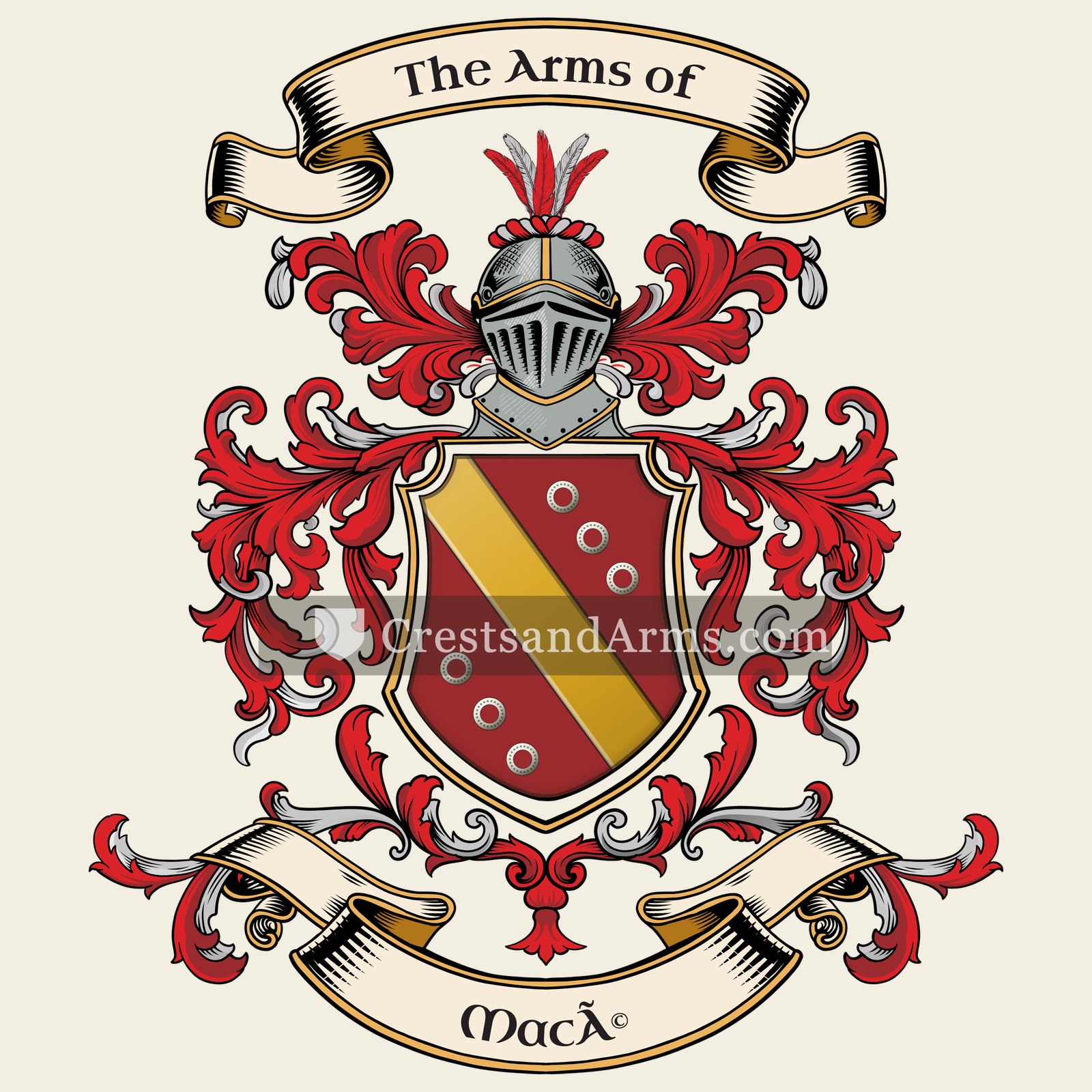
 bendDefence, and the scarf of a commander
 ringFidelity, and a promise kept
 bendDefence, and the scarf of a commander
 ringFidelity, and a promise kept


 chevronProtection, and faithful service completed
 mulletThe third son, and a divine quality from above
 gauntletA challenge given and the readiness to meet it