Map of Spain showing where the Machado arms are recorded
The Machado arms were recorded in Flandre, c. 1722.
Flandre grew rich on cloth, and its towns were among the busiest in Europe. Merchant families bought land with their profits and took arms to go with it, so trade put as many names in the registers here as land did.
This is where the arms were entered in the register. Families often moved to other parts of the country, so the same name can turn up in more than one region.
The body that granted and recorded arms in Spain in this period.
Philip V of Spain
Sovereign of the period
Philip V of Spain
1714–1724
Reigning in Spain when the Machado arms are first recorded.
How Arms Worked in Spain
In Spain, a coat of arms was considered a form of property that belonged to the entire family line. These arms were passed down from a father to all his children equally. Younger branches of the family usually kept the original design without needing to add any special marks to distinguish their specific line.
Granting authority
The Cronista Rey de Armas was the official body that regulated and granted coats of arms throughout Spain.
How they got arms
Families often obtained their arms through royal grants or by proving their noble status to the official heraldic authority.
Where arms were recorded
Coats of arms were officially recorded in the registers of the Cronista Rey de Armas starting in 1496.
The family's standing
Recorded among the armigerous families of Flandre.
Origin & History of the Machado Family in Spain
The surname Machado traces its roots back to the Iberian Peninsula, where it emerged as a descriptive name rooted in the Spanish word for an axe or a heavy hammer. Historically, the name was often associated with individuals who worked as blacksmiths or those who displayed great strength in labor and battle. As the family expanded beyond the borders of Spain, its members became part of the complex migrations that defined early modern Europe. By 1722, records confirm that members of the Machado family had established a presence in the region of Flanders. This movement was likely driven by the shifting political alliances and military movements that connected the Spanish crown to its territories in the Low Countries. The transition from the Iberian landscape to the northern cities of Flanders demonstrates how the family adapted to new environments while maintaining their distinct ancestral identity across generations.
Meaning of the Machado family crest colors & symbols
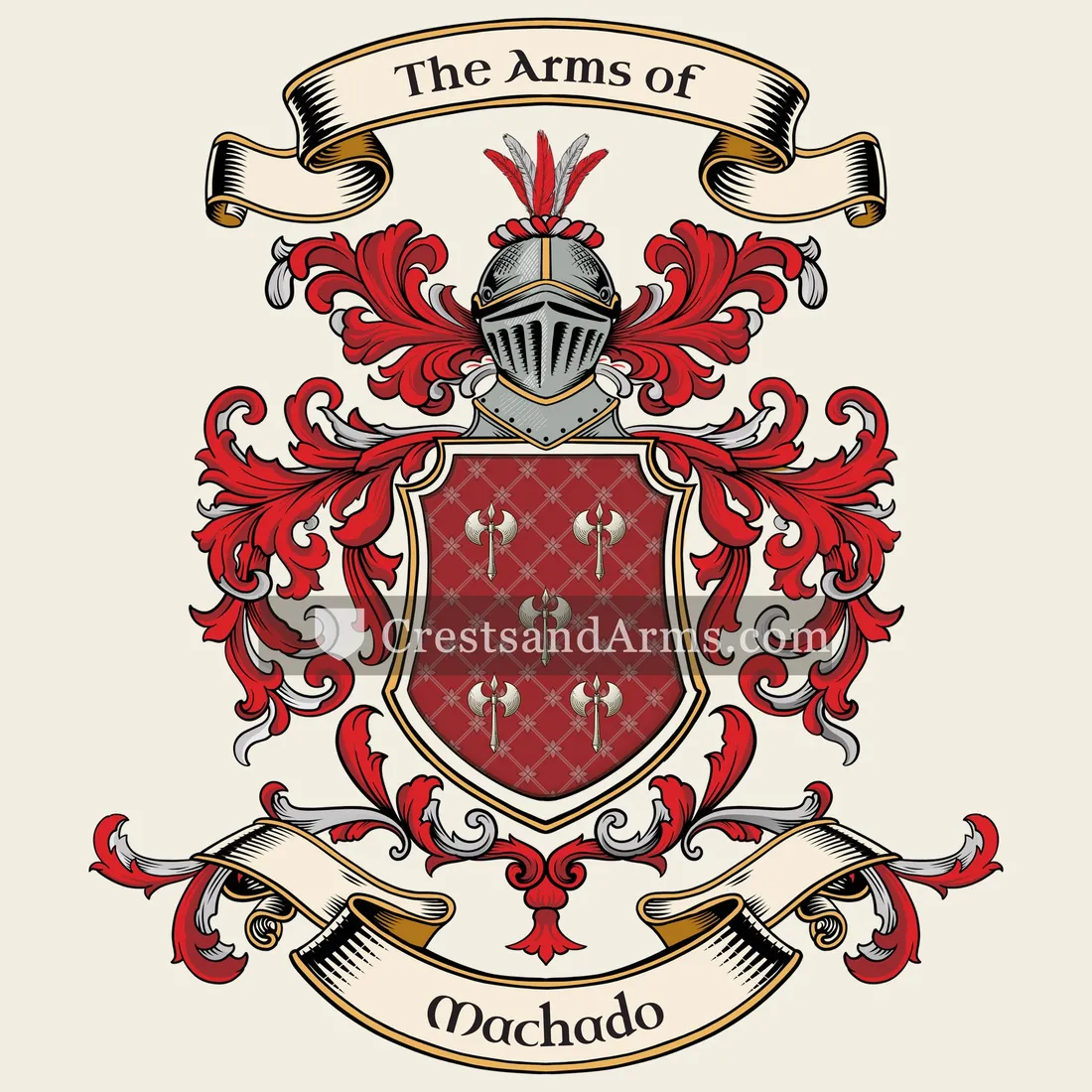
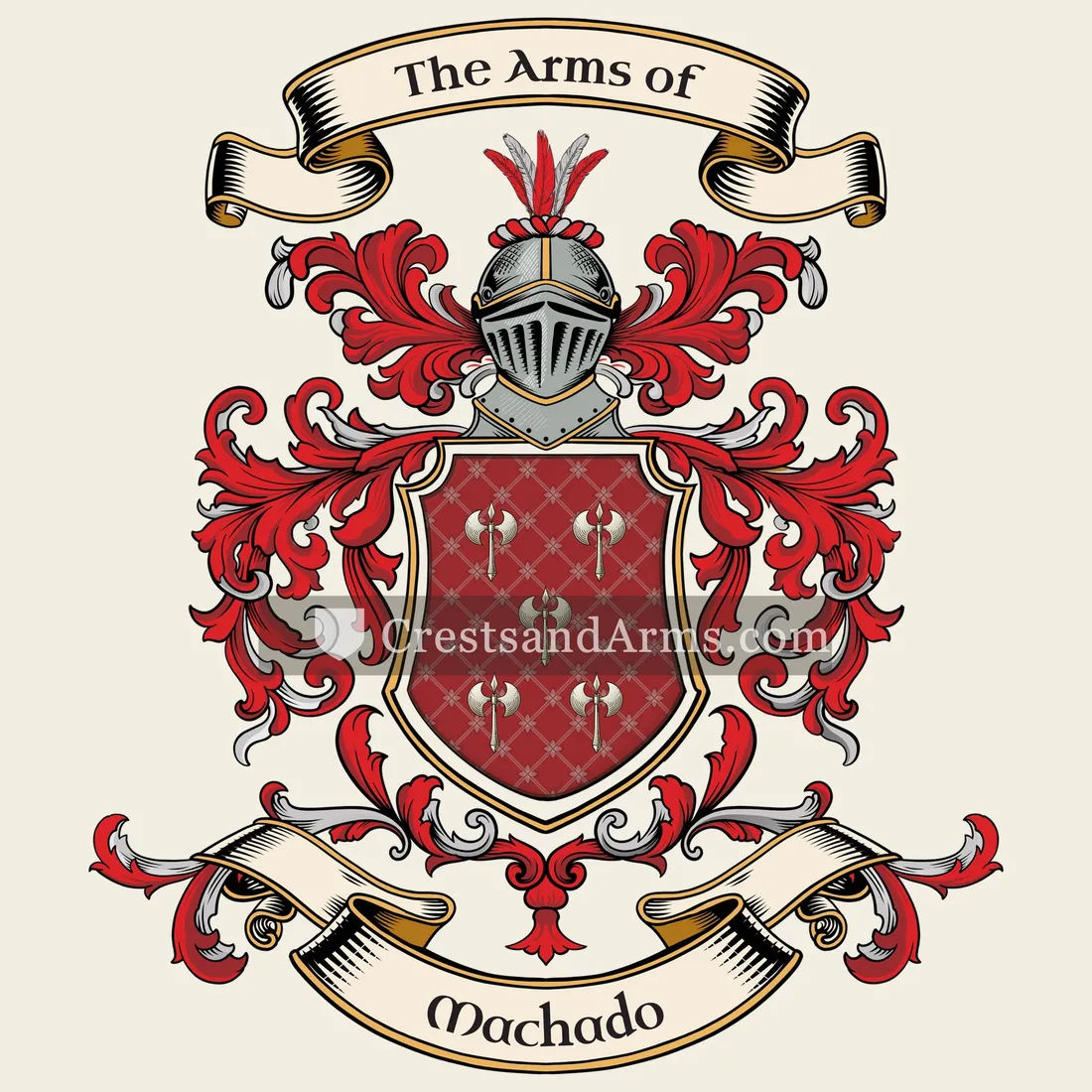
Symbols on this shield
axeThe execution of military duty
Colours
Red (Gules)Means: Military strength
Silver (Argent)Means: Peace and sincerity
Historical info
Source
Sir Bernard Burke, The General Armory of England, Scotland, Ireland and Wales, London: Harrison & Sons, 1884
Blazon (the actual original written record)
“Gu. five battle axes, two, one and two”
ScotlandClarenceux King, c. 1516
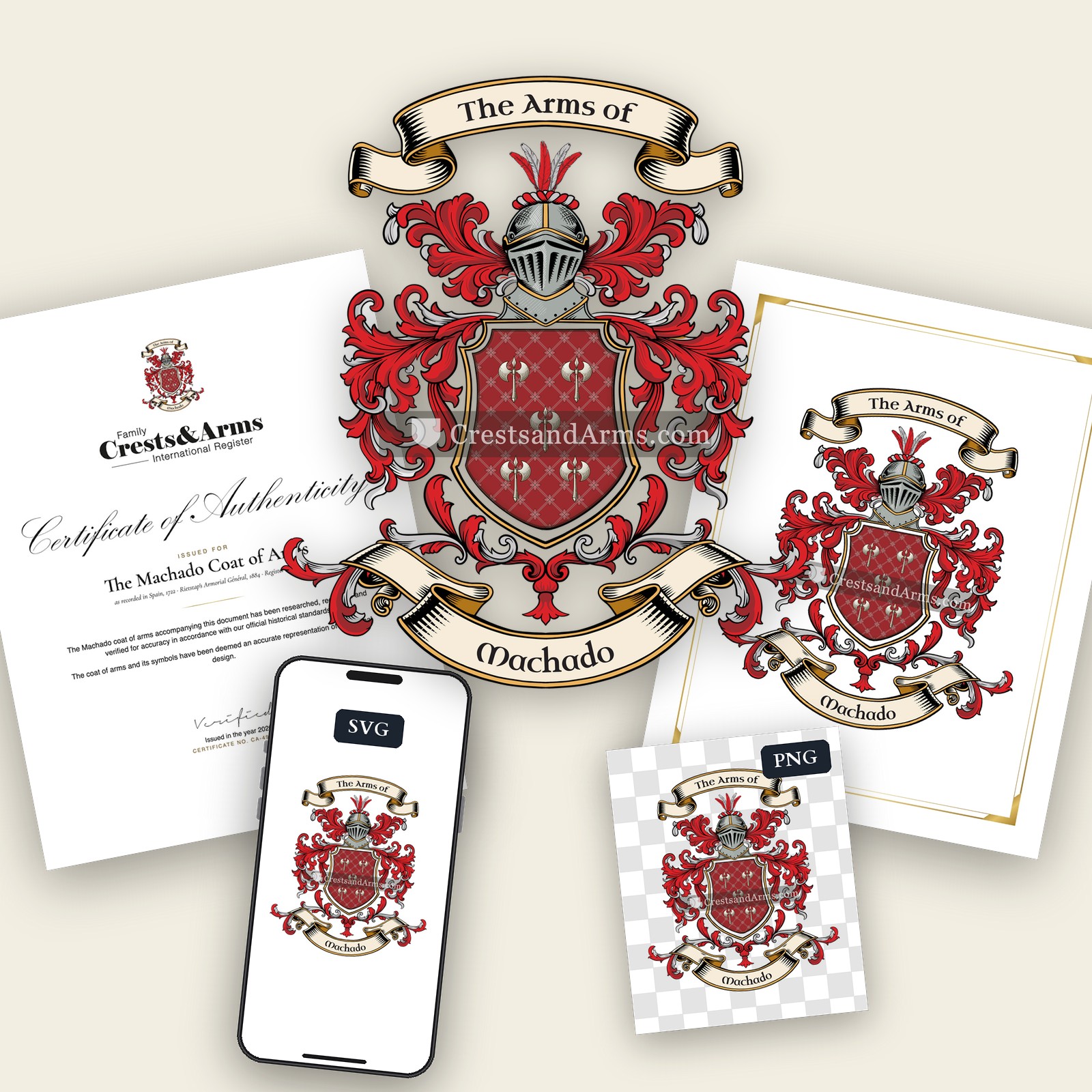
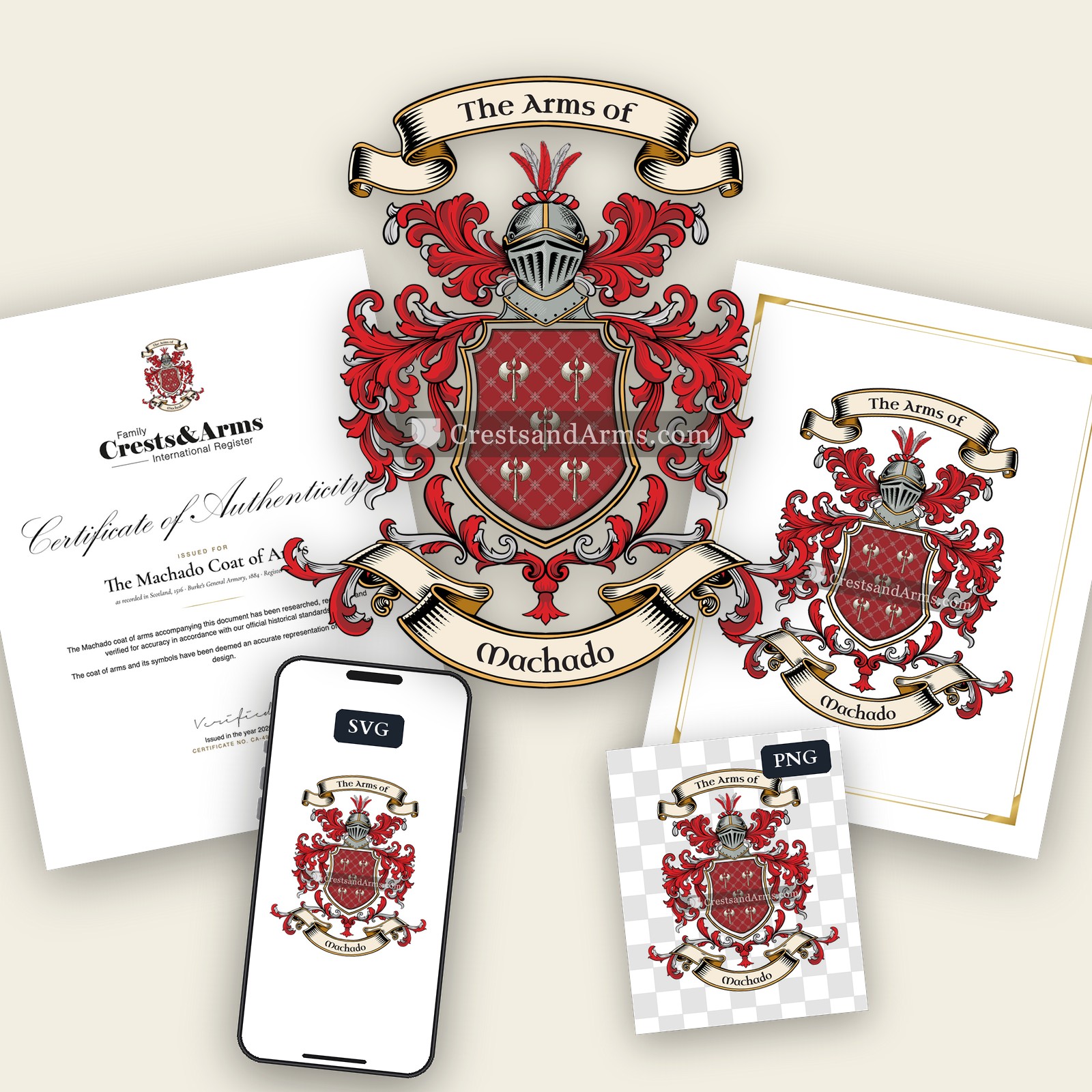
Digital archive packCoat of arms PNG, gold border print PDF, vector SVG and the certificate of authenticity. Sent to your email in minutes.
Map of Scotland showing where the Machado arms are recorded
The Machado arms were recorded in Clarenceux King, c. 1516.
Arms such as these were typically recorded in Edinburgh.
Edinburgh was the seat of Scotland's government, its courts and its heralds. Families with business there settled nearby, and being close to where arms were recorded is exactly why so many of them appear.
This is where the arms were entered in the register. Families often moved to other parts of the country, so the same name can turn up in more than one region.
The body that granted and recorded arms in Scotland in this period.
James V of Scotland
Sovereign of the period
James V of Scotland
1513–1542
Reigning in Spain when the Machado arms are first recorded.
How Arms Worked in Scotland
Scottish heraldry is unique because it treats a coat of arms as a piece of personal property protected by law. Only one person can own a specific design at any given time. When a family grows, the head keeps the original shield while other relatives must apply for their own distinct version with slight changes to prove their specific identity.
Granting authority
The Court of the Lord Lyon acts as the official body that regulates and controls all heraldic matters throughout Scotland.
How they got arms
Individuals obtain a legal right to their arms through a formal petition process that confirms their identity and family connection.
Where arms were recorded
All valid coats of arms are officially entered into the Public Register of All Arms and Bearings starting from 1672.
The family's standing
Recorded among the armigerous families of Scotland.
Origin & History of the Machado Family in Scotland
The history of the Machado name in Scotland is a fascinating study of migration and integration during the early sixteenth century. While the name is primarily associated with the Iberian Peninsula, records confirm that individuals bearing this surname were established in Edinburgh as early as 1516. During this period, Scotland maintained active trade and diplomatic ties with various European powers, which likely facilitated the arrival of foreign merchants and skilled professionals in the capital. These early family members would have navigated a society defined by the transition from the Middle Ages to the Renaissance, often settling into the urban fabric of the Royal Mile. By integrating into the local economy and social structures of Edinburgh, the Machado family became part of the diverse population that helped shape the city’s development during the reign of King James V. Their presence highlights how international connections influenced Scottish life long before the modern era of global travel.
Machado Meaning & Related Branches
Root word
Machado
Derived from the Latin word machaera meaning a sword or blade.
This name
MachadoRefers to a maker or user of axes or heavy cutting tools.
also spelled
Mashado
Machadoh
Machad
Documented Sources
J. B. Rietstap, Armorial Général, Gouda: G. B. van Goor Zonen, 1884–87
Moll, Francesc de Borja, Els llinatges catalans: Catalunya, País Valencià, Illes Balears, 1959
Faure, Roberto, Diccionario de apellidos españoles, 2001
Archivo General de Simancas, Consejo de Estado, Flandes
Algemeen Rijksarchief (General State Archives of Belgium), Audientie, Espagnol
Digital archive packCoat of arms PNG, gold border print PDF, vector SVG and the certificate of authenticity. Sent to your email in minutes.


 axeThe execution of military duty
 axeThe execution of military duty