Map of Spain showing where the Maciag arms are recorded
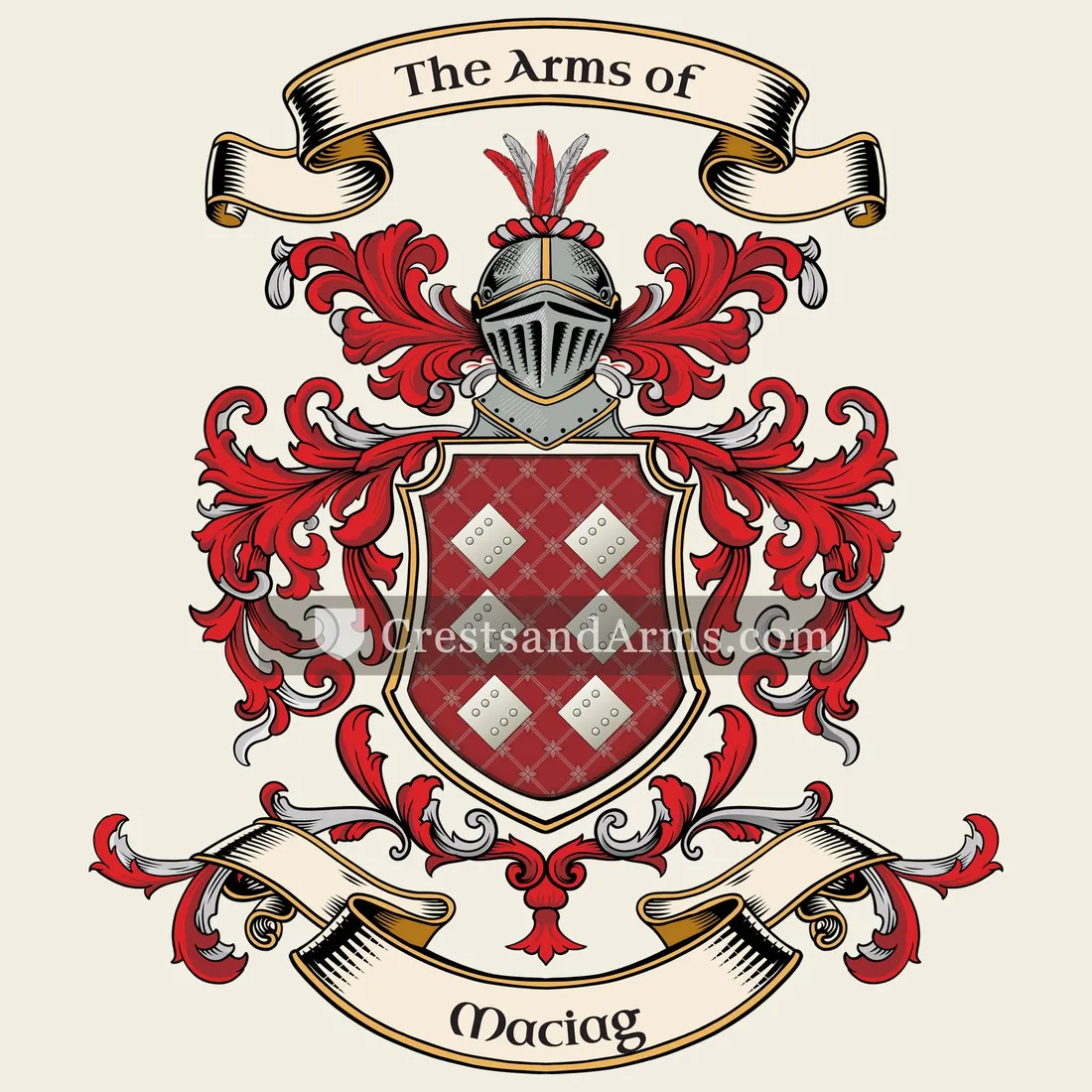
The Maciag arms were recorded in Léon, c. 1722.
This is where the arms were entered in the register. Families often moved to other parts of the country, so the same name can turn up in more than one region.
The body that granted and recorded arms in Spain in this period.
Philip V of Spain
Sovereign of the period
Philip V of Spain
1714–1724
Reigning in Spain when the Maciag arms are first recorded.
How Arms Worked in Spain
In Spain, a coat of arms was considered a form of property that belonged to the entire family line. These arms were passed down from a father to all his children equally. Younger branches of the family usually kept the original design without needing to add any special marks to distinguish their specific line.
Granting authority
The Cronista Rey de Armas was the official body that regulated and granted coats of arms throughout Spain.
How they got arms
Families often obtained their arms through royal grants or by proving their noble status to the official heraldic authority.
Where arms were recorded
Coats of arms were officially recorded in the registers of the Cronista Rey de Armas starting in 1496.
The family's standing
Recorded among the armigerous families of Spain.
Origin & History of the Maciag Family in Spain
The surname Maciag is deeply rooted in the historical landscape of Poland, where it evolved as a patronymic name derived from the given name Maciej, the Polish equivalent of Matthew. While the name is most commonly associated with the central regions of Poland, historical documentation confirms that members of the family were established in the town of Léon by 1722. During this period, families often settled in specific administrative hubs to participate in local trade or agricultural management. The presence of the Maciag name in these early records suggests that the family was part of the established social fabric of the region, likely integrated into the local parish or municipal systems that tracked residents for tax and census purposes. Over the centuries, the name has remained a consistent identifier for families who maintained strong ties to their ancestral roots while adapting to the shifting political borders of Eastern Europe.
Maciag Meaning & Related Branches
Root word
Matthias
Derived from the Hebrew name Mattityahu meaning gift of God.
This name
MaciagA patronymic surname indicating descent from a person named Matthew or Matthias.
also spelled
Masias
Documented Sources
J. B. Rietstap, Armorial Général, Gouda: G. B. van Goor Zonen, 1884–87
Archiwum Państwowe w Lublinie, Akta stanu cywilnego parafii rzymskokatolickiej w Leonowie
Archiwum Główne Akt Dawnych, Metryki koronne
Krzysztof Rymut, Nazwiska Polaków: Słownik historyczno-etymologiczny, 1999
Aleksander Brückner, Słownik etymologiczny języka polskiego, 1927
Digital archive packCoat of arms PNG, gold border print PDF, vector SVG and the certificate of authenticity. Sent to your email in minutes.


 dieFortune met with a steady hand
 dieFortune met with a steady hand