A record of documented arms, meaning and origin, researched for the Mackenzie family lines. Documented in 2 countries.
Reg. 3386 · French, M–O
Coat of Arms & Family Crest Details
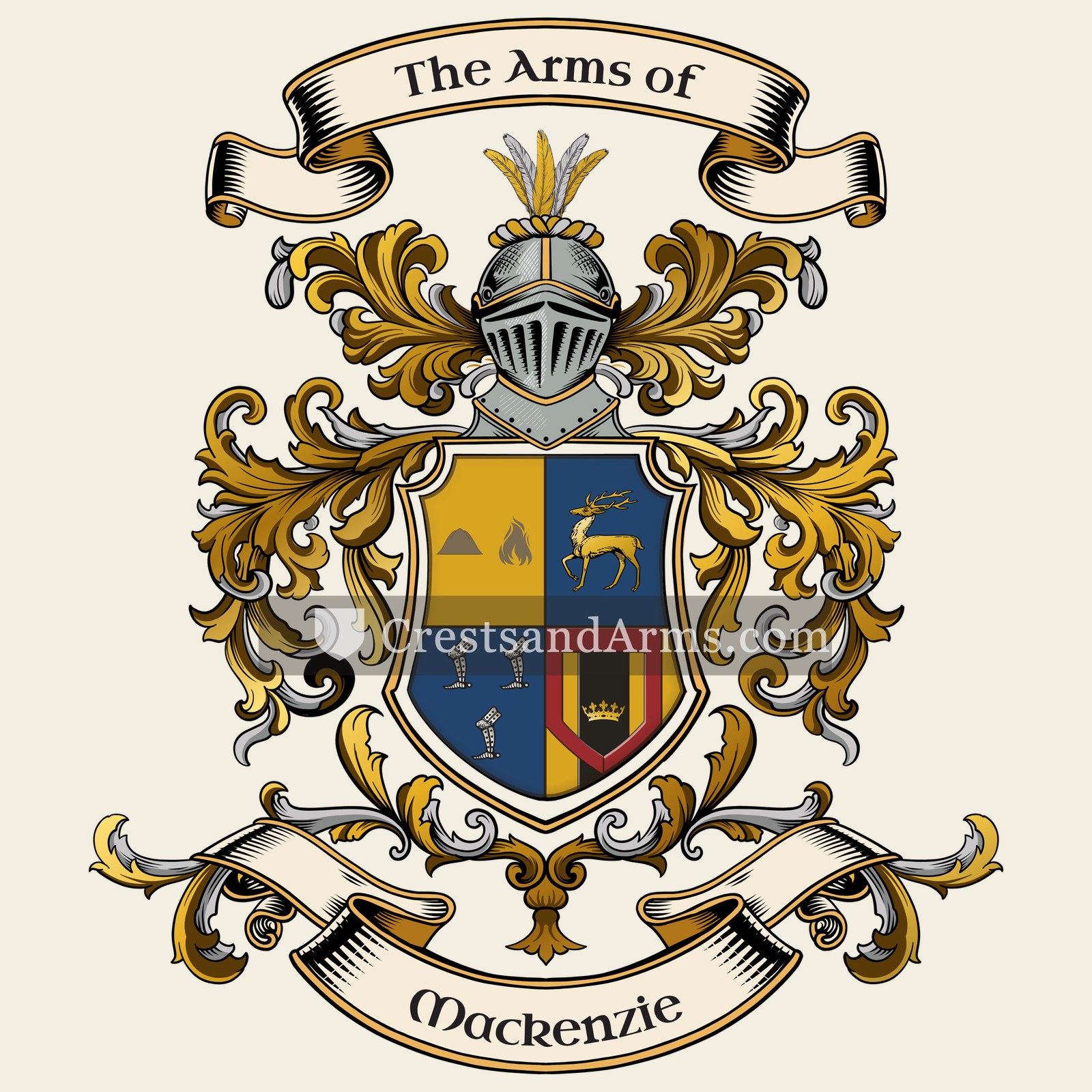
Symbols on this shield
mountThe ground held, and steadfastness upon it
paleMilitary strength, and a fortified defence
fireZeal and purification
stagPeace and harmony, and one who will not fight unprovoked
legStrength and swiftness
crownSovereignty, authority and just reward
Colours
Gold (Or)Means: Generosity
Blue (Azure)Means: Loyalty and truth
Black (Sable)Means: Constancy
Red (Gules)Means: Military strength
Historical info
Source
J. B. Rietstap, Armorial Général, Gouda: G. B. van Goor Zonen, 1884–87
Blazon (the actual original written record)
“Ec.: au 1 d'or à un volcan au nat. en abime, vomissant des flammes (Macleod); au 2 d'azur à un rencontre de cerf d'or (Mackenzie); au 3 de gu. à trois jambes, arm. et éperonnées, posées en pairle et réunies par les cuisses sur le coeur du quartier, le tout au nat. (ile de Man); au 4 d'arg. au pal de sa., ch. d'une couronne royale d'or, le tout enclos dans une bord. fleur. et c.-fleur. de gu. (Erskine d'Innerdale). C.: un soleil d'or. T.: deux sauvages de carn., ceints et cour. de lierre, portant chacun une massue sur son épaule. D.: LUCEO, NON URO.”
Francec. 1685
Digital archive packCoat of arms PNG, gold border print PDF, vector SVG and the certificate of authenticity. Sent to your email in minutes.
Map of France showing where the Mackenzie arms are recorded
The Mackenzie arms were recorded in France, c. 1685.
Arms such as these were typically recorded in Bretagne.
More families held coats of arms in Bretagne than anywhere else in France. The land was divided into many small estates rather than a few large ones, so far more households counted as gentry, and each needed a shield of its own to be told apart.
This is where the arms were entered in the register. Families often moved to other parts of the country, so the same name can turn up in more than one region.
The body that granted and recorded arms in France in this period.
Louis XIV of France
Sovereign of the period
Louis XIV of France
1643–1715
Reigning in France when the Mackenzie arms are first recorded.
How Arms Worked in France
In France, a coat of arms was a mark of honor that passed down through the male line to all legitimate descendants. Families often used the same shield without changes to show their shared heritage. If a branch wanted to stand out, they could add a small mark to their shield to show their specific place in the family tree.
Granting authority
The Juge d'armes de France acted as the official authority that regulated and verified coats of arms across the country.
How they got arms
Families typically inherited their arms from ancestors, though they could also receive them through royal grants or by proving their noble status.
Where arms were recorded
Coats of arms were officially recorded in the Armorial Général de France, which began its main collection in the year 1696.
The family's standing
Recorded among the armigerous families of France.
Origin & History of the Mackenzie Family in France
The history of the Mackenzie name in France begins with the displacement of Scottish families during the late seventeenth century. By 1685, members of the family were established in the region of Bretagne, having arrived as part of the broader migration of Scots who sought refuge or military service abroad due to political and religious instability at home. These early settlers often integrated into the local society by adapting their Gaelic surname to fit the phonetic patterns of the French language. While the name remained distinctly Scottish in its roots, its presence in Bretagne highlights the long-standing historical connection between the Kingdom of Scotland and the Kingdom of France. These families often found roles within the French military or merchant classes, allowing them to maintain their identity while becoming active participants in the regional history of western France.
Coat of Arms & Family Crest Details
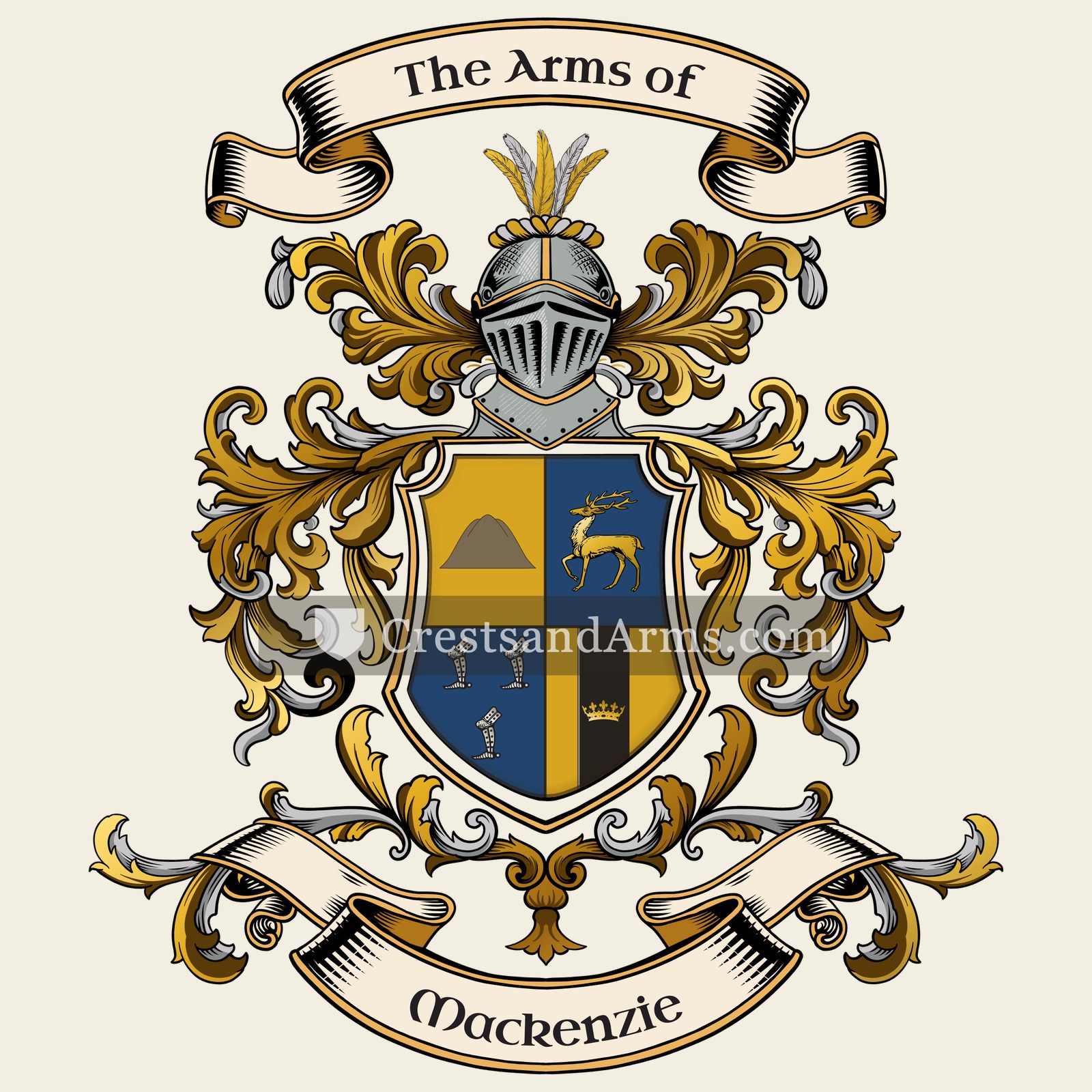
Symbols on this shield
mountThe ground held, and steadfastness upon it
paleMilitary strength, and a fortified defence
stagPeace and harmony, and one who will not fight unprovoked
legStrength and swiftness
crownSovereignty, authority and just reward
Colours
Gold (Or)Means: Generosity
Blue (Azure)Means: Loyalty and truth
Black (Sable)Means: Constancy
Historical info
Source
Sir Bernard Burke, The General Armory of England, Scotland, Ireland and Wales, London: Harrison & Sons, 1884
Blazon (the actual original written record)
“Quarterly, 1st, or, a rock in flames ppr., for MACLEOD, of Lewis; 2nd, az. a stag's head cabossed or, for MACKENZIE; 3rd, gu. three human legs armed ppr. conjoined in the centre at the upper part of the thigh, flexed in triangle, garnished and spurred or, for the Isle of Man; 4th, ar. on a pale sa. an imperial crown within a double tressure flory and counterflory with fleurs-de-lis gu”
SutherlandTarbet · Sutherland, c. 1628
Digital archive packCoat of arms PNG, gold border print PDF, vector SVG and the certificate of authenticity. Sent to your email in minutes.
Map of Scotland showing where the Mackenzie arms are recorded
The Mackenzie arms were recorded in Sutherland, c. 1628.
Sutherland was empty Highland country in the far north, held by a very small number of families. Land there rarely changed hands, and families who held it appear in the records.
This is where the arms were entered in the register. Families often moved to other parts of the country, so the same name can turn up in more than one region.
The body that granted and recorded arms in Scotland in this period.
Charles I of England
Sovereign of the period
Charles I of England
1625–1649
Reigning in France when the Mackenzie arms are first recorded.
How Arms Worked in Scotland
Scottish heraldry is unique because it treats a coat of arms as a piece of personal property protected by law. Only one person can own a specific design at any given time. When a family grows, the head keeps the original shield while other relatives must apply for their own distinct version with slight changes to prove their specific identity.
Granting authority
The Court of the Lord Lyon acts as the official body that regulates and controls all heraldic matters throughout Scotland.
How they got arms
Individuals obtain a legal right to their arms through a formal petition process that confirms their identity and family connection.
Where arms were recorded
All valid coats of arms are officially entered into the Public Register of All Arms and Bearings starting from 1672.
The family's standing
Recorded among the armigerous families of Sutherland.
Origin & History of the Mackenzie Family in Scotland
The Mackenzie name originates from the Gaelic phrase Mac Coinnich, which translates to son of the fair or handsome one. The family rose to prominence in the rugged landscapes of the Scottish Highlands, where they established themselves as a powerful force in the region of Ross. While their influence spread across the north, historical records confirm that members of the family were firmly established in Sutherland by 1628. During this era, the Mackenzies were known for their strategic alliances and their ability to expand their land holdings through both marriage and political maneuvering. They played a significant role in the complex social structure of the Highlands, often acting as key figures in local governance and regional conflicts. By maintaining strong ties to their ancestral roots, the family successfully navigated the turbulent history of Scotland for many generations.
Mackenzie Meaning & Related Branches
Root word
MacCoinnich
Son of the handsome or fair one
This name
MackenzieA Scottish Gaelic surname meaning son of the attractive or comely person.
also spelled
Mackensie
Mckenzie
McKenzie
Kenzie
Related arms
Forbessimilar arms
Humesimilar arms
M'Kenziesimilar arms
Landelrecorded with Mackenzie, same area
Documented Sources
J. B. Rietstap, Armorial Général, Gouda: G. B. van Goor Zonen, 1884–87
Augé-Chiquet, Philippe, La vie, la mort et la survie des Écossais en France, 1937
Michel, Francisque, Les Écossais en France, les Français en Écosse, 1862
Archives départementales d'Ille-et-Vilaine, Série B: Cours et juridictions
Digital archive packCoat of arms PNG, gold border print PDF, vector SVG and the certificate of authenticity. Sent to your email in minutes.


 mountThe ground held, and steadfastness upon it
 paleMilitary strength, and a fortified defence
 fireZeal and purification
 stagPeace and harmony, and one who will not fight unprovoked
 legStrength and swiftness
 crownSovereignty, authority and just reward
 mountThe ground held, and steadfastness upon it
 paleMilitary strength, and a fortified defence
 fireZeal and purification
 stagPeace and harmony, and one who will not fight unprovoked
 legStrength and swiftness
 crownSovereignty, authority and just reward