A record of documented arms, meaning and origin, researched for the Mackinnon family of England.
Reg. 5568 · English, M–O
Coat of Arms & Family Crest Details
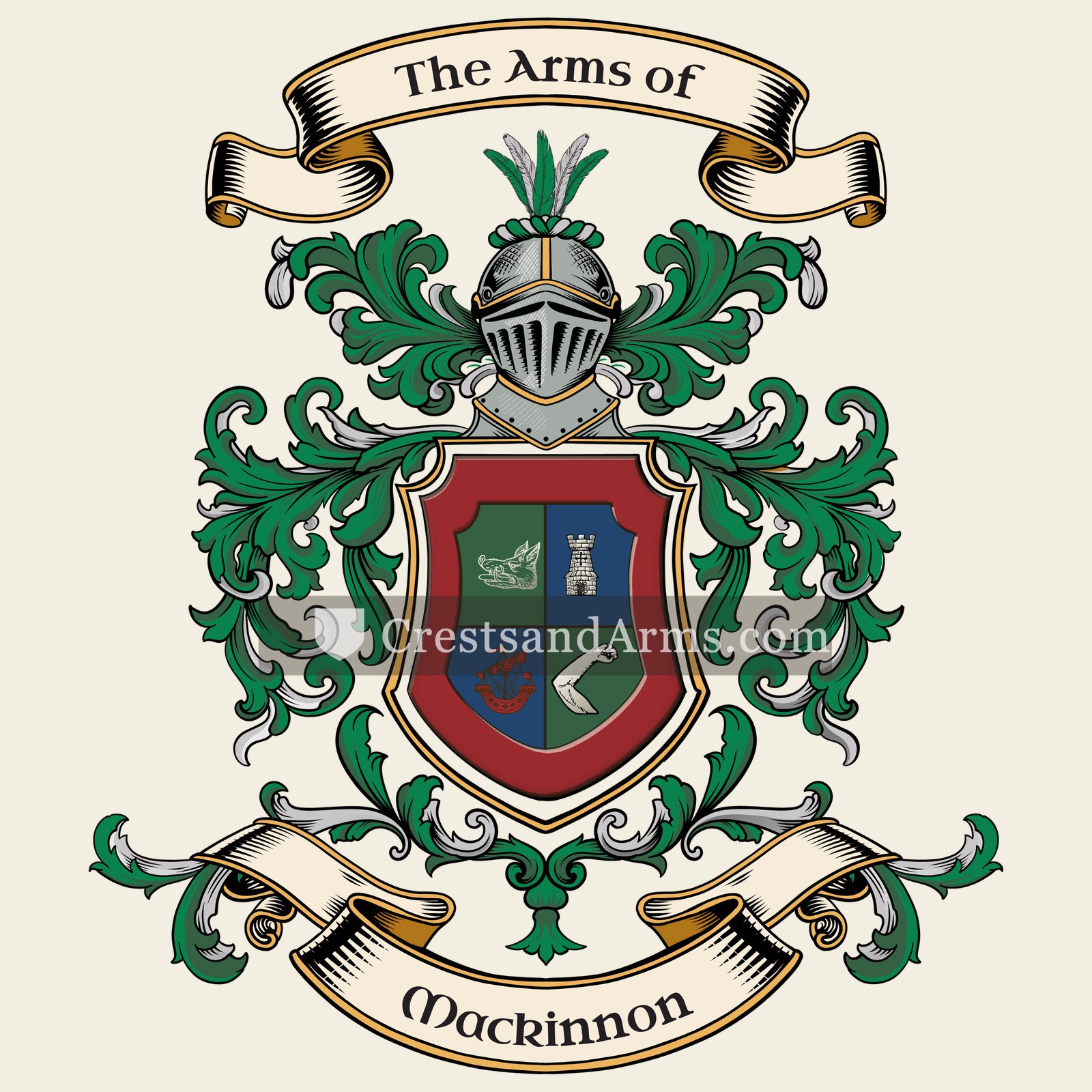
Symbols on this shield
bordureA difference between branches of one family
boars headA fierce fighter who battles to the end
towerGrandeur and solidity, and a stronghold defended
shipEnterprise, and a great voyage undertaken
armA person of action, industrious and laborious
Colours
Green (Vert)Means: Hope
Blue (Azure)Means: Loyalty and truth
Red (Gules)Means: Military strength
Silver (Argent)Means: Peace and sincerity
Historical info
Source
Sir Bernard Burke, The General Armory of England, Scotland, Ireland and Wales, London: Harrison & Sons, 1884
Blazon (the actual original written record)
“Quarterly, 1st, vert a boar's head couped, holding in the mouth a shin-bone ar.; 2nd, az. a tower triple-towered ar.; 3rd, or, a galley gu.; 4th, ar. a man's arm couped below the wrist from the sinister ppr. grasping a cross crosslet fitchée sa. all within a bordure gu”
HantsPortswood Park · Hants, c. 1620
Digital archive packCoat of arms PNG, gold border print PDF, vector SVG and the certificate of authenticity. Sent to your email in minutes.
Map of England showing where the Mackinnon arms are recorded
The Mackinnon arms were recorded in Hants, c. 1620.
Hampshire had the naval dockyards at Portsmouth on one side and good farmland on the other. Sea money and land money both bought estates, and an estate was what brought a family its coat of arms.
This is where the arms were entered in the register. Families often moved to other parts of the country, so the same name can turn up in more than one region.
The body that granted and recorded arms in England in this period.
James VI and I
Sovereign of the period
James VI and I
1603–1625
Reigning in England when the Mackinnon arms are first recorded.
How Arms Worked in England
English heraldry allowed arms to be shared by all legitimate descendants of the original owner. These symbols were treated as personal property that moved through the generations to all children. While the eldest son kept the original design, other family members could use the same shield without needing to change it or register their own unique versions.
Granting authority
The College of Arms in London has regulated the use of coats of arms throughout England and Wales since 1484.
How they got arms
Families typically obtained their coats of arms through a formal grant from the Crown or by proving their ancient right to them.
Where arms were recorded
All official coats of arms are recorded in the registers kept at the College of Arms, which date back to the fifteenth century.
The family's standing
Recorded among the armigerous families of Hants.
Origin & History of the Mackinnon Family in England
The name MacKinnon originates from the Gaelic phrase Mac Fhionghuin, which translates to son of the fair born. Historically, the family is deeply rooted in the Scottish Highlands and the Hebrides, where they were recognized as a prominent clan with strong ties to the ancient lords of the region. By the year 1620, members of the family were already well established in the area of Hants, England, suggesting that they were part of a broader movement of Scottish families migrating south during the early seventeenth century. These early settlers often integrated into local trade and agricultural communities while maintaining their distinct cultural identity. Their presence in Hants reflects the shifting social landscape of the British Isles during a time when families were increasingly moving across borders to seek new opportunities.
Mackinnon Meaning & Related Branches
Root word
Mac Fhionghuin
Son of the fair-born or son of the fair one.
This name
MackinnonDerived from Gaelic, signifying a descendant of a fair or handsome individual.
also spelled
McKinnon
Kinnon
Documented Sources
Sir Bernard Burke, The General Armory of England, Scotland, Ireland and Wales, London: Harrison & Sons, 1884
Black, George F., The Surnames of Scotland: Their Origin, Meaning, and History, 1946
Way of Plean, George and Squire, Romilly, Clans and Tartans, 1995


 bordureA difference between branches of one family
 boars headA fierce fighter who battles to the end
 towerGrandeur and solidity, and a stronghold defended
 shipEnterprise, and a great voyage undertaken
 armA person of action, industrious and laborious
 bordureA difference between branches of one family
 boars headA fierce fighter who battles to the end
 towerGrandeur and solidity, and a stronghold defended
 shipEnterprise, and a great voyage undertaken
 armA person of action, industrious and laborious