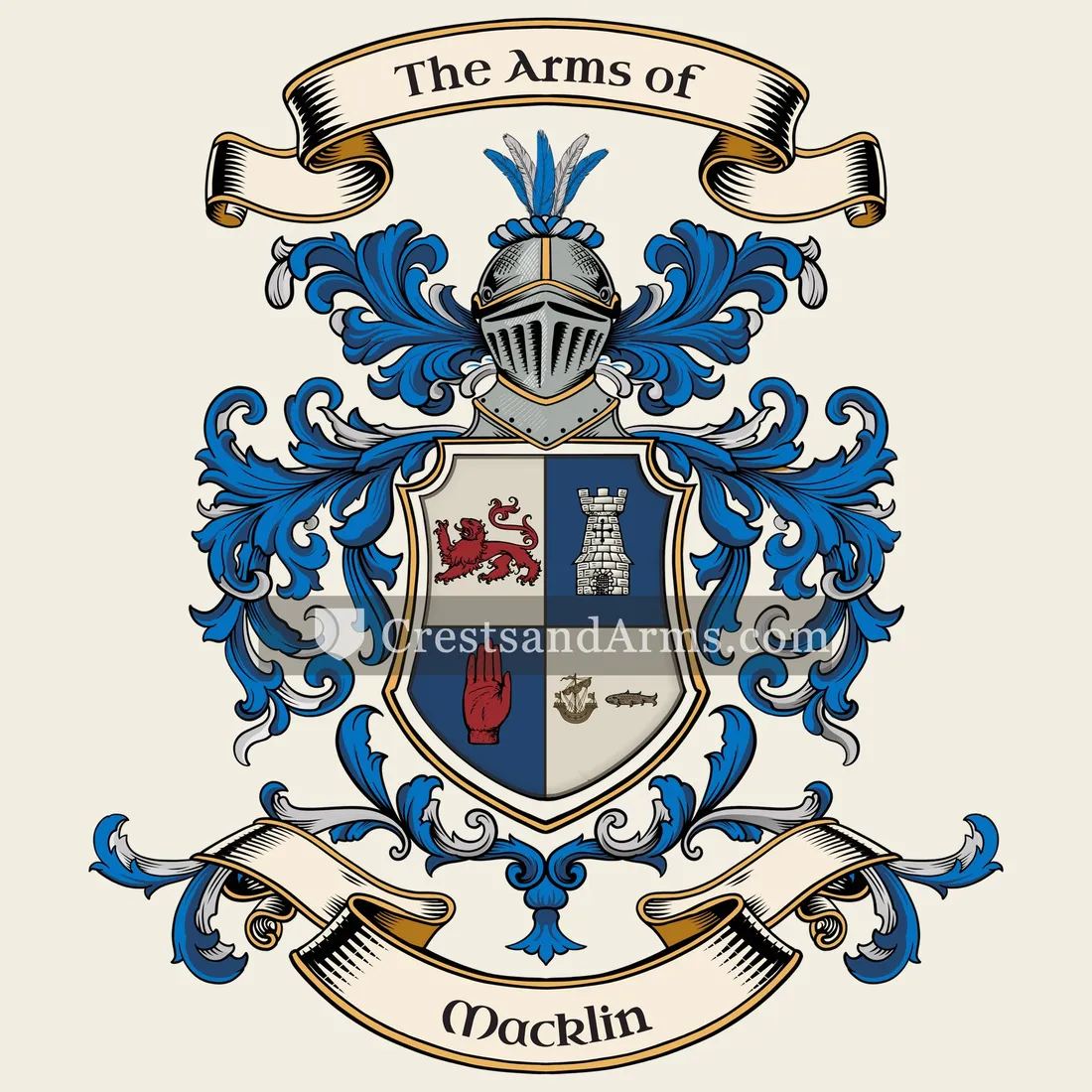
A record of documented arms, meaning and origin, researched for the Macklin family lines. Documented in 2 countries.
Reg. 1098 · Britain, M–O
Meaning of the Macklin family crest colors & symbols
Symbols on this shield
lionCourage, strength and royalty
towerGrandeur and solidity, and a stronghold defended
shipEnterprise, and a great voyage undertaken
eagleNobility, strength and a keen mind
fishA true and generous mind, and Christian faith
Colours
Gold (Or)Means: Generosity
Blue (Azure)Means: Loyalty and truth
Red (Gules)Means: Military strength
Silver (Argent)Means: Peace and sincerity
Historical info
Source
J. B. Rietstap, Armorial Général, Gouda: G. B. van Goor Zonen, 1884–87
Blazon (the actual original written record)
“Ec.: au 1 d'or au lion de gu.; au 2 d'azur à une tour d'arg., sommée de trois tourelles de sa., maçonnée du même, portillé de gu., aj. de quatre pièces du même, deux fenêtres accostant la porte et les deux autres la surmontant; au 3 d'arg. à une galère au nat., les voiles ferlées; au 4 d'arg. à deux têtes d'aigle affr. de gu. en chef et un saumon nageant au nat. en p.”
Britainc. 1700
Digital archive packCoat of arms PNG, gold border print PDF, vector SVG and the certificate of authenticity. Sent to your email in minutes.
Map of Britain showing where the Macklin arms are recorded
The Macklin arms were recorded in Britain, c. 1700.
Arms such as these were typically recorded in Kent.
Kent sits between London and the short crossing to Europe, and the trade passing through made it wealthy. Merchant families bought land with that money, and it was landowners who took coats of arms.
This is where the arms were entered in the register. Families often moved to other parts of the country, so the same name can turn up in more than one region.
The body that granted and recorded arms in Britain in this period.
William III of England
Sovereign of the period
William III of England
1694–1702
Reigning in Britain when the Macklin arms are first recorded.
How Arms Worked in Britain
English heraldry allowed arms to be shared by all legitimate descendants of the original owner. These symbols were treated as personal property that moved through the generations to all children. While the eldest son kept the original design, other family members could use the same shield without needing to change it or register their own unique versions.
Granting authority
The College of Arms in London has regulated the use of coats of arms throughout England and Wales since 1484.
How they got arms
Families typically obtained their coats of arms through a formal grant from the Crown or by proving their ancient right to them.
Where arms were recorded
All official coats of arms are recorded in the registers kept at the College of Arms, which date back to the fifteenth century.
The family's standing
Recorded among the armigerous families of Britain.
Origin & History of the Macklin Family in Britain
The surname Macklin has deep roots in the British Isles, with historical records confirming that families bearing this name were established in the county of Kent by the early 1700s. The name is generally considered to be a variation of the Gaelic name Mac Gilleoin, which translates to the son of the servant of John. Over many generations, the spelling evolved as families moved across different regions and interacted with local dialects. By the eighteenth century, the Macklin name had become well-integrated into the social fabric of Kent, where members of the family often worked as skilled tradespeople or laborers in the growing rural communities. These early ancestors lived through a time of significant agricultural and social change in England, contributing to the local economy and the development of parish life. Their presence in Kent during this period suggests that the family had successfully transitioned from their ancestral origins into the settled life of the English countryside.
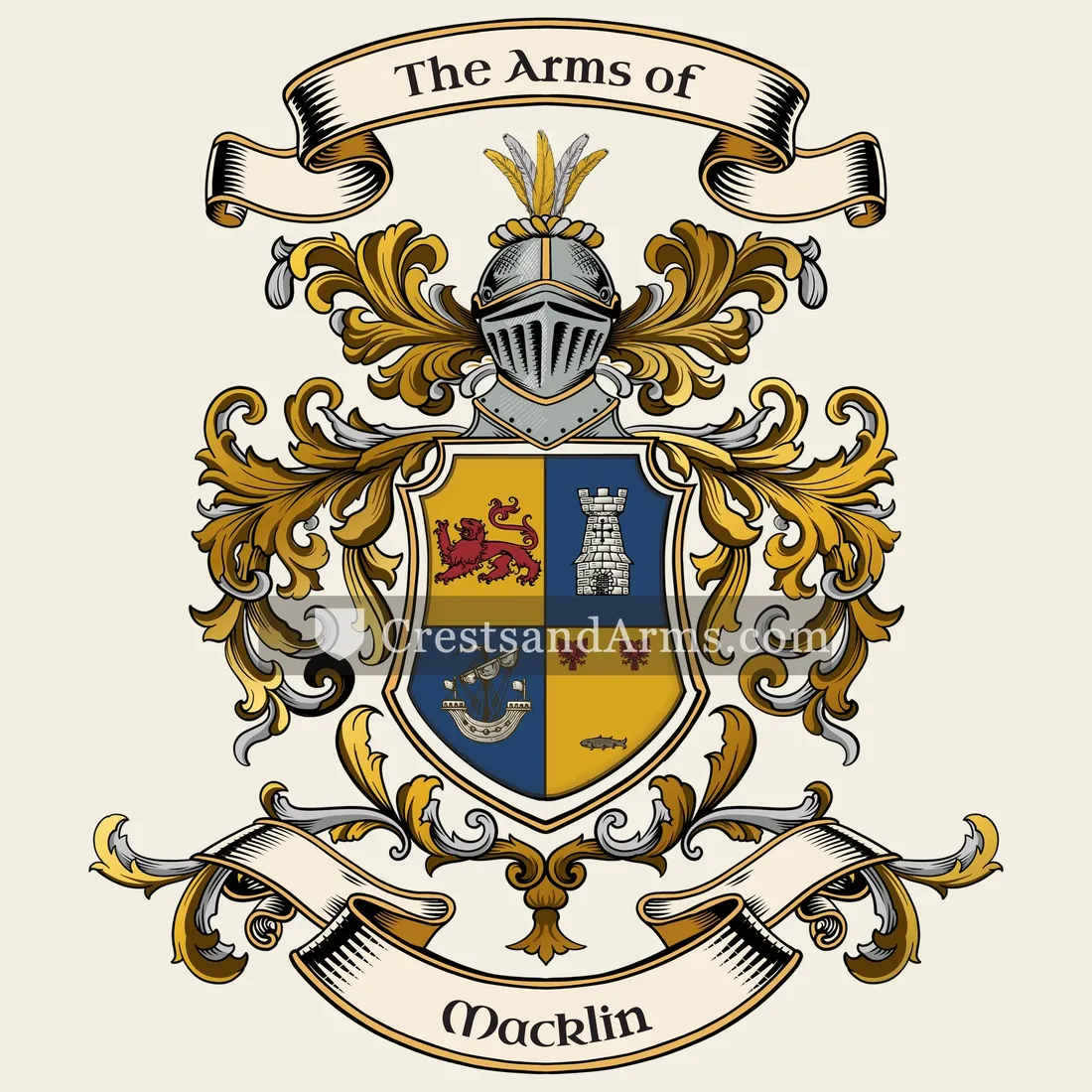
Meaning of the Macklin family crest colors & symbols
Symbols on this shield
lionCourage, strength and royalty
towerGrandeur and solidity, and a stronghold defended
handFaith, sincerity and justice
shipEnterprise, and a great voyage undertaken
fishA true and generous mind, and Christian faith
Colours
Silver (Argent)Means: Peace and sincerity
Blue (Azure)Means: Loyalty and truth
Red (Gules)Means: Military strength
Historical info
Source
Sir Bernard Burke, The General Armory of England, Scotland, Ireland and Wales, London: Harrison & Sons, 1884
Blazon (the actual original written record)
“Quarterly, 1st, ar. a lion ramp. gu.; 2nd, az. a tower ar.; 3rd, or, a dexter hand couped in fesse gu. holding a cross crosslet fitchée az.; 4th, ar. a lymphad ppr. her sails furled, in base a salmon naiant ppr”
GloucesterKington House · Gloucester, c. 1620
Digital archive packCoat of arms PNG, gold border print PDF, vector SVG and the certificate of authenticity. Sent to your email in minutes.
Map of England showing where the Macklin arms are recorded
The Macklin arms were recorded in Gloucester, c. 1620.
Gloucestershire had good farmland, a cloth trade in its valleys and a river carrying goods to Bristol. All three made money, and money bought the estates that brought arms with them.
This is where the arms were entered in the register. Families often moved to other parts of the country, so the same name can turn up in more than one region.
The body that granted and recorded arms in England in this period.
James VI and I
Sovereign of the period
James VI and I
1603–1625
Reigning in Britain when the Macklin arms are first recorded.
How Arms Worked in England
English heraldry allowed arms to be shared by all legitimate descendants of the original owner. These symbols were treated as personal property that moved through the generations to all children. While the eldest son kept the original design, other family members could use the same shield without needing to change it or register their own unique versions.
Granting authority
The College of Arms in London has regulated the use of coats of arms throughout England and Wales since 1484.
How they got arms
Families typically obtained their coats of arms through a formal grant from the Crown or by proving their ancient right to them.
Where arms were recorded
All official coats of arms are recorded in the registers kept at the College of Arms, which date back to the fifteenth century.
The family's standing
Recorded among the armigerous families of Gloucester.
Origin & History of the Macklin Family in England
The family name Macklin has deep roots in the English landscape, with historical records confirming that members of the family were established in the city of Gloucester by 1620. The name itself is thought to be a variation of the Gaelic name Mac Gilleoin, which translates to son of the servant of Saint John. Over many centuries, families moved from their ancestral homes in Ireland and Scotland into various English counties, where the spelling of their names often shifted to match local pronunciations and writing styles. By the early 17th century, the Macklins in Gloucester were part of a growing urban population during a time of significant social and economic change. These early settlers likely worked as tradespeople or merchants, contributing to the busy life of a cathedral city that served as a major hub for trade along the River Severn. Their presence in the region during this period suggests that the family had successfully integrated into the local community and established a stable life long before the great migrations of later centuries.
Macklin Meaning & Related Branches
Root word
Mac Giolla Fhinn
Son of the servant of the fair one.
This name
MacklinAn Anglicized Irish surname derived from a Gaelic patronymic indicating devotion to a fair-haired saint.
also spelled
Maclane
McLaine
MacLean
Documented Sources
J. B. Rietstap, Armorial Général, Gouda: G. B. van Goor Zonen, 1884–87
Bardsley, Charles Wareing, A Dictionary of English and Welsh Surnames, 1901
Reaney, P.H., A Dictionary of British Surnames, 1958
Kent Archives, Parish Registers of Kent, 1700–1750
Digital archive packCoat of arms PNG, gold border print PDF, vector SVG and the certificate of authenticity. Sent to your email in minutes.


 lionCourage, strength and royalty
 towerGrandeur and solidity, and a stronghold defended
 shipEnterprise, and a great voyage undertaken
 eagleNobility, strength and a keen mind
 fishA true and generous mind, and Christian faith
 lionCourage, strength and royalty
 towerGrandeur and solidity, and a stronghold defended
 shipEnterprise, and a great voyage undertaken
 eagleNobility, strength and a keen mind
 fishA true and generous mind, and Christian faith


 handFaith, sincerity and justice