A record of documented arms, meaning and origin, researched for the Mac Leod family lines. Documented in 3 countries.
Reg. 3519 · Dutch, M–O
Coat of Arms & Family Crest Details
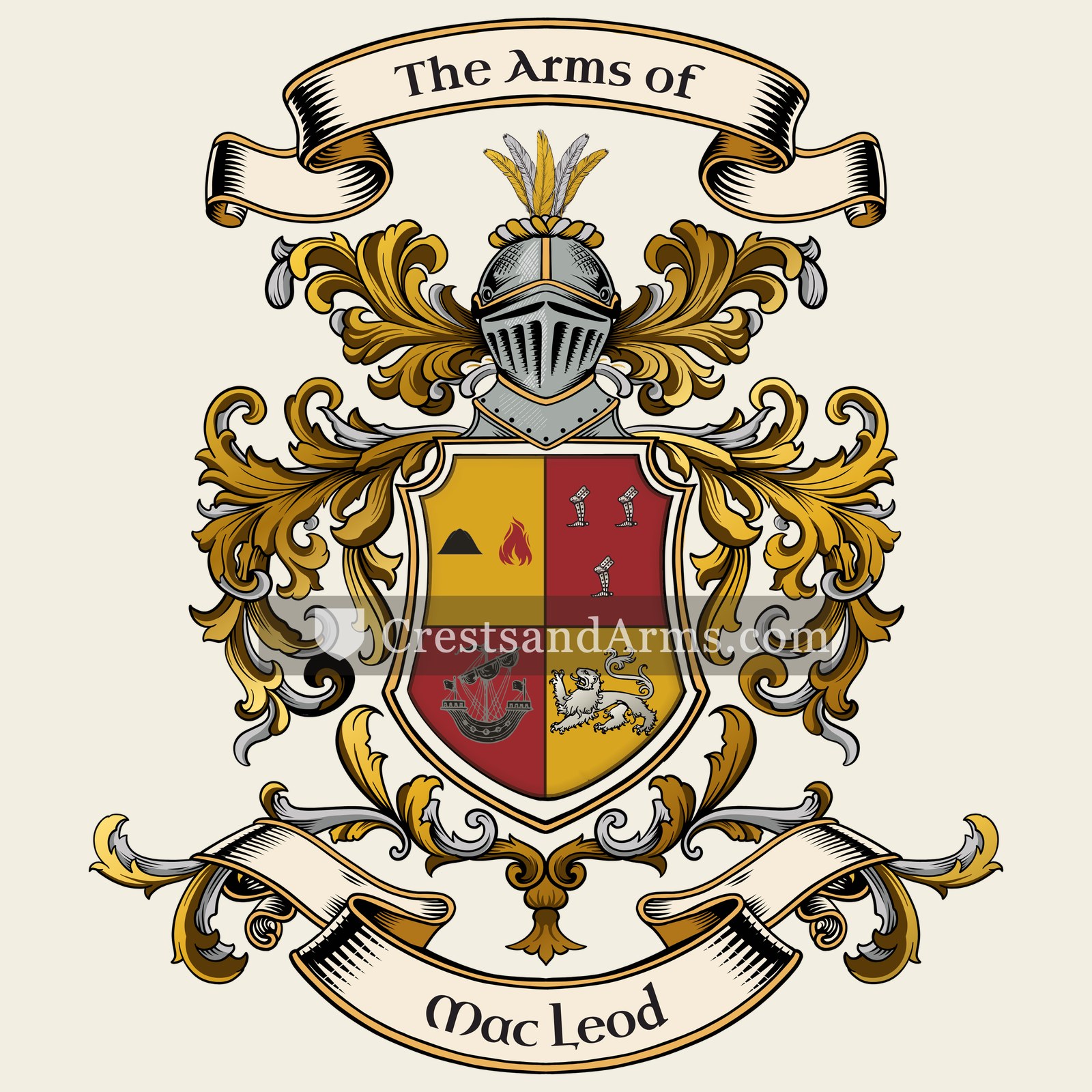
Symbols on this shield
mountThe ground held, and steadfastness upon it
fireZeal and purification
legStrength and swiftness
shipEnterprise, and a great voyage undertaken
lionCourage, strength and royalty
Colours
Gold (Or)Means: Generosity
Red (Gules)Means: Military strength
Black (Sable)Means: Constancy
Silver (Argent)Means: Peace and sincerity
Historical info
Source
J. B. Rietstap, Armorial Général, Gouda: G. B. van Goor Zonen, 1884–87
Blazon (the actual original written record)
“Ec.: au 1 d'or à un volcan de sa. en abîme, vomissant des flammes de gu.; au 2 de gu. à trois jambes, arm. d'arg., éperonnées d'or, posées en pairle et réunies par les cuisses sur le coeur du quartier; au 3 d'or à une galère de sa., les voiles ferlées; au 4 de gu. au lion d'arg. C.: un soleil d'or. Légende au-dessus du cimier: LUCEO NON URO. T.: deux sauvages, iss. chacun d'un volcan, supp. des flammes de leurs mains et de leur tête, le tout au nat. D.: QUOCUNQUE JECERIS STABIT.”
Netherlandsc. 1815
Digital archive packCoat of arms PNG, gold border print PDF, vector SVG and the certificate of authenticity. Sent to your email in minutes.
Map of Netherlands showing where the Mac Leod arms are recorded
The Mac Leod arms were recorded in Netherlands, c. 1815.
Arms such as these were typically recorded in Friesland.
Friesland was low, wet country on the northern coast of the Netherlands, farmed by families who had held the same land for centuries. Free landholders were unusually common there, and a free landholder could carry arms.
This is where the arms were entered in the register. Families often moved to other parts of the country, so the same name can turn up in more than one region.
Region
Friesland
First recorded
1815
Granting Authority for the Mac Leod Arms
Hoge Raad van Adel
Photograph made by me · CC BY-SA 3.0
The body that granted and recorded arms in Netherlands in this period.
William I of the Netherlands
Sovereign of the period
William I of the Netherlands
1815–1840
Reigning in Netherlands when the Mac Leod arms are first recorded.
How Arms Worked in Netherlands
In the Netherlands, coats of arms were often used by noble families and those who held specific public offices. These arms were passed down through the generations to legitimate descendants. Younger branches of a family usually kept the original design without needing to add special marks. This system ensured that the family identity remained clear and consistent over many years.
Granting authority
The Hoge Raad van Adel is the official body that regulates and manages noble titles and coats of arms in the Netherlands.
How they got arms
Families typically obtained their coats of arms through official royal grants or by proving their long-standing historical use of the symbols.
Where arms were recorded
Coats of arms are officially recorded in the registers held by the Hoge Raad van Adel, which began its work in 1814.
The family's standing
Recorded among the armigerous families of Netherlands.
Origin & History of the Mac Leod Family in Netherlands
The history of the Mac Leod family in the Netherlands began in the early nineteenth century when members of this Scottish lineage settled in the province of Friesland. While the name is deeply rooted in the Hebrides of Scotland, the Dutch branch established a distinct presence during the Napoleonic era. In 1815, records confirm that family members held positions of influence within the Dutch military and civil administration. These early settlers successfully integrated into the local Frisian society while maintaining their connection to their ancestral heritage. Their transition into Dutch life was marked by their participation in the political and social reforms that followed the establishment of the Kingdom of the Netherlands. By embedding themselves in the regional leadership of Friesland, the family ensured that their name became a recognized part of the local historical record.
Coat of Arms & Family Crest Details
Symbols on this shield
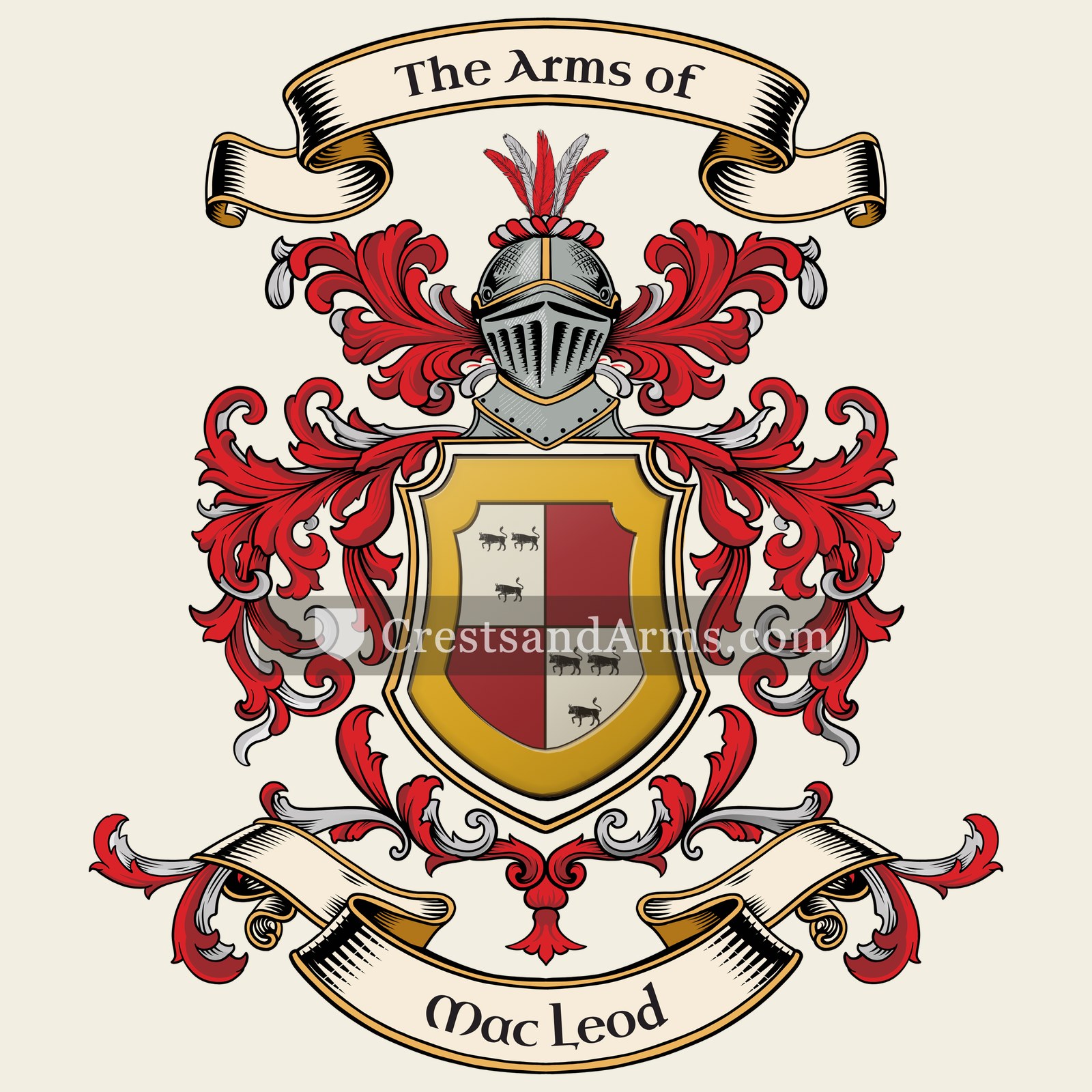
bordureA difference between branches of one family
bullValour and generosity
Colours
Silver (Argent)Means: Peace and sincerity
Red (Gules)Means: Military strength
Gold (Or)Means: Generosity
Black (Sable)Means: Constancy
Historical info
Source
Sir Bernard Burke, The General Armory of England, Scotland, Ireland and Wales, London: Harrison & Sons, 1884
Blazon (the actual original written record)
“Quarterly, 1st and 4th, as MACLEOD, of that Ilk; 2nd and 3rd, the arms of the Isle of Man, as above, all within a bordure embattled or. Crest and Mottoes, as the last”
StaffordArley Castle · Stafford, c. 1844
Digital archive packCoat of arms PNG, gold border print PDF, vector SVG and the certificate of authenticity. Sent to your email in minutes.
Map of England showing where the Mac Leod arms are recorded
The Mac Leod arms were recorded in Stafford, c. 1844.
Staffordshire was mixed country of moorland, farmland and early ironworking. Its landed families were spread widely rather than concentrated, and each holding brought its own claim to arms.
This is where the arms were entered in the register. Families often moved to other parts of the country, so the same name can turn up in more than one region.
The body that granted and recorded arms in England in this period.
Victoria
Sovereign of the period
Victoria
1837–1901
Reigning in Netherlands when the Mac Leod arms are first recorded.
How Arms Worked in England
English heraldry allowed arms to be shared by all legitimate descendants of the original owner. These symbols were treated as personal property that moved through the generations to all children. While the eldest son kept the original design, other family members could use the same shield without needing to change it or register their own unique versions.
Granting authority
The College of Arms in London has regulated the use of coats of arms throughout England and Wales since 1484.
How they got arms
Families typically obtained their coats of arms through a formal grant from the Crown or by proving their ancient right to them.
Where arms were recorded
All official coats of arms are recorded in the registers kept at the College of Arms, which date back to the fifteenth century.
The family's standing
Recorded among the armigerous families of Stafford.
Origin & History of the Mac Leod Family in England
The MacLeod name originates from the Norse-Gaelic roots of the Hebrides, but its presence in England tells a different story of migration and professional life during the nineteenth century. While the family is historically tied to the rugged landscapes of Scotland, members of the MacLeod line established a clear footprint in the English Midlands by 1844. Records show that individuals bearing this name were living in Stafford during this period, likely drawn to the area by the expansion of the railway network and the growth of local industries. These early English residents were part of a broader movement of Scottish families relocating south to pursue new opportunities in trade and administration. By settling in Staffordshire, they integrated their northern heritage into the developing urban landscape of Victorian England, marking a transition from their ancestral island roots to the heart of the British industrial centers.
Coat of Arms & Family Crest Details
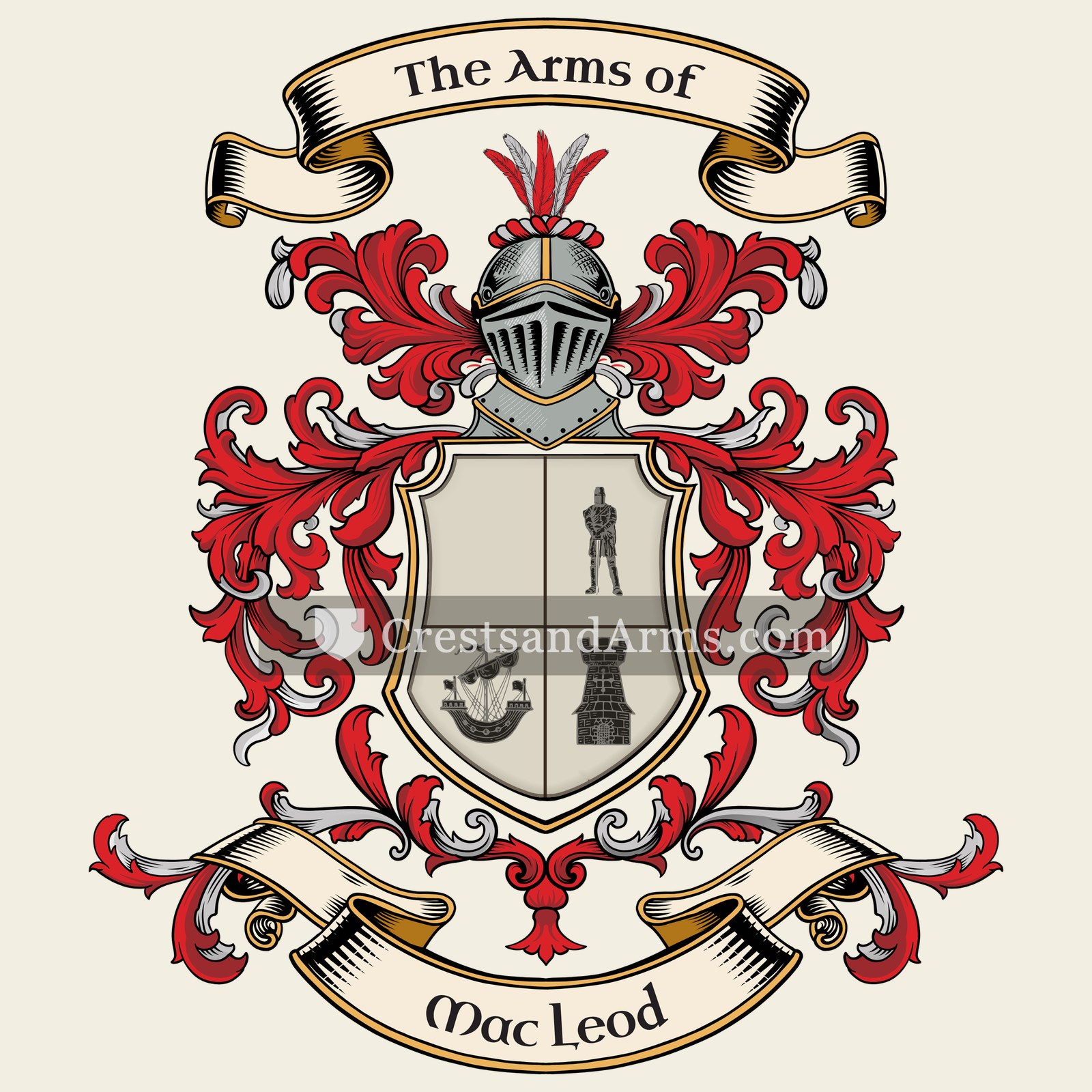
Symbols on this shield
knightChivalry and service in arms
shipEnterprise, and a great voyage undertaken
towerGrandeur and solidity, and a stronghold defended
Colours
Silver (Argent)Means: Peace and sincerity
Black (Sable)Means: Constancy
Historical info
Source
Sir Bernard Burke, The General Armory of England, Scotland, Ireland and Wales, London: Harrison & Sons, 1884
Blazon (the actual original written record)
“Quarterly, 1st, as MACLEOD, of Lewis; 2nd, Isle of Man; 3rd, or, a lymphad sa. flags gu.; 4th, az. a castle triple-towered and embattled ar. masoned sa. windows and portcullis gu”
RossCadboll · Ross, c. 1725
Digital archive packCoat of arms PNG, gold border print PDF, vector SVG and the certificate of authenticity. Sent to your email in minutes.
Map of Scotland showing where the Mac Leod arms are recorded
The Mac Leod arms were recorded in Ross, c. 1725.
Ross was Highland country reaching from the North Sea to the Atlantic, held by clan families. Chiefs recorded arms to mark the head of a line and branches recorded their own beneath them.
This is where the arms were entered in the register. Families often moved to other parts of the country, so the same name can turn up in more than one region.
The body that granted and recorded arms in Scotland in this period.
George I of Great Britain
Sovereign of the period
George I of Great Britain
1714–1727
Reigning in Netherlands when the Mac Leod arms are first recorded.
How Arms Worked in Scotland
Scottish heraldry is unique because it treats a coat of arms as a piece of personal property protected by law. Only one person can own a specific design at any given time. When a family grows, the head keeps the original shield while other relatives must apply for their own distinct version with slight changes to prove their specific identity.
Granting authority
The Court of the Lord Lyon acts as the official body that regulates and controls all heraldic matters throughout Scotland.
How they got arms
Individuals obtain a legal right to their arms through a formal petition process that confirms their identity and family connection.
Where arms were recorded
All valid coats of arms are officially entered into the Public Register of All Arms and Bearings starting from 1672.
The family's standing
Recorded among the armigerous families of Ross.
Origin & History of the Mac Leod Family in Scotland
The MacLeod name originates from the Gaelic personal name Leod, which is derived from the Old Norse name Ljótr, meaning ugly or fierce. This linguistic root reflects the deep connection between the early family members and the Norse settlers who dominated the Hebrides and the western coast of Scotland during the Middle Ages. By the time the family established a firm presence in the region of Ross by 1725, they had already spent centuries integrating into the complex social structure of the Scottish Highlands. The clan functioned as a powerful kinship group that held significant influence over land and local governance. Their history is defined by a transition from Norse maritime traditions to the Gaelic clan system, where they became known for their resilience and strategic alliances. Throughout these early centuries, the family played a central role in the political and cultural life of the Scottish islands and the mainland.
Mac Leod Meaning & Related Branches
Root word
Ljótr
Old Norse term meaning ugly or fierce.
This name
Mac LeodSon of the ugly or fierce one, originating from Norse settlers in Scotland.
also spelled
McLeod
MacCloud
MacLoud
Related arms
Villesimilar arms
Annesleyrecorded with Mac Leod, same area
Woodwardrecorded with Mac Leod, same area
Documented Sources
J. B. Rietstap, Armorial Général, Gouda: G. B. van Goor Zonen, 1884–87


 mountThe ground held, and steadfastness upon it
 fireZeal and purification
 legStrength and swiftness
 shipEnterprise, and a great voyage undertaken
 lionCourage, strength and royalty
 mountThe ground held, and steadfastness upon it
 fireZeal and purification
 legStrength and swiftness
 shipEnterprise, and a great voyage undertaken
 lionCourage, strength and royalty


 bordureA difference between branches of one family
 bullValour and generosity


 knightChivalry and service in arms
 towerGrandeur and solidity, and a stronghold defended