Map of Scotland showing where the Mactaggart arms are recorded
The Mactaggart arms were recorded in London, c. 1796.
Arms such as these were typically recorded in Edinburgh.
Edinburgh was the seat of Scotland's government, its courts and its heralds. Families with business there settled nearby, and being close to where arms were recorded is exactly why so many of them appear.
This is where the arms were entered in the register. Families often moved to other parts of the country, so the same name can turn up in more than one region.
The body that granted and recorded arms in Scotland in this period.
George III of Great Britain
Sovereign of the period
George III of Great Britain
1760–1801
Reigning in Scotland when the Mactaggart arms are first recorded.
How Arms Worked in Scotland
Scottish heraldry is unique because it treats a coat of arms as a piece of personal property protected by law. Only one person can own a specific design at any given time. When a family grows, the head keeps the original shield while other relatives must apply for their own distinct version with slight changes to prove their specific identity.
Granting authority
The Court of the Lord Lyon acts as the official body that regulates and controls all heraldic matters throughout Scotland.
How they got arms
Individuals obtain a legal right to their arms through a formal petition process that confirms their identity and family connection.
Where arms were recorded
All valid coats of arms are officially entered into the Public Register of All Arms and Bearings starting from 1672.
The family's standing
Recorded among the armigerous families of Scotland.
Origin & History of the Mactaggart Family in Scotland
The name Mactaggart originates from the Gaelic language, where it translates to "son of the priest." This indicates that the family’s earliest ancestors were likely descendants of a member of the clergy who served the church during a time when clerical celibacy was not strictly enforced. While the name has deep roots in the western regions of Scotland, by the late eighteenth century, the family had established a presence in the bustling city of Edinburgh. Records from 1796 confirm that members of the Mactaggart family were living and working in the capital during a period of rapid urban growth and intellectual expansion. This transition from rural origins to the heart of Scottish society reflects the broader movement of families seeking new opportunities in the city during the Scottish Enlightenment.
Mactaggart Meaning & Related Branches
Root word
Mac an t-Sagairt
Gaelic phrase meaning son of the priest.
This name
MactaggartA Scottish surname denoting descent from a member of the clergy.
also spelled
Tagart
Taggart
Mactaggart
Mctaggart
Documented Sources
Sir Bernard Burke, The General Armory of England, Scotland, Ireland and Wales, London: Harrison & Sons, 1884
Black, George F., The Surnames of Scotland: Their Origin, Meaning, and History, 1946
National Records of Scotland, Old Parish Registers of Edinburgh, 1796
Digital archive packCoat of arms PNG, gold border print PDF, vector SVG and the certificate of authenticity. Sent to your email in minutes.


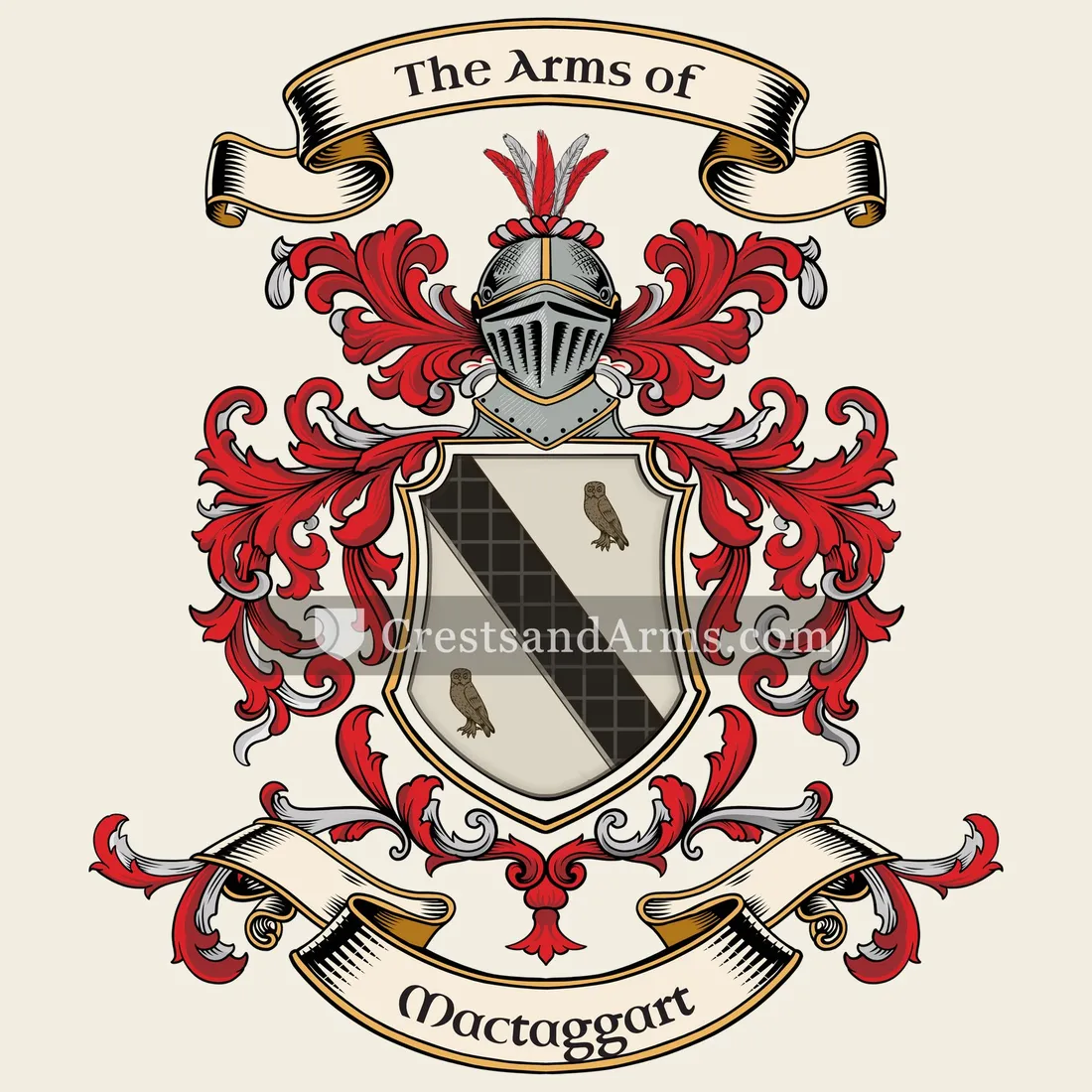
 bendDefence, and the scarf of a commander
 owlWisdom and vigilance by night
 bendDefence, and the scarf of a commander
 owlWisdom and vigilance by night