A record of documented arms, meaning and origin, researched for the Mafi family lines. Documented in 2 countries.
Reg. 3205 · Italian, M–O
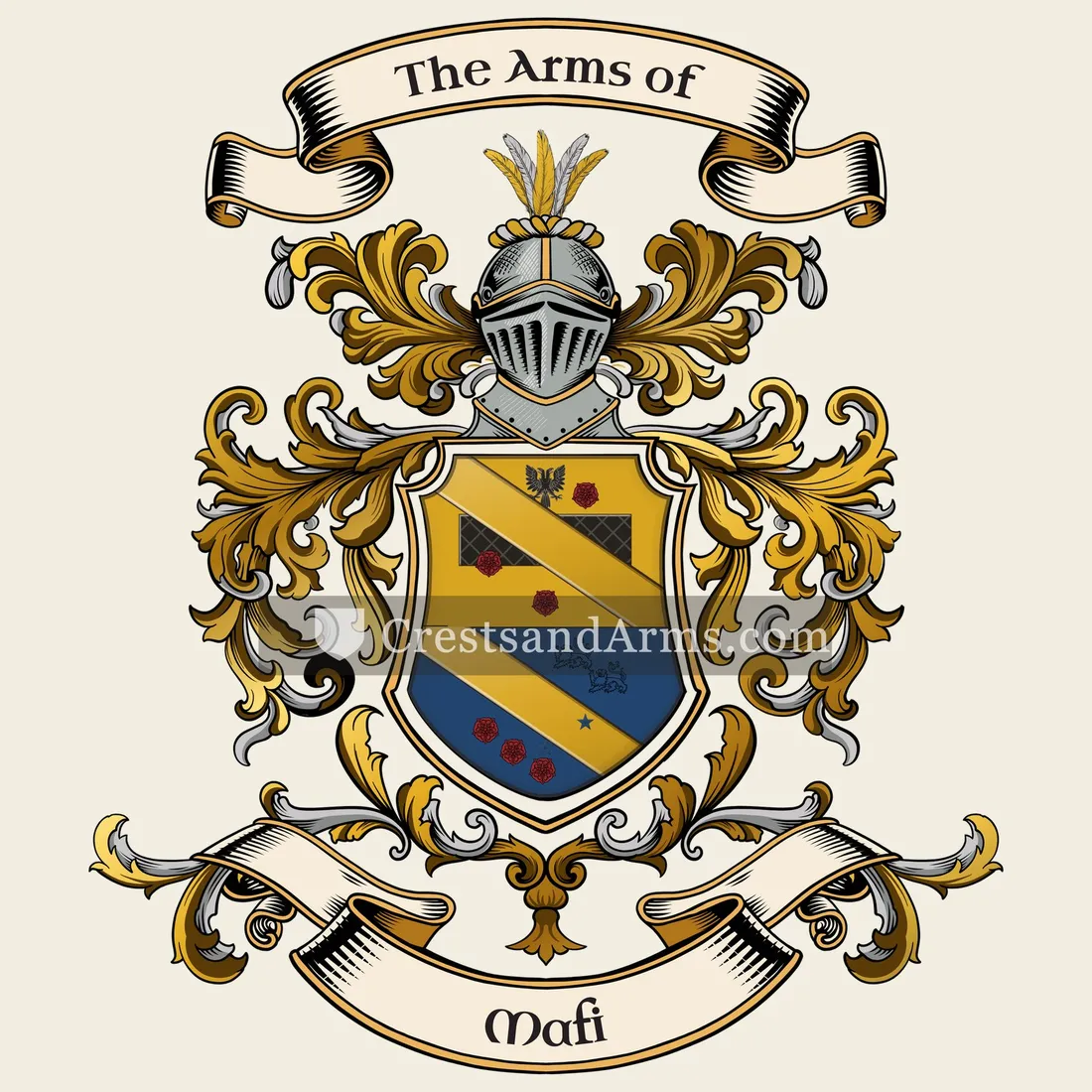
Meaning of the Mafi family crest colors & symbols
Symbols on this shield
bendDefence, and the scarf of a commander
lionCourage, strength and royalty
roseThe seventh son, and beauty with grace
mulletThe third son, and a divine quality from above
eagleNobility, strength and a keen mind
Colours
Gold (Or)Means: Generosity
Blue (Azure)Means: Loyalty and truth
Silver (Argent)Means: Peace and sincerity
Black (Sable)Means: Constancy
Red (Gules)Means: Military strength
Historical info
Source
J. B. Rietstap, Armorial Général, Gouda: G. B. van Goor Zonen, 1884–87
Blazon (the actual original written record)
“Coupé: au 1 d'or à l'aigle ép. de sa.; au 2 parti: a. d'azur à la bande d'or, ch. de trois roses de gu., bout. d'or; b. de gu. à la bande d'arg., acc. en chef d'un lion d'or, soutenu de la bande, et en p. d'une étoile d'or. Deux cq. cour. C.: 1º un buste d'homme, hab. aux armes du 2 a., coiffé d'un bonnet albanais d'azur, retr. et houppé d'or; 1. d'or et d'azur; 2º un lion iss. d'or; l. d'arg. et de gu.”
Italyc. 1761
Digital archive packCoat of arms PNG, gold border print PDF, vector SVG and the certificate of authenticity. Sent to your email in minutes.
Map of Italy showing where the Mafi arms are recorded
The Mafi arms were recorded in Italy, c. 1761.
Arms such as these were typically recorded in Venice.
Venice ran on trade, and its great families were merchants before they were anything else. The city kept a formal list of its noble houses, and a name on that list carried arms as a matter of record.
This is where the arms were entered in the register. Families often moved to other parts of the country, so the same name can turn up in more than one region.
The body that granted and recorded arms in Italy in this period.
Francesco Loredan
Sovereign of the period
Francesco Loredan
1752–1762
Reigning in Italy when the Mafi arms are first recorded.
How Arms Worked in Italy
In the Italian states, coats of arms were often used by noble families to show their status and history. These symbols were passed down through the generations to all legitimate male descendants. Younger branches of a family usually kept the original design but sometimes added small changes to distinguish their specific line from the main branch.
Granting authority
Various local rulers and city governments controlled the use of coats of arms across the different Italian states.
How they got arms
Families often assumed their own arms or received them as official grants from local lords, popes, or city councils.
Where arms were recorded
Arms were recorded in local city archives or private family books rather than in one single national register.
The family's standing
Recorded among the armigerous families of Italy.
Origin & History of the Mafi Family in Italy
The history of the Mafi family in Italy is deeply tied to the vibrant social and commercial life of Venice during the eighteenth century. By 1761, records confirm that members of the family were established residents of this influential maritime republic. During this era, Venice served as a major crossroads for trade and cultural exchange between Europe and the East. Families living in the city often participated in the complex merchant networks that defined the Venetian economy. While the name Mafi may have roots in various regional dialects, its presence in Venice suggests that these early ancestors were likely integrated into the urban fabric of a city known for its strict record-keeping and bureaucratic precision. As the family navigated life in the Venetian lagoons, they contributed to the unique historical tapestry of a society that valued both maritime commerce and artistic achievement.
Meaning of the Mafi family crest colors & symbols
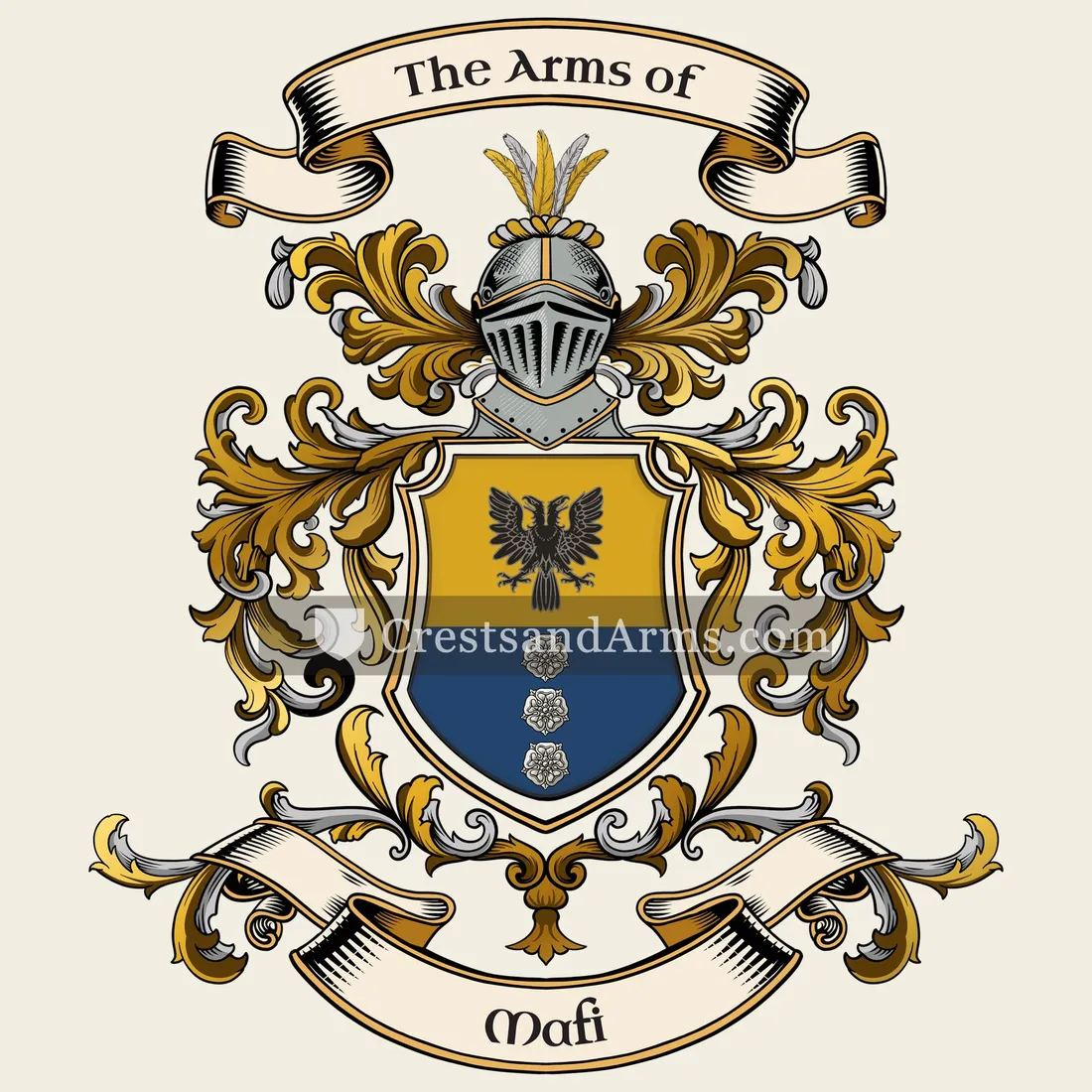
Symbols on this shield
eagleNobility, strength and a keen mind
roseThe seventh son, and beauty with grace
Colours
Gold (Or)Means: Generosity
Blue (Azure)Means: Loyalty and truth
Black (Sable)Means: Constancy
Silver (Argent)Means: Peace and sincerity
Historical info
Source
J. B. Rietstap, Armorial Général, Gouda: G. B. van Goor Zonen, 1884–87
Blazon (the actual original written record)
“Coupé: au 1 d'or à l'aigle ép. de sa.; au 2 d'azur à trois roses à quatre feuilles d'arg., rangées en barre. Cq. cour. C.: un buste d'homme, hab. du 2, coiffé d'un bonnet albanais d'azur, retr. et houppé d'or. L.: à dextre d'or et de sa., à sen. d'arg. et d'azur.”
BavariaBavaria, c. 1657
Digital archive packCoat of arms PNG, gold border print PDF, vector SVG and the certificate of authenticity. Sent to your email in minutes.
Map of Germany showing where the Mafi arms are recorded
The Mafi arms were recorded in Bavaria, c. 1657.
Bavaria was a country of old landed families and walled market towns. Estates passed down the same line for centuries, and both the landowners and the leading townsmen kept arms, which is why so many Bavarian names sit in the registers.
This is where the arms were entered in the register. Families often moved to other parts of the country, so the same name can turn up in more than one region.
The body that granted and recorded arms in Germany in this period.
Ferdinand III, Holy Roman Emperor
Sovereign of the period
Ferdinand III, Holy Roman Emperor
1637–1657
Reigning in Italy when the Mafi arms are first recorded.
How Arms Worked in Germany
In the Holy Roman Empire, coats of arms were often granted to individuals by the Emperor or his representatives. These arms were then passed down through the generations to all legitimate descendants of the original holder. Younger branches of a family usually kept the same shield design without needing to change it, as the arms belonged to the entire lineage.
Granting authority
The Holy Roman Emperor held the sole power to grant new coats of arms throughout his vast imperial territories.
How they got arms
Families typically obtained their coats of arms through a formal imperial grant or by proving their noble status to the authorities.
Where arms were recorded
These grants were officially recorded in the Imperial Chancery registers, which began keeping formal records of such honors during the Middle Ages.
The family's standing
Recorded among the armigerous families of Bavaria.
Origin & History of the Mafi Family in Germany
The history of the Mafi family in Germany begins in the seventeenth century, specifically within the region of Bavaria. Records confirm that members of the family were established in this area by 1657, a time when the region was still recovering from the long and difficult period of the Thirty Years' War. During this era, families often moved across borders due to shifting political alliances and the search for new economic opportunities in the southern German states. The name itself reflects the movement of people across the Alps, as it is linked to historical migration patterns between Italy and the southern German territories. As these early ancestors settled into Bavarian life, they integrated into the local social structure, likely working in trade or agriculture, which were the primary ways families sustained themselves in the rural communities of the time. By establishing a presence in Bavaria, the Mafi family became part of the diverse cultural fabric that defined the region during the transition into the modern era.
Mafi Meaning & Related Branches
Root word
Matthaeus
Gift of God derived from the Hebrew name Matityahu.
This name
MafiA patronymic or diminutive form indicating descent from an ancestor named Matteo.
also spelled
Mafei
Maffey
Documented Sources
J. B. Rietstap, Armorial Général, Gouda: G. B. van Goor Zonen, 1884–87
Archivio di Stato di Venezia, Anagrafi di Popolazione (1761)
Cessi, Roberto, Storia della Repubblica di Venezia, 1944
Lane, Frederic C., Venice, A Maritime Republic, 1973
Digital archive packCoat of arms PNG, gold border print PDF, vector SVG and the certificate of authenticity. Sent to your email in minutes.


 bendDefence, and the scarf of a commander
 lionCourage, strength and royalty
 roseThe seventh son, and beauty with grace
 mulletThe third son, and a divine quality from above
 eagleNobility, strength and a keen mind
 bendDefence, and the scarf of a commander
 lionCourage, strength and royalty
 roseThe seventh son, and beauty with grace
 mulletThe third son, and a divine quality from above
 eagleNobility, strength and a keen mind