Map of Switzerland showing where the Magerman arms are recorded
The Magerman arms were recorded in Valais, c. 1745.
This is where the arms were entered in the register. Families often moved to other parts of the country, so the same name can turn up in more than one region.
The body that granted and recorded arms in Switzerland in this period.
How Arms Worked in Switzerland
In Switzerland, coats of arms were not restricted to the nobility and were often adopted by common citizens and families. These symbols were passed down through generations to show family identity. When branches of a family grew, they often changed small details of the design to distinguish their own line from the original group.
Granting authority
Cantonal and civic authorities managed the use of coats of arms within their specific regions and local jurisdictions.
How they got arms
Families typically assumed their own coats of arms based on local custom rather than receiving them from a central monarch.
Where arms were recorded
Arms were recorded in various cantonal and civic registers starting from the fourteenth century throughout the Swiss region.
The family's standing
Recorded among the armigerous families of Switzerland.
Origin & History of the Magerman Family in Switzerland
The family name Magerman carries a history deeply rooted in the rugged landscape of the Swiss Alps. By the year 1745, records confirm that members of the family were well-established residents of the Valais region. This area was historically defined by its isolated mountain valleys and a culture centered on alpine farming and trade. Families living in Valais during the eighteenth century often relied on communal land rights and seasonal migration to support their livelihoods. The name itself likely evolved from local linguistic roots, reflecting the practical roles or geographic origins of those who first bore it in the high-altitude settlements. As the family grew, they became part of the long-standing social fabric of the canton, contributing to the unique traditions and community structures that defined life in the Swiss mountains during the late modern period.
Magerman Meaning & Related Branches
Root word
Mager
A Germanic term referring to someone who is thin or lean.
This name
MagermanAn occupational or descriptive surname denoting a person of slender physical build.
also spelled
Mageran
Documented Sources
J. B. Rietstap, Armorial Général, Gouda: G. B. van Goor Zonen, 1884–87
Archives de l'État du Valais, Registres paroissiaux de l'Ancien Régime
Furrer, Gregor, Die Geschichte des Wallis: Vom Mittelalter bis zur Gegenwart, 2005
Imesch, Hans, Bevölkerungsgeschichte des Kantons Wallis, 1988
Digital archive packCoat of arms PNG, gold border print PDF, vector SVG and the certificate of authenticity. Sent to your email in minutes.


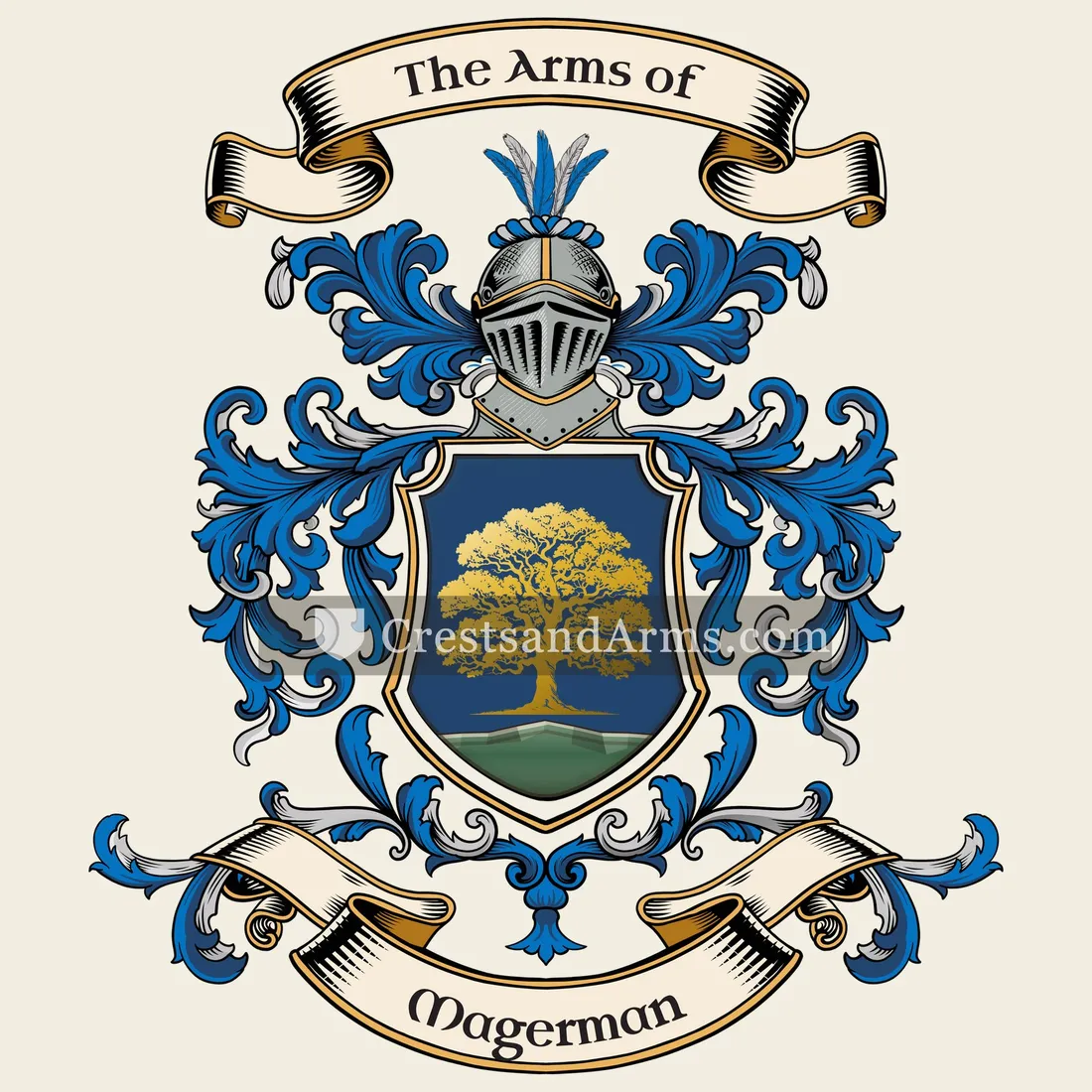
 mountThe ground held, and steadfastness upon it
 treeLife, endurance and deep roots
 mountThe ground held, and steadfastness upon it
 treeLife, endurance and deep roots