Map of Belgium showing where the Magsino arms are recorded
The Magsino arms were recorded in Bruges, c. 1737.
This is where the arms were entered in the register. Families often moved to other parts of the country, so the same name can turn up in more than one region.
The body that granted and recorded arms in Belgium in this period.
Charles VI, Holy Roman Emperor
Sovereign of the period
Charles VI, Holy Roman Emperor
1711–1740
Reigning in Belgium when the Magsino arms are first recorded.
How Arms Worked in Belgium
In Belgium, a coat of arms is considered personal property that is passed down through the male line to legitimate descendants. Families often use the same shield design across generations to show their shared heritage. If a branch of the family wants to change the design, they must apply for an official update to their specific version of the arms.
Granting authority
The Conseil héraldique is the official body that regulates and approves all coats of arms in Belgium.
How they got arms
Families obtain their coats of arms through formal royal grants or by confirming their historical right to use existing designs.
Where arms were recorded
All approved coats of arms are officially recorded in the public registers of the Conseil héraldique since 1844.
The family's standing
Recorded among the armigerous families of Belgium.
Origin & History of the Magsino Family in Belgium
The history of the Magsino family in Belgium begins with documented evidence of their presence in the city of Bruges as early as 1737. During this period, Bruges was a significant center for trade and craftsmanship, attracting families who sought to integrate into the local mercantile and civic structures. The Magsino name appears in municipal records during a time when the city was transitioning through various economic shifts, suggesting that the family likely participated in the urban life of the Low Countries. By establishing themselves in a major hub like Bruges, the early members of this family became part of the intricate social fabric of the eighteenth century. Their presence in these official registers indicates that they were recognized inhabitants who contributed to the local community and navigated the legal requirements of the time. This historical footprint serves as a testament to their early integration into the region long before the name became associated with other parts of the world.
Coat of Arms & Family Crest Details
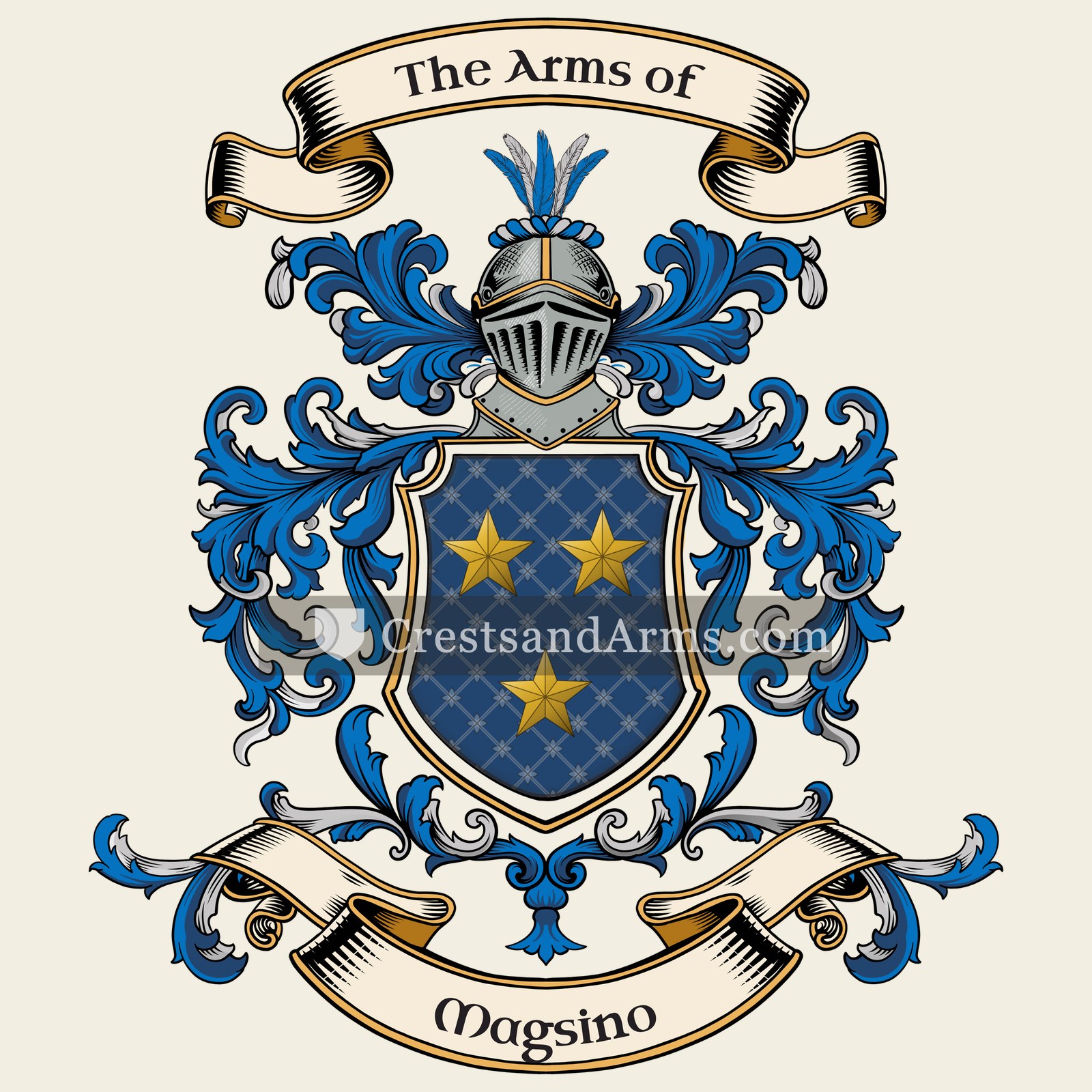
Symbols on this shield
mulletThe third son, and a divine quality from above
Colours
Blue (Azure)Means: Loyalty and truth
Gold (Or)Means: Generosity
Historical info
Source
J. B. Rietstap, Armorial Général, Gouda: G. B. van Goor Zonen, 1884–87
Blazon (the actual original written record)
“D'azur à trois étoiles d'or.”
ArtoisArtois, c. 1663
Digital archive packCoat of arms PNG, gold border print PDF, vector SVG and the certificate of authenticity. Sent to your email in minutes.
Map of France showing where the Magsino arms are recorded
The Magsino arms were recorded in Artois, c. 1663.
Artois lay on the disputed ground between France and the Low Countries and was fought over for centuries. Families there held their land under arms, and a shield was how a fighting household was known.
This is where the arms were entered in the register. Families often moved to other parts of the country, so the same name can turn up in more than one region.
The body that granted and recorded arms in France in this period.
Louis XIV of France
Sovereign of the period
Louis XIV of France
1643–1715
Reigning in Belgium when the Magsino arms are first recorded.
How Arms Worked in France
In France, a coat of arms was a mark of honor that passed down through the male line to all legitimate descendants. Families often used the same shield without changes to show their shared heritage. If a branch wanted to stand out, they could add a small mark to their shield to show their specific place in the family tree.
Granting authority
The Juge d'armes de France acted as the official authority that regulated and verified coats of arms across the country.
How they got arms
Families typically inherited their arms from ancestors, though they could also receive them through royal grants or by proving their noble status.
Where arms were recorded
Coats of arms were officially recorded in the Armorial Général de France, which began its main collection in the year 1696.
The family's standing
Recorded among the armigerous families of Artois.
Origin & History of the Magsino Family in France
The history of the Magsino family in France traces back to the northern region of Artois, where records confirm their presence as early as 1663. During the seventeenth century, Artois was a landscape defined by shifting borders and the influence of both French and Spanish administrative traditions. Families living in this area often navigated a complex social environment shaped by the aftermath of the Thirty Years' War and the subsequent integration of the region into the French kingdom under Louis XIV. Living in Artois meant that the Magsino ancestors were likely part of a resilient community that adapted to changing local laws and agricultural demands. By maintaining their presence in this specific territory, the family became part of the long-term demographic fabric of northern France, contributing to the local workforce and the distinct cultural identity of the Artois province during a period of significant national expansion.
Related Branches & Arms
Root word
Magasin
A storehouse, warehouse, or place where goods are kept.
This name
MagsinoDerived from a topographic or occupational name for someone who lived near or worked in a warehouse.
also spelled
Massin
Mazin
Documented Sources
J. B. Rietstap, Armorial Général, Gouda: G. B. van Goor Zonen, 1884–87
Stadsarchief Brugge, Bevolkingsregisters en Poortersboeken (1737)
Digital archive packCoat of arms PNG, gold border print PDF, vector SVG and the certificate of authenticity. Sent to your email in minutes.


 ramLeadership and authority
 vol / wingsSwiftness and protection
 ramLeadership and authority
 vol / wingsSwiftness and protection


 mulletThe third son, and a divine quality from above