Map of France showing where the Maillet arms are recorded
The Maillet arms were recorded in Lorraine, c. 1587.
Lorraine sat on the border between France and the German lands, and border country bred soldiers. Families here held small estates and served in arms, and a fighting man was exactly the sort who carried a shield of his own.
This is where the arms were entered in the register. Families often moved to other parts of the country, so the same name can turn up in more than one region.
The body that granted and recorded arms in France in this period.
Henry III of France
Sovereign of the period
Henry III of France
1574–1589
Reigning in France when the Maillet arms are first recorded.
How Arms Worked in France
In France, a coat of arms was a mark of honor that passed down through the male line to all legitimate descendants. Families often used the same shield without changes to show their shared heritage. If a branch wanted to stand out, they could add a small mark to their shield to show their specific place in the family tree.
Granting authority
The Juge d'armes de France acted as the official authority that regulated and verified coats of arms across the country.
How they got arms
Families typically inherited their arms from ancestors, though they could also receive them through royal grants or by proving their noble status.
Where arms were recorded
Coats of arms were officially recorded in the Armorial Général de France, which began its main collection in the year 1696.
The family's standing
Recorded among the armigerous families of Lorraine.
Origin & History of the Maillet Family in France
The surname Maillet finds its roots in the medieval French language, where it functioned as a descriptive nickname derived from the word "mail," meaning a mallet or a heavy hammer. This name was likely bestowed upon individuals who worked as blacksmiths, carpenters, or stone masons, as these trades relied heavily on such tools. By the late sixteenth century, the family had established a notable presence in the Lorraine region of eastern France. Records confirm that members of the Maillet family were living in this area by 1587, a time when Lorraine was a semi-independent duchy caught between the cultural influences of France and the Holy Roman Empire. During this period, families in Lorraine often moved between rural farming communities and growing market towns to support the local economy. The Maillet name persisted through these turbulent years, reflecting the family's deep connection to the craftsmanship and labor that defined life in the borderlands of early modern France.
Coat of Arms & Family Crest Details
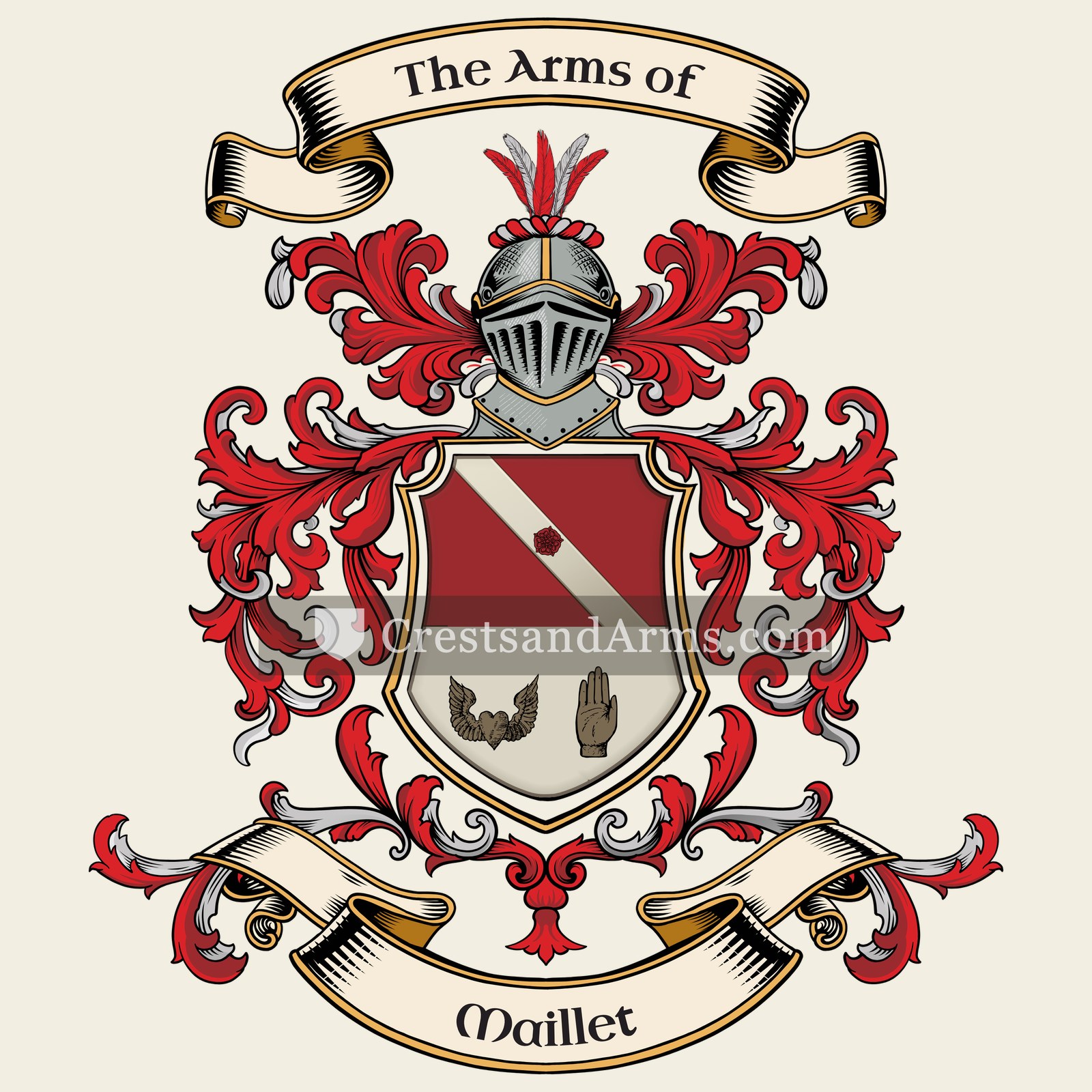
Symbols on this shield
bendDefence, and the scarf of a commander
roseThe seventh son, and beauty with grace
heartSincerity, charity and true affection
handFaith, sincerity and justice
Colours
Red (Gules)Means: Military strength
Silver (Argent)Means: Peace and sincerity
Historical info
Source
J. B. Rietstap, Armorial Général, Gouda: G. B. van Goor Zonen, 1884–87
Blazon (the actual original written record)
“Coupé: au 1 de gu. à la bande coticée d'arg., ch. d'une rose de gu.: au 2 d'arg. à un coeur enflammé à dextre, soutenu d'un échafaudage, et une main, mouv. de la p., brandissant un marteau dans la direction du coeur, le tout au nat.”
SwitzerlandGenève, c. 1745
Digital archive packCoat of arms PNG, gold border print PDF, vector SVG and the certificate of authenticity. Sent to your email in minutes.
Map of Switzerland showing where the Maillet arms are recorded
The Maillet arms were recorded in Genève, c. 1745.
This is where the arms were entered in the register. Families often moved to other parts of the country, so the same name can turn up in more than one region.
The body that granted and recorded arms in Switzerland in this period.
How Arms Worked in Switzerland
In Switzerland, coats of arms were not restricted to the nobility and were often adopted by common citizens and families. These symbols were passed down through generations to show family identity. When branches of a family grew, they often changed small details of the design to distinguish their own line from the original group.
Granting authority
Cantonal and civic authorities managed the use of coats of arms within their specific regions and local jurisdictions.
How they got arms
Families typically assumed their own coats of arms based on local custom rather than receiving them from a central monarch.
Where arms were recorded
Arms were recorded in various cantonal and civic registers starting from the fourteenth century throughout the Swiss region.
The family's standing
Recorded among the armigerous families of Switzerland.
Origin & History of the Maillet Family in Switzerland
The family name Maillet has deep roots in the French-speaking regions of Switzerland, with a documented presence in Geneva dating back to at least 1745. The name itself is derived from the Old French word "mail," which referred to a heavy hammer or mallet used by blacksmiths or stonemasons. This suggests that the earliest ancestors of the Maillet family were likely skilled tradespeople who played an essential role in the construction and industrial growth of the city. As Geneva developed into a major hub for watchmaking and banking during the eighteenth century, families like the Maillets became part of the local social fabric, often working in specialized crafts that defined the region’s economy. By settling in Geneva, these early family members integrated into a society that valued precision and trade, helping to establish the name as a recognized part of the city’s historical identity.
Related Branches & Arms
Root word
malleus
Latin word meaning a hammer or mallet.
This name
MailletA diminutive occupational name for someone who worked as a hammerer or blacksmith.
also spelled
Maillette
Mailley
Mayay
Related arms
Mailleyvariant spelling
Documented Sources
J. B. Rietstap, Armorial Général, Gouda: G. B. van Goor Zonen, 1884–87
Dauzat, Albert. Dictionnaire étymologique des noms de famille et prénoms de France. 1951
Digital archive packCoat of arms PNG, gold border print PDF, vector SVG and the certificate of authenticity. Sent to your email in minutes.


 fessThe military belt, and readiness to serve
 chevronProtection, and faithful service completed
 chiefAuthority, wisdom and dominion
 fessThe military belt, and readiness to serve
 chevronProtection, and faithful service completed
 chiefAuthority, wisdom and dominion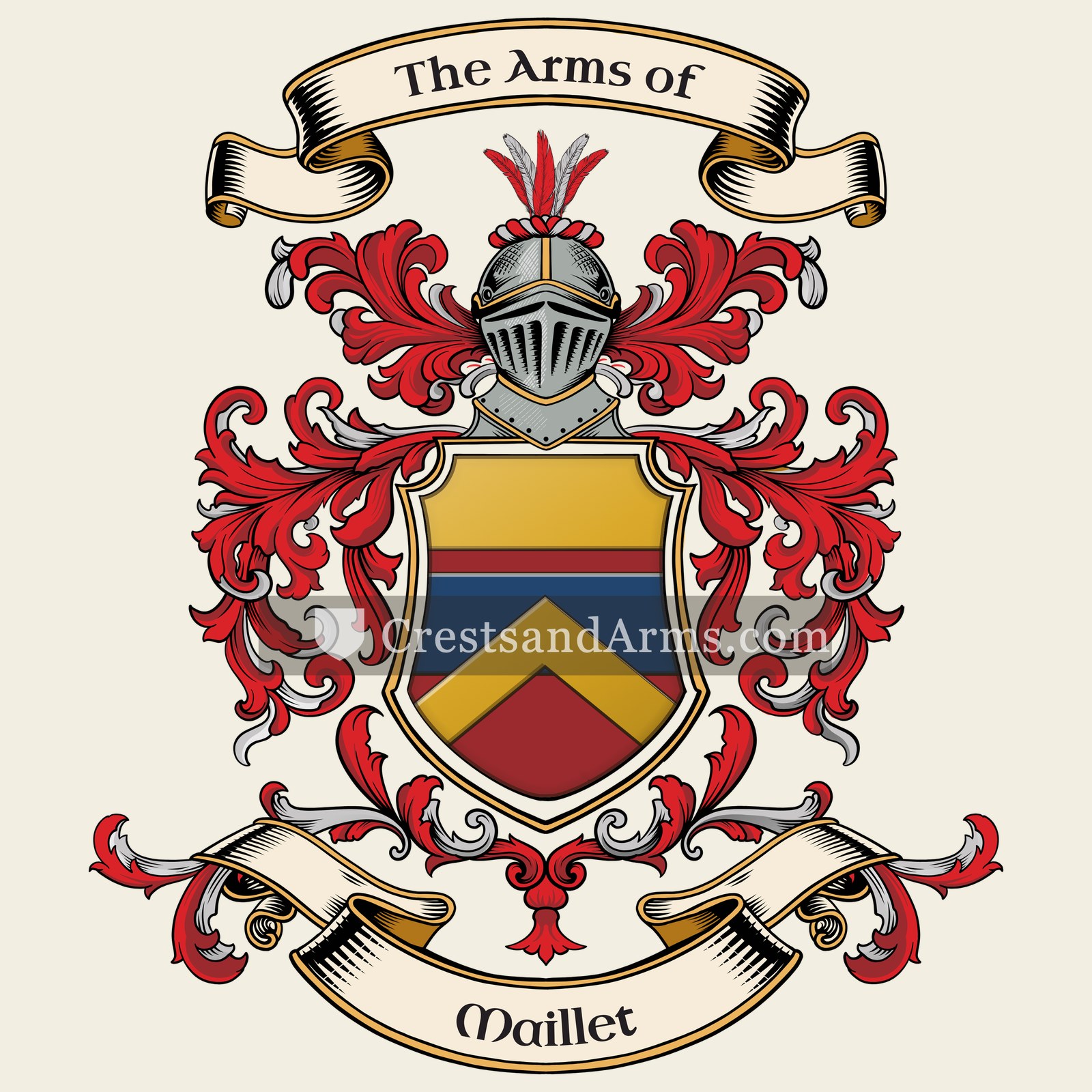


 bendDefence, and the scarf of a commander
 roseThe seventh son, and beauty with grace
 heartSincerity, charity and true affection
 handFaith, sincerity and justice