Map of France showing where the Main arms are recorded
The Main arms were recorded in Ile-de-France, c. 1663.
Ile-de-France is the country around Paris, and proximity to the court mattered. Families who served the crown were rewarded with land near it, and land near the capital carried arms almost as a matter of course.
This is where the arms were entered in the register. Families often moved to other parts of the country, so the same name can turn up in more than one region.
The body that granted and recorded arms in France in this period.
Louis XIV of France
Sovereign of the period
Louis XIV of France
1643–1715
Reigning in France when the Main arms are first recorded.
How Arms Worked in France
In France, a coat of arms was a mark of honor that passed down through the male line to all legitimate descendants. Families often used the same shield without changes to show their shared heritage. If a branch wanted to stand out, they could add a small mark to their shield to show their specific place in the family tree.
Granting authority
The Juge d'armes de France acted as the official authority that regulated and verified coats of arms across the country.
How they got arms
Families typically inherited their arms from ancestors, though they could also receive them through royal grants or by proving their noble status.
Where arms were recorded
Coats of arms were officially recorded in the Armorial Général de France, which began its main collection in the year 1696.
The family's standing
Recorded among the armigerous families of Ile-de-France.
Origin & History of the Main Family in France
The family name Main has deep roots in the historical region of Île-de-France, where records confirm members of the family were established by 1663. During this period, the name likely functioned as a topographic descriptor, identifying people who lived near a prominent physical feature or a specific landmark. In the social structure of seventeenth-century France, families often settled in rural parishes surrounding Paris, where they worked as skilled artisans or farmers. As the region served as the political and economic heart of the kingdom, the Main family would have been part of a complex society defined by local parish life and the shifting demands of the French crown. By maintaining a presence in this central territory, the family was positioned within the most influential area of the country during a time of significant cultural and administrative growth.
Coat of Arms & Family Crest Details
Symbols on this shield
bendDefence, and the scarf of a commander
handFaith, sincerity and justice
Colours
ErmineMeans: Dignity
Black (Sable)Means: Constancy
Gold (Or)Means: Generosity
Historical info
Source
Sir Bernard Burke, The General Armory of England, Scotland, Ireland and Wales, London: Harrison & Sons, 1884
Blazon (the actual original written record)
“Erm. on a bend sa. three dexter hands or”
BuckinghamBuckingham, c. 1620
Digital archive packCoat of arms PNG, gold border print PDF, vector SVG and the certificate of authenticity. Sent to your email in minutes.
Map of England showing where the Main arms are recorded
The Main arms were recorded in Buckingham, c. 1620.
Buckinghamshire was quiet farming country on the road out of London. Court officials and lawyers bought manors there within easy reach of the capital, and a manor was the usual reason to take arms.
This is where the arms were entered in the register. Families often moved to other parts of the country, so the same name can turn up in more than one region.
The body that granted and recorded arms in England in this period.
James VI and I
Sovereign of the period
James VI and I
1603–1625
Reigning in France when the Main arms are first recorded.
How Arms Worked in England
English heraldry allowed arms to be shared by all legitimate descendants of the original owner. These symbols were treated as personal property that moved through the generations to all children. While the eldest son kept the original design, other family members could use the same shield without needing to change it or register their own unique versions.
Granting authority
The College of Arms in London has regulated the use of coats of arms throughout England and Wales since 1484.
How they got arms
Families typically obtained their coats of arms through a formal grant from the Crown or by proving their ancient right to them.
Where arms were recorded
All official coats of arms are recorded in the registers kept at the College of Arms, which date back to the fifteenth century.
The family's standing
Recorded among the armigerous families of Buckingham.
Origin & History of the Main Family in England
The surname Main has deep roots in the English landscape, often serving as a descriptive label for individuals who lived near a prominent landmark or a significant piece of land. By the early 17th century, the family was firmly established in the county of Buckinghamshire, where records confirm their presence in the town of Buckingham by 1620. During this era, families with this name were typically involved in local trade or agriculture, living as settled members of the community during a time of great social change. The name itself likely evolved from Old English or Old French terms meaning strong or large, suggesting that early ancestors may have been known for their physical stature or their influence within their local parishes. As these families grew, they became part of the fabric of English village life, leaving behind traces in parish registers and tax documents that help historians piece together their movement across the region.
Coat of Arms & Family Crest Details
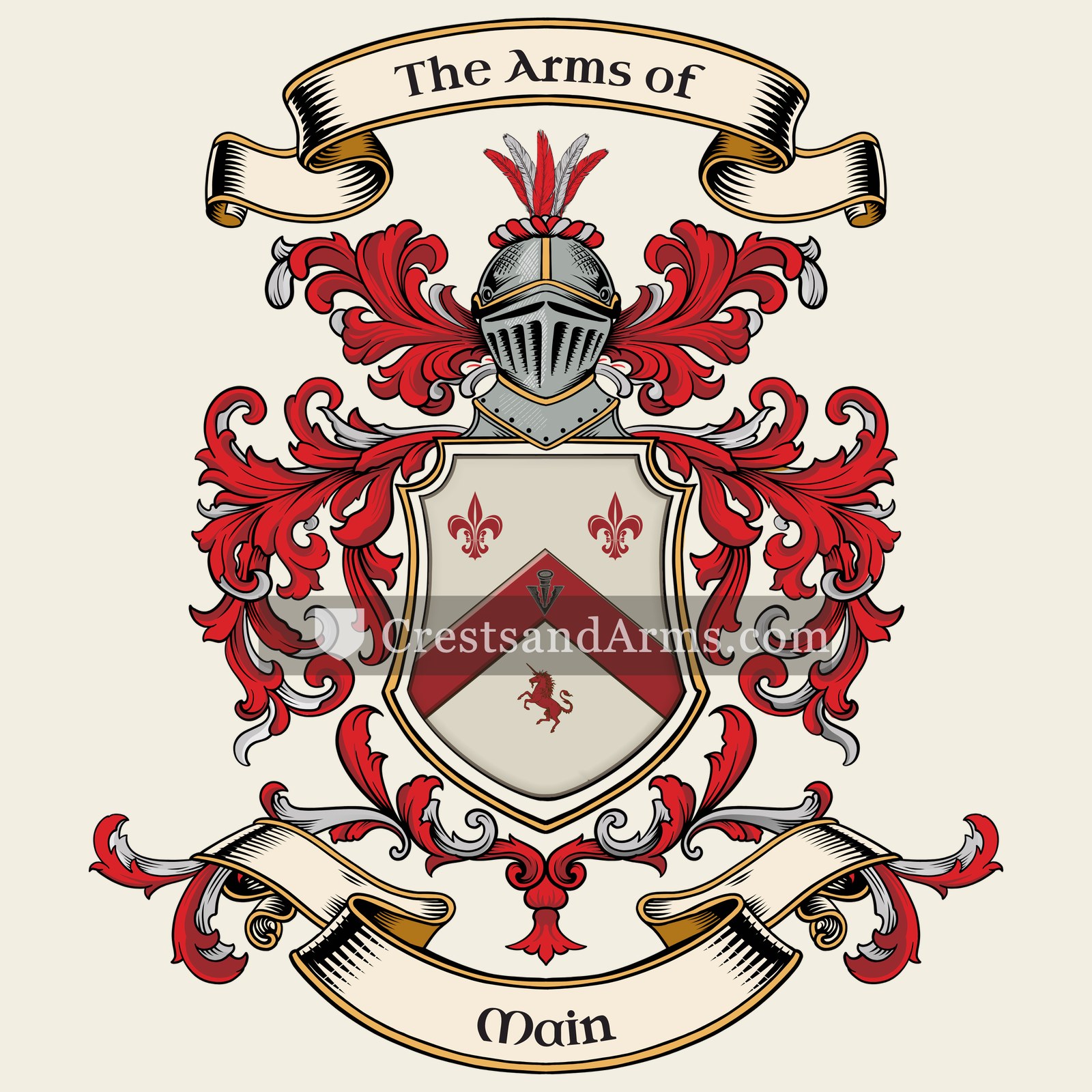
Symbols on this shield
chevronProtection, and faithful service completed
fleur de lisPurity, light, and the sixth son
unicornPurity, and extreme courage in defence of honour
arms pheon arrowheadReadiness for battle, and the broad arrow of the sovereign
Colours
Silver (Argent)Means: Peace and sincerity
Red (Gules)Means: Military strength
Black (Sable)Means: Constancy
Historical info
Source
Sir Bernard Burke, The General Armory of England, Scotland, Ireland and Wales, London: Harrison & Sons, 1884
Blazon (the actual original written record)
“Ar. on a chev. voided gu. betw. two fleurs-de-lis in chief and a unicorn's head couped in base a pheon sa”
EdinburghEdinburgh, c. 1685
Digital archive packCoat of arms PNG, gold border print PDF, vector SVG and the certificate of authenticity. Sent to your email in minutes.
Map of Scotland showing where the Main arms are recorded
The Main arms were recorded in Edinburgh, c. 1685.
Edinburgh was the seat of Scotland's government, its courts and its heralds. Families with business there settled nearby, and being close to where arms were recorded is exactly why so many of them appear.
This is where the arms were entered in the register. Families often moved to other parts of the country, so the same name can turn up in more than one region.
The body that granted and recorded arms in Scotland in this period.
Charles II of England
Sovereign of the period
Charles II of England
1660–1685
Reigning in France when the Main arms are first recorded.
How Arms Worked in Scotland
Scottish heraldry is unique because it treats a coat of arms as a piece of personal property protected by law. Only one person can own a specific design at any given time. When a family grows, the head keeps the original shield while other relatives must apply for their own distinct version with slight changes to prove their specific identity.
Granting authority
The Court of the Lord Lyon acts as the official body that regulates and controls all heraldic matters throughout Scotland.
How they got arms
Individuals obtain a legal right to their arms through a formal petition process that confirms their identity and family connection.
Where arms were recorded
All valid coats of arms are officially entered into the Public Register of All Arms and Bearings starting from 1672.
The family's standing
Recorded among the armigerous families of Edinburgh.
Origin & History of the Main Family in Scotland
The surname Main has deep roots in the historical landscape of Scotland, where it likely emerged as a descriptive name for a person of great physical stature or strength. By the late seventeenth century, the family was firmly established in the bustling capital of Edinburgh. Records from 1685 show that members of the Main family were active participants in the city’s social and professional life during a time of significant political transition. As the family grew, they became integrated into the urban fabric of Scotland, often working as skilled tradespeople or merchants who helped shape the local economy. Their presence in the capital suggests that they were part of the rising middle class that navigated the complex religious and social shifts of the era. Over time, the name spread from the city centers into the surrounding regions, leaving a lasting mark on the demographic history of the Scottish Lowlands.
Main Meaning & Related Branches
Root word
Magnus
Latin term meaning great or large in size and importance.
This name
MainA topographic name for someone living near a prominent landmark or a nickname for a large person.
also spelled
Mayn
Man
Maine
Mayne
Mane
Related arms
Maynesimilar arms
Maynvariant spelling
Maynesvariant spelling
Wallacerecorded with Main, same area
Documented Sources
J. B. Rietstap, Armorial Général, Gouda: G. B. van Goor Zonen, 1884–87
Archives Nationales, Minutier central des notaires de Paris, Series Y
Favier, Jean, Paris au XVe siècle, 1974
Foisil, Madeleine, Le Siècle de Louis XIV, 1995
Digital archive packCoat of arms PNG, gold border print PDF, vector SVG and the certificate of authenticity. Sent to your email in minutes.


 skullMortality remembered, and courage in the face of death
 skullMortality remembered, and courage in the face of death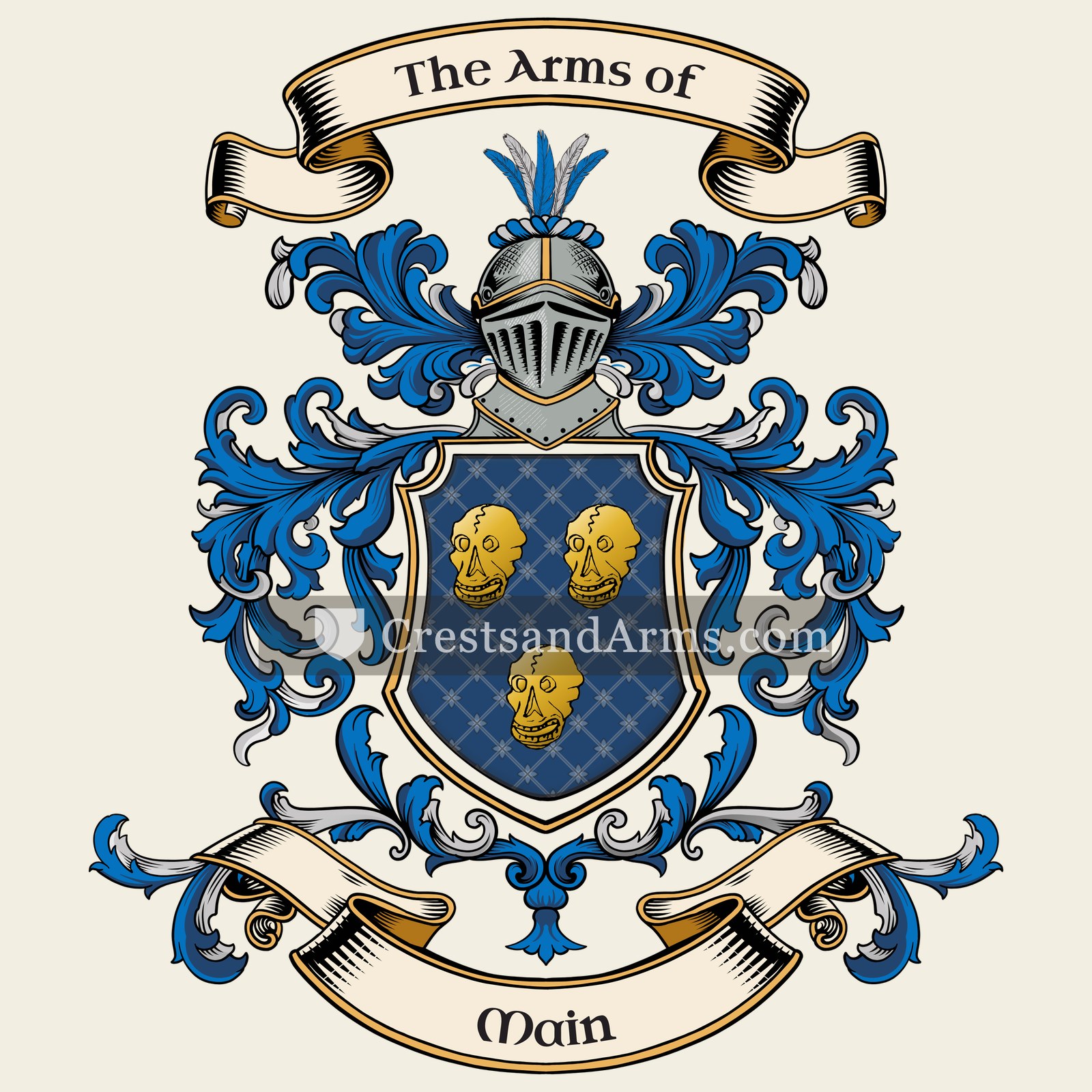


 bendDefence, and the scarf of a commander
 handFaith, sincerity and justice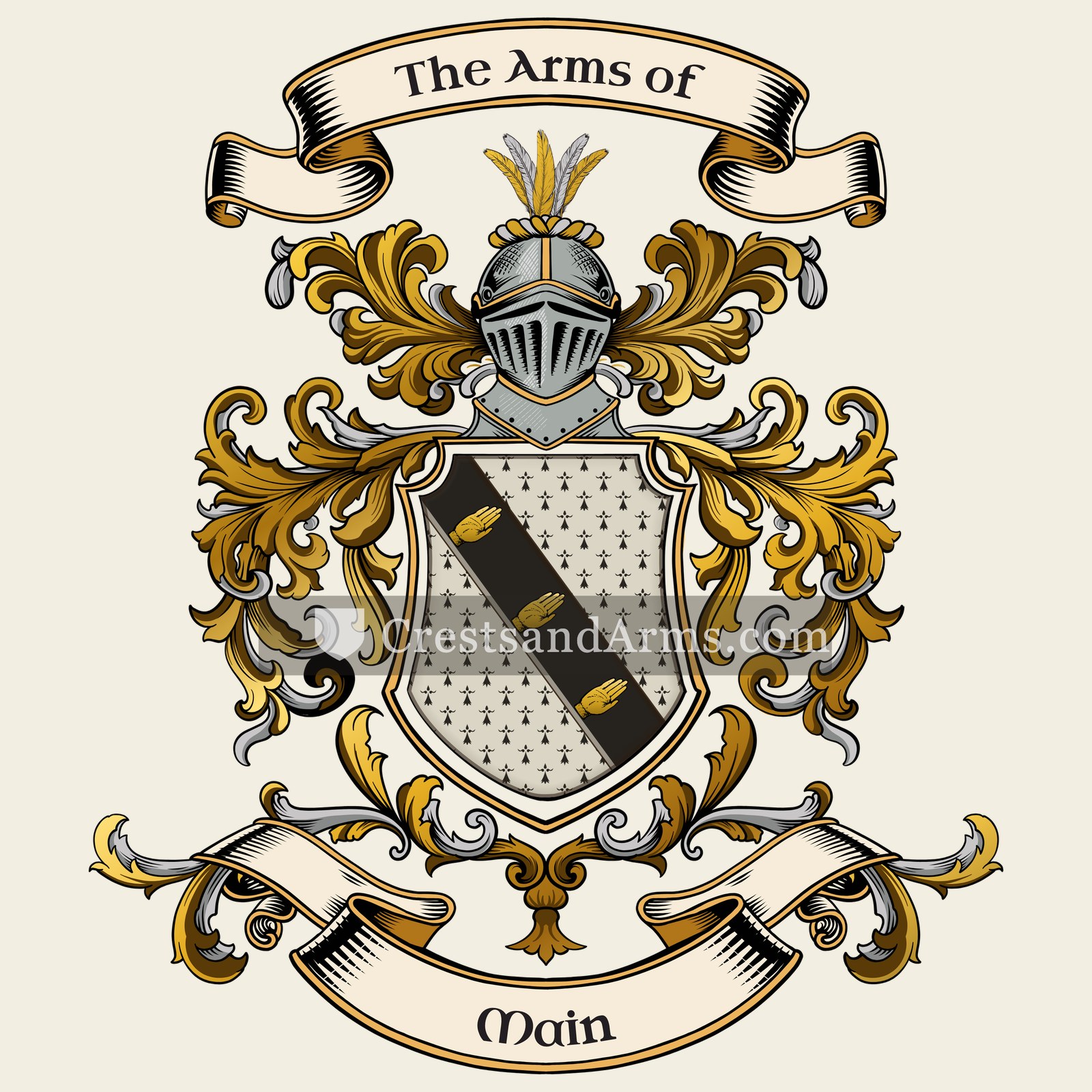


 chevronProtection, and faithful service completed
 fleur de lisPurity, light, and the sixth son
 unicornPurity, and extreme courage in defence of honour
 arms pheon arrowheadReadiness for battle, and the broad arrow of the sovereign