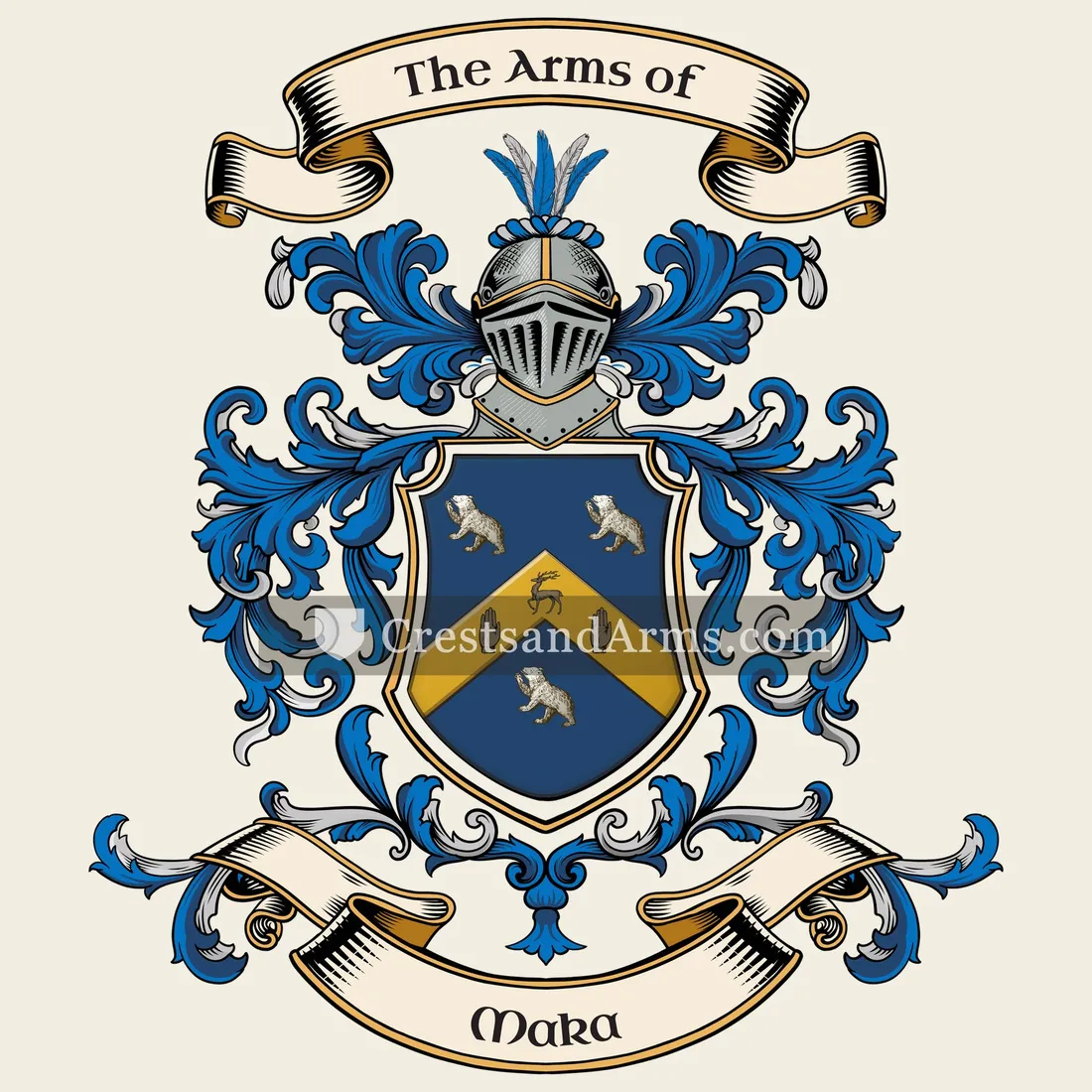
A record of documented arms, meaning and origin, researched for the Maka family lines. Documented in 2 countries.
Reg. 4452 · Dutch, M–O
Meaning of the Maka family crest colors & symbols
Symbols on this shield
chevronProtection, and faithful service completed
fusilTravail and industry
stagPeace and harmony, and one who will not fight unprovoked
armA person of action, industrious and laborious
bearStrength, cunning and protection of kin
Colours
Blue (Azure)Means: Loyalty and truth
Gold (Or)Means: Generosity
Silver (Argent)Means: Peace and sincerity
Historical info
Source
J. B. Rietstap, Armorial Général, Gouda: G. B. van Goor Zonen, 1884–87
Blazon (the actual original written record)
“D'azur au chev. d'or, ch. d'une tête de cerf au nat. et de deux avant-bras de carn., posés dans le sens du chev., tenant chacun un poignard d'arg., dirigé vers la tête de cerf; ledit chev. acc. de trois têtes d'ours coupées d'arg., emmuselées de gu. Brl. d'azur et d'arg. C.: un avant-bras de carn., en pal, tenant un poignard d'arg., en pal. L. d'arg. et d'azur. T.: deux chasseurs au nat., le fusil en pied. D.: MANU FORTI.”
GueldersGuelders, c. 1815
Digital archive packCoat of arms PNG, gold border print PDF, vector SVG and the certificate of authenticity. Sent to your email in minutes.
Map of Netherlands showing where the Maka arms are recorded
The Maka arms were recorded in Guelders, c. 1815.
Guelders was river country in the east of the Netherlands, held by families whose estates sat along the water. Land there stayed in the same hands for generations, and long tenure is what fills a register of arms.
This is where the arms were entered in the register. Families often moved to other parts of the country, so the same name can turn up in more than one region.
Region
Guelders
First recorded
1815
Granting Authority for the Maka Arms
Hoge Raad van Adel
Photograph made by me · CC BY-SA 3.0
The body that granted and recorded arms in Netherlands in this period.
William I of the Netherlands
Sovereign of the period
William I of the Netherlands
1815–1840
Reigning in Netherlands when the Maka arms are first recorded.
How Arms Worked in Netherlands
In the Netherlands, coats of arms were often used by noble families and those who held specific public offices. These arms were passed down through the generations to legitimate descendants. Younger branches of a family usually kept the original design without needing to add special marks. This system ensured that the family identity remained clear and consistent over many years.
Granting authority
The Hoge Raad van Adel is the official body that regulates and manages noble titles and coats of arms in the Netherlands.
How they got arms
Families typically obtained their coats of arms through official royal grants or by proving their long-standing historical use of the symbols.
Where arms were recorded
Coats of arms are officially recorded in the registers held by the Hoge Raad van Adel, which began its work in 1814.
The family's standing
Recorded among the armigerous families of Guelders.
Origin & History of the Maka Family in Netherlands
The history of the Maka family in the Netherlands is deeply rooted in the province of Guelders, where records confirm their presence by the early nineteenth century. During this period, the region was undergoing significant administrative changes following the end of the Napoleonic era and the establishment of the Kingdom of the Netherlands. Families like the Makas often lived in rural or semi-urban communities where they contributed to the local agricultural and trade economies. The name itself likely evolved through regional dialects and oral traditions as it was recorded in civil registers. Because these early family members were established in Guelders by 1815, they were among the first generations to be formally documented under the standardized civil registration system introduced by the Dutch government. This transition from church records to state-run registries provides a clear starting point for tracing the family’s growth and movement across the Dutch landscape during the nineteenth century.
Meaning of the Maka family crest colors & symbols
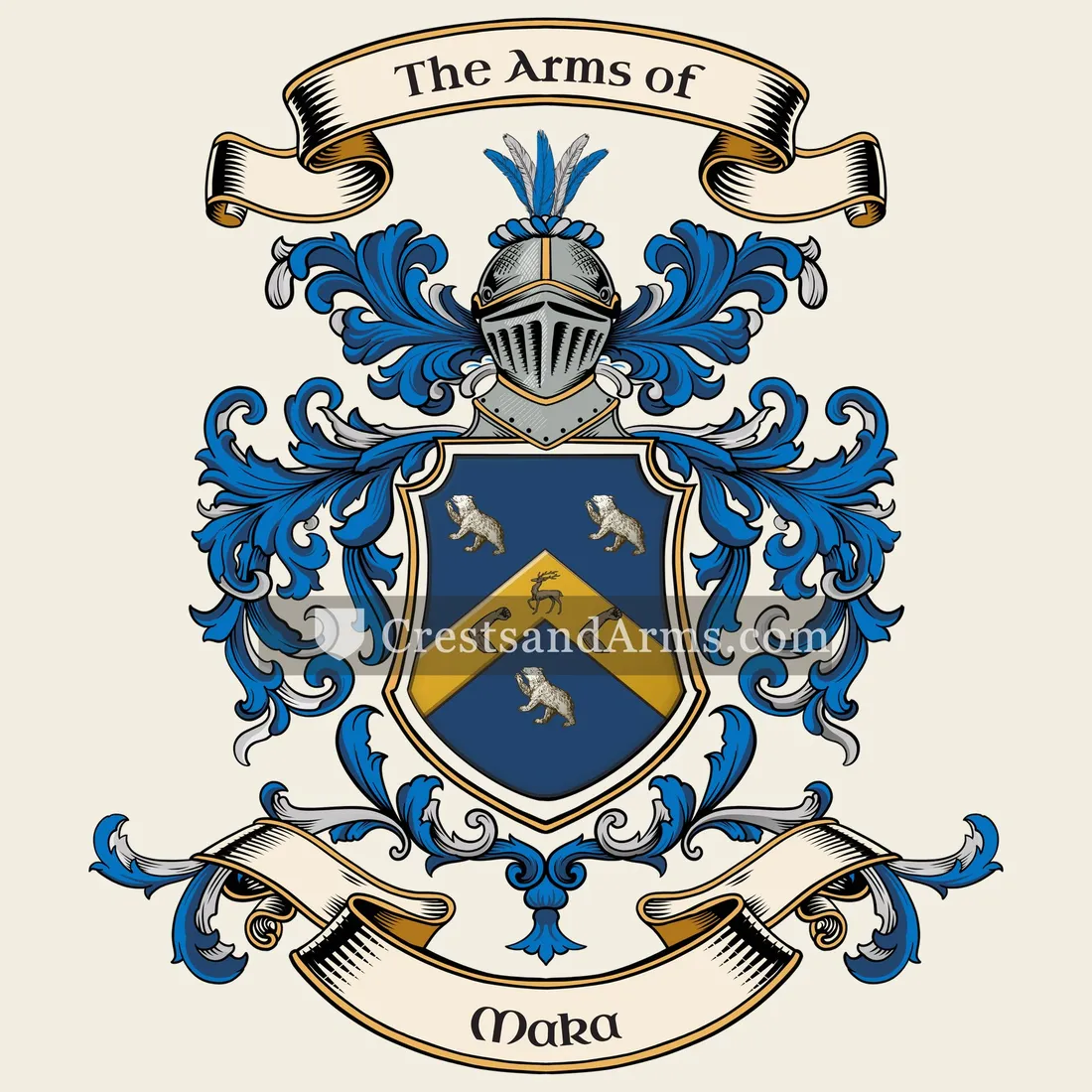
Symbols on this shield
chevronProtection, and faithful service completed
stagPeace and harmony, and one who will not fight unprovoked
bearStrength, cunning and protection of kin
handFaith, sincerity and justice
Colours
Blue (Azure)Means: Loyalty and truth
Gold (Or)Means: Generosity
Silver (Argent)Means: Peace and sincerity
Historical info
Source
Sir Bernard Burke, The General Armory of England, Scotland, Ireland and Wales, London: Harrison & Sons, 1884
Blazon (the actual original written record)
“Az. on a chev. or, betw. three bears' heads couped ar. muzzled gu. a roebuck's head erased betw. two hands issuant from the ends of the chev. each holding a dagger all ppr”
Englandc. 1620
Digital archive packCoat of arms PNG, gold border print PDF, vector SVG and the certificate of authenticity. Sent to your email in minutes.
Map of England showing where the Maka arms are recorded
The Maka arms were recorded in England, c. 1620.
Arms such as these were typically recorded in York.
Yorkshire is the largest of the English counties, and it held more gentry families than any other. Land there was split among a great many households rather than a few, so a great many of them carried arms.
This is where the arms were entered in the register. Families often moved to other parts of the country, so the same name can turn up in more than one region.
The body that granted and recorded arms in England in this period.
James VI and I
Sovereign of the period
James VI and I
1603–1625
Reigning in Netherlands when the Maka arms are first recorded.
How Arms Worked in England
English heraldry allowed arms to be shared by all legitimate descendants of the original owner. These symbols were treated as personal property that moved through the generations to all children. While the eldest son kept the original design, other family members could use the same shield without needing to change it or register their own unique versions.
Granting authority
The College of Arms in London has regulated the use of coats of arms throughout England and Wales since 1484.
How they got arms
Families typically obtained their coats of arms through a formal grant from the Crown or by proving their ancient right to them.
Where arms were recorded
All official coats of arms are recorded in the registers kept at the College of Arms, which date back to the fifteenth century.
The family's standing
Recorded among the armigerous families of England.
Origin & History of the Maka Family in England
The history of the Maka family in England begins in the historic city of York, where records confirm their presence by the year 1620. During the early seventeenth century, York served as a vital northern hub for trade and religious administration, placing the family in a region defined by its deep medieval roots and shifting social structures. Families living in York at this time often navigated a landscape shaped by the aftermath of the Reformation and the growing influence of the merchant class. Given the location, the Maka family likely participated in the local economy of the city, which was famous for its guilds and bustling market squares. While the name remains rare in English records from this period, its appearance in York suggests that the family was part of the established urban population during a time of significant national transition. By settling in such a prominent administrative center, the early members of the family were positioned within a community that valued record-keeping and civic participation.
Maka Meaning & Related Branches
Root word
Maka
Derived from the Frisian name Makke, meaning power or strength.
This name
MakaA patronymic surname originating from the Frisian region, signifying descendant of Makke.
also spelled
Mackey
Mackai
McKay
Mackie
Documented Sources
J. B. Rietstap, Armorial Général, Gouda: G. B. van Goor Zonen, 1884–87
Gelders Archief, Burgerlijke Stand Gelderland (Civil Registry of Guelders)


 chevronProtection, and faithful service completed
 fusilTravail and industry
 stagPeace and harmony, and one who will not fight unprovoked
 armA person of action, industrious and laborious
 bearStrength, cunning and protection of kin
 chevronProtection, and faithful service completed
 fusilTravail and industry
 stagPeace and harmony, and one who will not fight unprovoked
 armA person of action, industrious and laborious
 bearStrength, cunning and protection of kin


 handFaith, sincerity and justice